

Recurring Crypto Payments: How They Work and How to Set Them Up
Aug 5, 2026

5 min read
Contents
What Are Recurring Crypto Payments?
One-Time vs. Recurring Payments in Crypto
How Recurring Crypto Billing Actually Works
Why Stablecoins Are the Default for Recurring Billing
Traditional Billing vs. Crypto Recurring Billing
Why You Should Consider Web3 Recurring Payments
Common Challenges with Recurring Crypto Payments (and How to Solve Them)
Where Crypto Subscriptions Fit
How to Start Using Inqud's Crypto Recurring Solution
Why Choose Inqud for Recurring Payments in Crypto?
Share
If you run a subscription business, you already know the quiet tax you pay every month. Cards expire, banks decline renewals, and paying customers slip away without ever meaning to leave. Recurring crypto payments give you another way to keep that revenue coming in on schedule.
The idea is simple. A customer approves a repeating charge once, and after that the payments happen on their own, in crypto, without anyone re-entering card details. For a lot of merchants that means fewer failed renewals and lower fees. Inqud builds this into its crypto payment gateway, so you can run a full crypto subscription service next to whatever billing you already have.
This guide walks through how recurring crypto billing works under the hood, why stablecoins have become the go-to for it, the problems you should plan for, and how to switch it on. We kept the parts that matter for real decisions.
What Are Recurring Crypto Payments?
Recurring crypto payments are repeat charges paid in cryptocurrency on a fixed schedule. Think monthly, quarterly, or yearly. Instead of a card on file, the customer connects a wallet and pre-approves the arrangement.
It mirrors the subscription model everyone already understands. The difference is the rails underneath. Rather than a card network moving the money, a blockchain does, and the whole thing can be automated with smart contracts or a payment gateway that handles the timing for you.
For the customer, the experience feels familiar. They agree once, then get charged the same amount each cycle until they cancel. If you want the full technical breakdown, we go deeper in our piece on how recurring crypto payments work.
One-Time vs. Recurring Payments in Crypto
A one-time crypto payment is a single, manual action. The customer opens their wallet, approves one transfer, and it's done. Nothing repeats, and nothing gets charged again unless they start over from scratch.
Recurring payments work differently. The customer gives permission once for a whole series of charges, and each future payment goes through without them lifting a finger. That one approval is what turns a single sale into predictable monthly income.
The gap between the two is really about control and convenience. One-time payments are great for a checkout or a single invoice. Recurring is what you want for memberships, software plans, or anything you bill again and again. Inqud's recurring crypto payment tools are built specifically for that second case.

Curious how a crypto setup would change your renewal numbers? Book a 25-minute review and we'll map recurring billing against your current churn and volume. Book a quick review.
How Recurring Crypto Billing Actually Works
Here's the honest part most product pages skip. Blockchains don't have a built-in "charge this wallet on the 1st of every month" button. Scheduled crypto payments have to be built on top, and there are a few proven ways to do it.
Which method you pick shapes everything else: how automated the billing feels, how much control the customer keeps, and what happens when a payment fails. The three main approaches below cover almost every crypto subscription you'll see in the wild, plus one more for streaming use cases.
Smart Contract Auto-Debit
This is the closest thing to a classic card subscription. The customer signs a smart contract once, granting permission for a set amount to be pulled from their wallet on a schedule. After that, the contract does the work.
Most of these run on Ethereum and other EVM chains, using ERC-20 tokens. Recurring Ethereum payments are common here because the network's smart contracts are mature and widely supported. To keep gas fees sane, a lot of businesses run the same contracts on Layer 2 networks like Polygon, Base, Arbitrum, or Optimism, which behave like Ethereum at a fraction of the cost.
The upside is real automation and full transparency, since anyone can read the contract terms on-chain. The trade-off is that changing the amount later, say for a price increase, usually means a new approval from the customer. It's powerful, but it rewards planning the terms carefully up front.
Reminders + Manual Confirmation
Some flows keep the customer in the driver's seat. The system sends a reminder when a payment is due, and the customer opens their wallet and confirms it themselves each cycle.
People who value control like this model, and it sidesteps a lot of smart contract complexity. The cost is obvious: more missed payments and lower conversion, because every cycle depends on someone remembering to click. It works best for high-trust relationships or larger, less frequent invoices where a manual step feels appropriate.
Recurring Crypto Invoices
The middle path is invoicing. Your gateway generates an invoice each cycle and sends the customer a one-click link to pay it, often supporting several currencies at once. It feels modern and friendly, and it doesn't lock anyone into a rigid contract.
This is the sweet spot for a lot of small and mid-sized merchants. Crypto recurring invoicing platforms handle the scheduling, the reminders, and the receipts, so you're not stitching it together yourself. Inqud can send these as shareable crypto payment links, which makes billing a new customer as easy as pasting a URL.
Prepaid Escrow and Payment Streams
Two more mechanisms are worth knowing. With prepaid escrow, the customer deposits funds up front, say a full year, and the contract releases them to you on schedule. With payment streaming, protocols like Superfluid or Sablier move money continuously, so a "monthly" plan is really paid out by the second.
Streaming is a niche but interesting fit for pay-as-you-go services and payroll. Escrow suits annual deals where the customer is happy to lock funds in exchange for a discount. Behind all of these sits the same recurring crypto payment infrastructure: something has to trigger the charge, confirm it, and handle the money reliably.
How the three recurring crypto billing methods compare
|
Billing Method |
Automation Level |
Payment Control |
Best Used For |
Main Drawback |
|
Smart Contract Auto-Debit |
Fully Automated |
Smart Contract / Protocol |
Standard SaaS, digital subscriptions, high-volume recurring plans |
Price changes require new contract approval |
|
Reminders + Manual Confirmation |
Manual (Triggered by Reminders) |
Customer (Every Cycle) |
High-ticket billing, B2B retainers, privacy-focused users |
Higher churn due to reliance on manual action |
|
Recurring Crypto Invoices |
Semi-Automated |
Customer (One-Click Link) |
Mid-market SaaS, agency services, flexible billing |
Depends on prompt action by the client |
|
Prepaid Escrow & Streaming |
Real-Time / Automated |
Smart Contract Escrow |
Pay-as-you-go, annual plans, continuous payroll |
Requires locked funds up front or specialized wallet integration |
Why Stablecoins Are the Default for Recurring Billing
Here's the thing about billing someone $30 a month in Bitcoin. The dollar value of that Bitcoin can swing 10% in a day, so your customer never quite knows what they'll pay, and your revenue turns bumpy. Recurring billing only works when the number stays put.
That's why stablecoin recurring payments have become the backbone of the whole category. Coins like USDT and USDC are pegged to the dollar, so 1 USDC stays roughly 1 USD. The customer sees a stable price, you see stable income, and your accounting stops being a headache.
Stablecoins are also widely supported across wallets and networks, which keeps setup simple. If a customer needs to top up their wallet first, a fiat-to-crypto onramp solution lets them buy stablecoins with a card and move straight into paying. For most subscription businesses, stablecoin recurring payments are not one option among many. It's the sensible default, with volatile coins as the exception.
Popular stablecoins for recurring billing at a glance
|
Stablecoin |
Pegged Currency |
Primary Networks Supported |
Typical Application |
|
USDC |
USD |
Ethereum, Solana, Polygon, Arbitrum, Base, Optimism |
Enterprise SaaS, global subscription platforms, US/EU merchants |
|
USDT |
USD |
Ethereum, TRON, BNB Chain, Polygon, Arbitrum |
Cross-border payments, global subscriptions, high-volume retail |
|
DAI |
USD |
Ethereum, Polygon, Arbitrum, Optimism |
Web3-native projects, DAOs, decentralized subscriptions |
|
EURC |
EUR |
Ethereum, Avalanche, Solana |
European businesses, Euro-denominated billing |
Traditional Billing vs. Crypto Recurring Billing
It helps to put the two side by side. Card-based recurring billing is familiar and easy for customers, but it carries costs that quietly eat into subscription margins. Crypto billing flips several of those trade-offs.
On fees, cards usually run around 2% to 4% plus fixed charges per transaction, while crypto often lands under 1.5%. On reach, card processing can be blocked or unavailable in whole regions, whereas crypto works for anyone with a wallet and an internet connection. Settlement is another gap: card money can take one to five business days to land, while crypto clears in seconds to minutes.
There are honest trade-offs too. Crypto payments are irreversible, which kills chargeback fraud but also means refunds have to be handled manually and with care. If you want the wider picture on how any of this clears behind the scenes, our explainer on what is payment processing lays out the fundamentals.
Traditional card billing vs crypto recurring billing
|
Criterion |
Traditional Card Billing |
Crypto Recurring Billing |
|
Transaction Fees |
High (typically 2% – 4% + fixed per-transaction fee) |
Low (often <1.5%, depending on layer/network) |
|
Geographic Reach |
Restricted by banking regions, currency conversion, and local card limits |
Global by default; accessible to anyone with a wallet |
|
Settlement Speed |
Slow (1 to 5 business days) |
Near-instant (seconds to a few minutes) |
|
Reversibility / Chargebacks |
Reversible; susceptible to friendly fraud and chargeback fees |
Irreversible; chargeback fraud is completely eliminated |
|
Privacy & Access |
Requires personal billing data, card details, and address |
Wallet-based authentication; minimal customer data exposure |
|
Fraud Risk |
High card testing and stolen card risk |
Low fraud risk; reliance on cryptographic signatures |
Why You Should Consider Web3 Recurring Payments
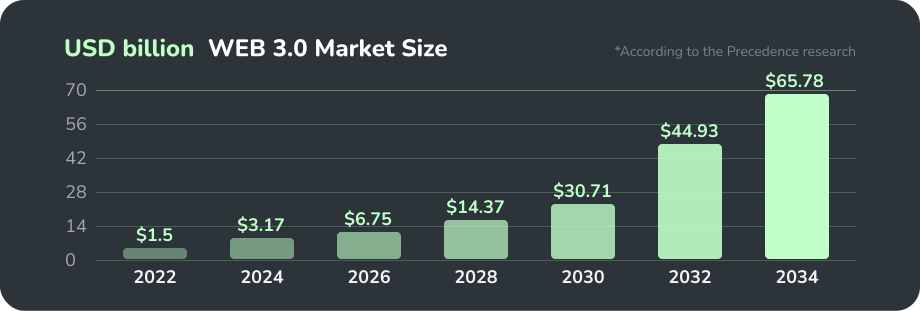
The recurring payments market is growing fast, and crypto is grabbing a share of it. Beyond the trend, there are concrete reasons a subscription business benefits from adding crypto rails. Here are the five that matter most.
Stop Losing Customers to Failed Card Payments
A big chunk of subscription churn isn't people choosing to leave. It's cards expiring, getting reissued, or hitting a random bank decline at renewal. Every one of those is lost revenue you did nothing to deserve.
Wallet-based crypto payments don't expire the way cards do. There's no reissue cycle and no "your card on file needs updating" email. Fewer broken renewals means more of the customers you already earned stay with you.
Cut Down on Transaction Costs
Card fees add up quietly. A few percent per charge, month after month, is a real line item once you have thousands of subscribers. Crypto rails typically cost a fraction of that, especially on Layer 2 networks.
Lower fees flow straight to your margin, or let you offer a friendlier price. On small recurring amounts, where fixed card fees hurt the most, the savings are especially noticeable.
Go Global, Instantly
Card acceptance is patchy across the world. Plenty of would-be customers live in places where your processor won't work or where local cards get declined at foreign merchants. Crypto doesn't care about borders.
Anyone with a wallet can pay you, from almost anywhere, in minutes. If you're building for a worldwide audience, the ability to accept crypto payments removes a wall that card networks quietly leave standing.
Boost Security and End Chargeback Fraud
Once a crypto payment confirms, it's final. That means no chargebacks, and no "friendly fraud" where a customer uses a service and then disputes the charge to claw the money back. For merchants who get burned by this, it's a genuine relief.
The flip side is responsibility. Irreversible payments mean you handle refunds deliberately and keep your own security tight. Our guide on how to accept crypto payments safely covers the habits that keep both you and your customers protected.
Get Ready for Programmable Money
Money that lives in smart contracts can follow rules. You can build logic like automatic discounts, usage-based pricing, or instant revenue splits between partners directly into how you get paid.
Most businesses won't need all of that on day one. But adopting crypto billing now puts you on rails that keep getting more capable, instead of ones that peaked a decade ago.
Want to see these benefits against your own numbers? Send us your volume and where your customers are, and we'll show you where a crypto setup would help and where it wouldn't. Send us your details.
Common Challenges with Recurring Crypto Payments (and How to Solve Them)
Crypto billing is not magic, and pretending otherwise helps nobody. There are real hurdles here. The good news is that each one has a known fix, and a decent gateway handles most of them for you.
Failed Payments and Retry Logic
Sometimes a charge just fails. The wallet is empty, or gas spikes, or the customer moved their funds. Unlike cards, a raw blockchain won't retry on its own unless someone builds that in.
The fix is a proper retry schedule with reminders. A common pattern is to try again on day 1, day 3, and day 7 after a failure, while emailing the customer each time. That grace window recovers a surprising amount of revenue that would otherwise vanish, and it keeps people from getting cut off over a simple timing slip.
Recurring payment retry schedule that recovers revenue
|
Day |
System Action |
Customer Notification |
|
Day 0 |
Initial payment attempt fails |
Immediate email notification sent with details and a top-up link |
|
Day 1 |
Automatic 1st retry attempt |
Gentle reminder email stating the retry was unsuccessful |
|
Day 3 |
Automatic 2nd retry attempt |
Alert warning of service interruption if balance is insufficient |
|
Day 7 |
Final retry attempt; account status updated |
Final notification confirming suspension or cancellation of subscription |
Price Volatility
If you bill in a volatile coin, the dollar value of each payment moves around. The main answer is stablecoins, which we covered above. Bill in USDC or USDT and the wobble mostly disappears.
For businesses that still take volatile coins, auto-conversion helps: incoming crypto gets converted to a stable value at the moment of payment. For larger recurring inflows, an OTC desk lets you convert big volumes at an agreed rate without moving the market against yourself.
Compliance: KYC/KYB and AML for Recurring Flows
Crypto doesn't exempt you from the rules. Depending on where you and your customers are, you may need KYC for individuals, KYB for businesses, and AML monitoring on the flows. This applies even when the payment setup is non-custodial.
The practical move is to run recurring billing through a provider that bakes compliance in, rather than assembling it yourself. That way identity checks and transaction monitoring happen in the background, and you stay on the right side of regulators without becoming one.
The "Push vs. Pull" Objection, Answered
You'll still find older articles arguing that crypto can't do subscriptions at all. The reasoning goes that crypto is a "push" system where the customer has to send each payment, unlike a "pull" system like direct debit, so businesses can't reliably collect on their own.
That was a fair point a few years ago. It's out of date now. Smart contract pre-authorization is exactly the fix: the customer approves a pull once, and the contract collects on schedule without them sending anything. Using cryptocurrency for recurring payments no longer means chasing customers every month, because the "pull" they were missing is built right into the contract.
Where Crypto Subscriptions Fit
Recurring crypto billing isn't for every business, but it's a strong fit for more than people expect. The common thread is a global, tech-comfortable audience and a product billed on repeat.
Software and SaaS is the obvious home. Tools sold worldwide benefit from skipping card declines and reaching customers in regions cards ignore, and you can drop a crypto payment widget onto your checkout to collect the first subscription in minutes. Creator and membership businesses fit too, from token-gated communities and paid content to DAO memberships and recurring donations, where supporters set a monthly amount and forget about it.
Business-to-business subscriptions are a quietly large slice. Distributed teams paying for cloud hosting, analytics, or project tools often prefer settling in stablecoins across borders, and our B2B crypto payments integration guide gets into how those flows are wired up. Add education platforms selling course access without regional blocks, and creative software serving users in places where local banking is shaky, and the map gets pretty wide.
Where crypto subscriptions fit: use cases by industry
|
Industry |
What Is Billed |
Preferred Currencies |
|
SaaS & Software |
Monthly/annual software licenses, cloud infrastructure, API usage |
USDC, USDT (Layer 2s) |
|
Creator Economy & Content |
Premium newsletters, token-gated access, community memberships |
USDC, ETH, SOL |
|
DAOs & Web3 Communities |
Monthly member dues, contributor retainers, recurring grants |
USDC, DAI, Native Tokens |
|
B2B & IT Infrastructure |
Web hosting, VPS, data analytics, consulting retainers |
USDT, USDC |
|
E-Learning & Publishing |
Ongoing course access, educational platform subscriptions |
USDC, USDT |
How to Start Using Inqud's Crypto Recurring Solution
Setting this up in Inqud is a short, guided process, and most merchants have it running within a day. Beyond recurring plans, the same account lets you accept crypto payments on your website for one-off sales too. Here's the walkthrough.

1) Sign in to your Inqud account. Log in to the dashboard to get started.

2) Open the Recurring section and pick your project. Head to the recurring area and choose the project you want to bill for.

3) Create a new project. Set up a fresh recurring project if you don't have one yet.

4) Fill in the billing details. Choose the payment frequency (subscription or on-demand), the period, the amount, the currency, and a grace period for late payments.

5) Select the network and currency. Pick which chains and tokens you'll accept from the dropdown, stablecoins included.

6) Set up your webhooks. Configure webhooks so your system gets notified automatically when payments succeed, fail, or need attention.
That's it. Once it's live, your customers approve their subscription on a secure hosted page, and the charges run on the schedule you set.
Why Choose Inqud for Recurring Payments in Crypto?
Plenty of tools can move crypto. What matters for subscriptions is whether the billing is steady, simple, and something your finance team can live with. A few things set Inqud apart here.
Auto-conversion gives you peace of mind. When a customer pays, incoming crypto can be converted at the live market rate, so volatile prices don't leave you guessing what landed. Setup stays genuinely simple for customers, who approve everything on a clean hosted page instead of wrestling with wallets and contracts.
You also decide who covers the fees, you or the customer, and you get broad currency support across Ethereum, BNB Smart Chain, Polygon, and more, with room to add tokens on request. And because Inqud is a full payments stack, you can grow into other tools when you need them, like a crypto POS terminal for in-person sales, all from one account. That's the point of recurring crypto payments done on solid infrastructure: it just keeps running in the background while you get on with the business.
Ready to start your first recurring billing flow? Talk to our team and we'll get you sandbox access within one business day, with pricing matched to your volume. Get started with Inqud.
Industries
IMB, Web3 payments
Products
Сrypto payment gateway
Tags
Features, Educational, Cryptocurrency, Payment methods
Author
FAQ
FAQ
What are recurring crypto payments?
Recurring crypto payments are repeat charges paid in cryptocurrency on a set schedule, like monthly or yearly. The customer approves the arrangement once, usually by connecting a wallet, and after that the payments run automatically until they cancel. They work like card subscriptions, just on blockchain rails instead of a card network.
Which wallets support recurring payments and subscriptions?
People often ask which wallets support recurring and subscriptions, and the honest answer is that it depends on the method. Most standard wallets, like MetaMask, Trust Wallet, and other EVM-compatible wallets, can approve a smart contract that pulls scheduled payments, which is what powers auto-debit subscriptions. For invoice-based or reminder-based billing, almost any wallet works, because the customer simply approves each payment when it's due. The key is the gateway handling the scheduling, not the wallet itself.
Can I set up recurring billing in USDC or other stablecoins?
Yes, and it's the recommended way to do it. Billing in USDC, USDT, or similar stablecoins keeps each charge steady in dollar terms, which is exactly what subscriptions need. If a customer doesn't hold stablecoins yet, they can pick some up through a fiat-to-crypto payments flow and start paying right away.
Can Bitcoin be used for recurring payments?
Sort of, however, Bitcoin's base layer doesn't support the smart contracts that power automatic pull payments, so true "set and forget" Bitcoin recurring payments are harder to do natively. In practice, most recurring setups either use a stablecoin or an ERC-20 token on a smart contract chain, or they bill Bitcoin through a reminder-and-invoice model where the customer confirms each charge. So Bitcoin can absolutely be part of a subscription, it just usually leans on the invoice approach rather than a self-executing contract.
What happens if a customer's wallet doesn't have enough funds?
The charge for that cycle fails, the same as a declined card. A good gateway then kicks off a retry schedule, commonly on day 1, day 3, and day 7, and emails the customer each time to remind them to top up. This grace window recovers a lot of payments that would otherwise be written off, and it keeps customers from losing access over a simple timing issue.
Is running crypto subscriptions compliant with KYC/AML rules?
It can be, as long as you build it right. Crypto doesn't remove your obligations, so depending on your regions you may need KYC, KYB, and AML monitoring on recurring flows, even in non-custodial setups. Running your billing through a provider that includes compliance means those checks happen in the background, so your crypto subscription stays on the right side of the rules without you managing it all by hand.
Inqud Solutions for Your Business

Crypto Checkout
Start accepting cryptocurrency payments from customers worldwide

Crypto Integration
Embed a cryptocurrency payment widget on your website

Subscription Billing
Set up automatic subscription and recurring billing in crypto

Pay via Link
Create and share payment links for crypto transactions

Crypto Gateway
Enable users to buy crypto with fiat currency seamlessly