


Stop the Leak: How the Top Payment Processing Companies in 2026 are Saving Your Margins
Apr 3, 2026

5 min read
Contents
What Are Payment Processing Companies?
How Payment Processing Works
Types of Payment Processing Companies
Top Payment Processing Companies in 2026
Payment Processing Companies Comparison
How to Choose a Payment Processing Company
Why Inqud Is a Reliable Payment Partner
Share
Think about the last time you bought something online. Maybe it was a plane ticket to a sunny beach or just a new pair of socks. You clicked a button, a little circle spun for a second, and suddenly your money vanished from your bank and turned into a confirmation email. It feels like magic, but behind that spinning circle is a massive, invisible machine working at lightning speed. This machine is built by payment processing companies, and they are the unsung heroes of our digital world.
Actually, the numbers are pretty wild: experts say the global digital payments market is heading toward a staggering $20 trillion by 2026. That is a lot of zeroes. In sectors like travel and hospitality, moving to modern systems can cut operational costs by up to 25 percent. Because people are traveling more and buying more from their phones, businesses need to keep up. Our team at Inqud knows this world inside out, and we are more than happy to help you explore and understand it. We put together this guide to show you what is happening behind the scenes and who is leading the pack.
What Are Payment Processing Companies?
Look at a payment processor as the digital waiter of the financial world. When you are at a restaurant, you do not walk into the kitchen to give the chef your credit card. You give it to the waiter. The waiter takes it to the back, checks if you have enough money, and brings back a receipt.
In the online world, these companies handle the communication between your business, the customer, and the banks. They make sure the credit card is not fake, the customer actually has the cash, and the money safely lands in your account. Without them, you would have to call up every bank individually every time someone wanted to buy a coffee. Nobody has time for that.
These firms do more than just move numbers around – they protect you from fraud, handle different currencies, and keep sensitive data safe from hackers. They are the glue holding the entire internet economy together.
How Payment Processing Works
It might look like one simple step, but the journey of a single dollar from a customer to a shop is actually a high-speed relay race. Let’s walk through the steps of how this happens when someone buys something on your site.
Step 1: The customer pays
The process starts when a customer enters their card details or connects their digital wallet. They might use a crypto payment widget to finish the checkout. This is the moment where the data is encrypted so that nobody can peek at those private numbers while they travel across the web.
Step 2: Sending the data
The payment gateway, which is the front-end part of the processor, sends the transaction info to the processor itself. We can compare the gateway to the digital card reader. It says, "Hey, someone wants to spend fifty bucks here."
Step 3: Checking with the networks
The processor then talks to the card networks like Visa or Mastercard. These networks act as the bridge to the customer’s bank. They ask the bank a very important question: "Is this person good for the money?"
Step 4: The bank says yes or no
The customer's bank checks the account balance and looks for anything suspicious. If everything looks fine, they send an approval message back through the network. This happens in about two seconds. If you have ever seen a "Transaction Declined" message, this is the step where you’re trying to figure out the problem on your side.
Step 5: The sale is confirmed
The merchant gets the approval, the customer sees a "Thank You" page, and the item is officially sold. But the merchant doesn't have the money yet. It is just a promise at this point.
Step 6: Settlement
At the end of the day, the processor gathers all the approved transactions and sends them to the bank to get the actual cash. This is called settlement. The bank moves the funds into the business account, usually after taking a small fee for their hard work.
Types of Payment Processing Companies
Not all processors are built the same way. Some are like giant supermarkets that do everything, while others are small boutiques focused on one specific thing.
Merchant account providers
These are traditional banks or financial institutions that give you a special type of bank account designed specifically to hold business funds from sales. You cannot just use your personal checking account for this. It is a bit old-school, but very reliable.
Payment Service Providers (PSPs)
These are the most popular for online shops. They allow you to accept crypto payments and credit cards without needing your own separate merchant account. They bundle thousands of businesses together, which makes it much faster to get started. If you want to start selling today, a PSP is usually the way to go.
Payment gateways
This is the software layer that sits on your website. Some companies only provide the gateway and let you choose a different processor for the back-end work. It is like choosing the skin of your phone but keeping the same internal parts.
Top Payment Processing Companies in 2026
The industry is moving fast. Old giants are trying to stay relevant while new, tech-heavy firms are taking over. Here is our list of the best performers this year.
1. Inqud
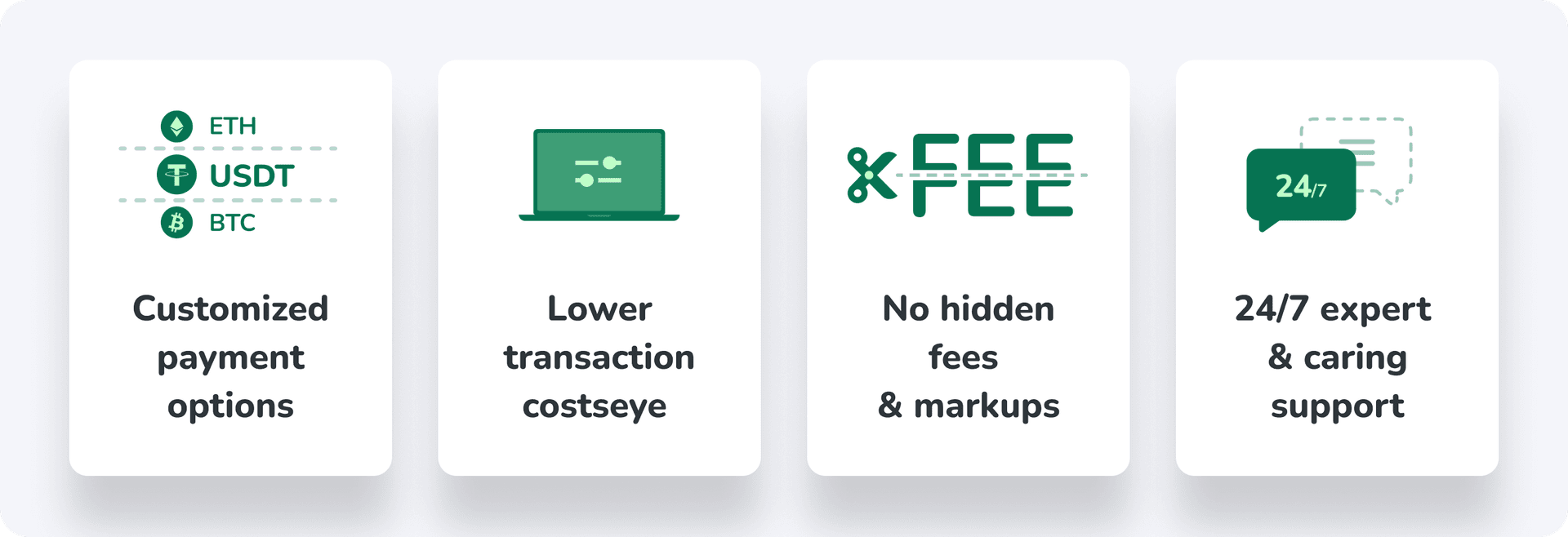
We might be a little biased, but we truly believe we offer the most flexible solution for the modern age. We are one of the top payment processing companies because we bridge the gap between traditional money and the digital future. Whether you need a crypto payment gateway or a way to handle recurring payments for your subscription service, we have built the tools to make it easy. We focus on speed, low fees, and making sure you never lose a sale because of a clunky checkout.
2. Stripe
Stripe is the heavy hitter for developers. They have great documentation and a lot of features. However, they can sometimes be a bit strict with certain industries and their fees can add up if you are doing a lot of international sales.
3. PayPal
Everyone knows the name. It is great because customers trust it. But for a business, the fees are often higher than the competition. They also have a habit of freezing accounts if they see a sudden spike in sales, which can be a nightmare for a growing shop.
4. Adyen
Adyen is built for big, global brands. They handle everything from physical stores to online checkouts in one system. They are fantastic if you are a massive corporation, but they might be a bit too complex for a small or medium business.
5. Chase Payment Solutions
If you like the security of a massive bank, Chase is a solid pick. They are reliable and offer good rates if you already use them for your business banking. The downside is that their tech can feel a bit dated compared to the newer fintech firms.
6. Square
Square is the king of the physical world. You have probably seen their little white card readers in coffee shops. They have expanded into the online space, making them a great choice if you sell both in person and on the web.
7. Checkout.com
This company is a favorite for high-growth tech firms. They focus on providing a lot of data about why payments fail so you can fix them. They are very tech-forward but can be a bit intimidating for beginners.
8. Fiserv
Fiserv is one of the biggest payment processing companies by volume. They are a massive "backend" company that many other firms actually use to process their transactions. They are very stable but not exactly known for being "cool" or easy to use.
9. Braintree
Owned by PayPal, Braintree is their more "techy" side. It is great for mobile apps and handles things like Venmo and Apple Pay very well. It is a solid middle ground between the simplicity of PayPal and the power of Stripe.
10. Authorize.net
This is one of the oldest players in the game. It is a very reliable best payment service provider for businesses that want a simple gateway that has worked for decades. It is not flashy, but it gets the job done.
Payment Processing Companies Comparison
Choosing between these can feel like trying to pick a favorite child. To make it easier, here is a quick look at how the top players stack up against each other.
|
Feature |
Inqud |
Stripe |
PayPal |
Adyen |
|
Primary audience |
High-growth startups & Web3 |
Developers & tech-savvy |
General consumers |
Global enterprises |
|
Personal support |
Dedicated account managers |
Primarily ticket-based |
Automated/Chatbots |
Enterprise-level only |
|
Crypto integration |
Deep native support (Widget, Gateway, POS) |
Limited/external plugins |
Basic (buy/hold/sell) |
Selective/regional |
|
Setup speed |
Same-day possible |
Fast but complex |
Fast |
Weeks of vetting |
|
Payout flexibility |
Fiat & crypto options |
Standard bank payouts |
PayPal balance/bank |
Multi-currency bank |
|
Industry agility |
High (Supports emerging sectors) |
Medium (strict on "high risk") |
Low (high freeze risk) |
Low (focus on legacy brands) |
|
Hidden fees |
None (transparent pricing) |
Variable (markup on FX) |
High (transaction + FX) |
Interchange++ (complex) |
How to Choose a Payment Processing Company
You should not just pick the first name you see on Google. Your choice will affect how much money you keep and how happy your customers are.
Look at the fees
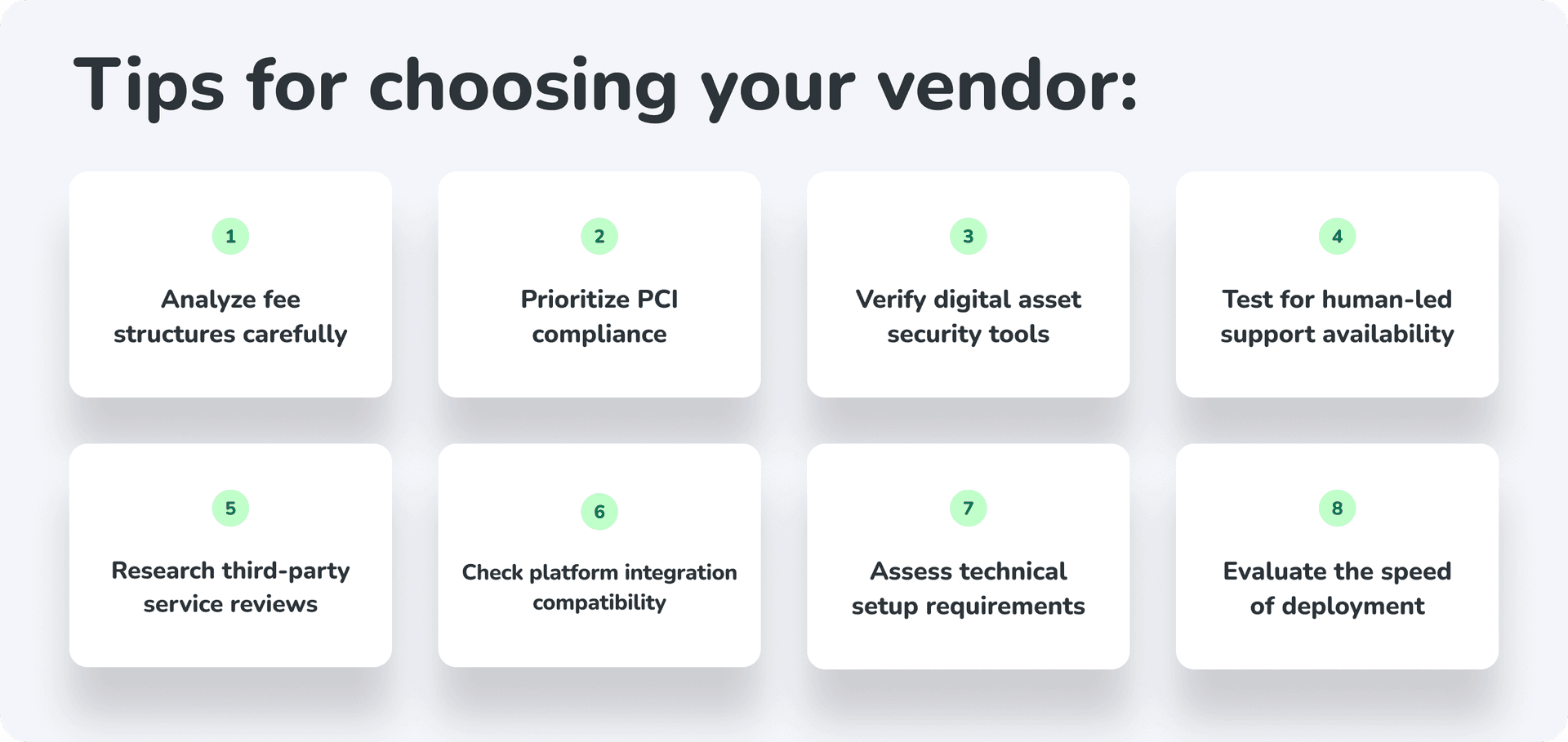
Some companies charge a flat fee, while others take a percentage plus a fixed amount. If you sell expensive items, a flat fee might save you thousands. If you sell cheap things like stickers, those fixed "per transaction" fees will eat your profits for breakfast.
Check the security
Security is not a place to cut corners. You want a company that is PCI-compliant. This means they follow the strict rules set by the big card companies to keep data safe. Also, look for firms that offer tools like an onramp-offramp service if you are dealing with digital assets. This ensures every move is legal and tracked.
Customer support
When your checkout breaks on a Friday night, you do not want to talk to a robot. You want a human who can fix it. Check reviews to see how helpful the support team actually is.
Integration ease
If you use Shopify, WooCommerce, or a custom-built site, the processor needs to play nice with it. Some take five minutes to set up with a payment link while others require a week of coding.
Why Inqud Is a Reliable Payment Partner
Frankly, the world of money is changing. People do not just want to pay with credit cards anymore. They want to use digital wallets, local bank transfers, and cryptocurrencies. We built Inqud to be the bridge to that future.
We help you accept crypto payments with the same ease as taking a standard card. If you are a high-volume trader or a business needing larger moves, our OTC desk provides the personalized touch you need. We even offer a crypto POS terminal for shops that want to take digital assets in the real world.
We don't believe in hidden fees or complicated contracts. Our goal is to make your financial life simpler so you can focus on actually running your business.
If you are looking for the electronic payment processing companies that can help your business grow in this new digital era, our team is standing by. We believe that whether you are a small shop or a growing enterprise, you deserve a partner who understands the technology of tomorrow. Let's make your payments work for you.
Industries
Web3 payments
Products
Сrypto payment gateway
Tags
Payment methods, Card2Crypto, Crypto Widget, Cryptocurrency
Author
What is a payment processor?
A payment processor is the company that handles the actual moving of data and money between the customer's bank and the merchant's bank. They make sure the transaction is valid and secure. They are essentially the financial transaction processing companies that keep the gears of commerce turning.
What should a business look for in a PSP?
Look for transparency in pricing, strong security features, and support for the payment methods your customers actually use. If your customers are tech-savvy, you probably want a top payment processors list that includes crypto support. Reliability is also huge. If the system goes down, you lose money.
Who are the biggest payment processing companies?
Companies like Fiserv, JPMorgan Chase, and Stripe are among the giants in terms of the amount of money they handle every year. These payment processing companies move trillions of dollars annually across the globe.
What are fintech payment companies?
These are tech-focused firms that use modern software to make payments faster and cheaper than traditional banks. Many fintech payment companies are now the preferred choice for startups because they are easier to set up and offer more features like digital wallet integration and global reach. You can find many of these payment processing companies online and get started in just a few hours.
Inqud Solutions for Your Business

Crypto Payments
Start accepting cryptocurrency payments from customers worldwide

Embedded Crypto Tool
Embed a cryptocurrency payment widget on your website

Auto Billing
Set up automatic subscription and recurring billing in crypto

Pay by Link
Create and share payment links for crypto transactions

Buy Crypto
Enable users to buy crypto with fiat currency seamlessly