


What is Financial Transaction Processing?
Apr 9, 2026

5 min read
Contents
What is Financial Transaction Processing?
Why Financial Transaction Processing Matters for Businesses
Key Components of Financial Transaction Processing
How Financial Transaction Processing Works
Main Challenges in Financial Transaction Processing
How Inqud Enhances Financial Transaction Processing
Share
You press a button on your screen and your new shoes are on their way. It feels like magic but it is actually a massive relay race happening in the background. In the few seconds it takes for that "Payment Successful" message to pop up, a dozen different computers have had a very intense conversation about your bank balance. If you run a business, understanding this conversation is the difference between a growing bank account and a pile of "declined" notifications.
What is Financial Transaction Processing?
At its simplest, it is the method that businesses use to accept payments from customers. It covers everything from the moment a card is swiped or a "Buy" button is clicked to the moment the money actually lands in the merchant's bank account. We are talking about the verification, authorization, and transfer of funds.
Around 70% of shoppers will abandon their cart if the checkout process feels slow or sketchy. This makes financial transaction processing one of the most important parts of any modern business. It is not about the visible buttons on the screen but the invisible plumbing underneath.
Every year, the world handles hundreds of trillions of dollars in these digital transfers. This requires massive financial processing power to ensure that no two people spend the same dollar at the same time – the scale is hard to imagine. In 2026, the global digital payments market is expected to reach over $27 trillion. To keep that machine running, financial data processing must be perfect. If a single digit is wrong, the money goes to the wrong place.
Insight: The hidden speed of money
Most people think money moves instantly because the screen says "Success" in one second. In reality, the money often takes 48 to 72 hours to finish its journey. You are seeing a digital promise of payment first, while the actual cash travels later through much slower pipes.
Why Financial Transaction Processing Matters for Businesses
If your payment system breaks, your business stops and you can have the best product in the world, but if you cannot take the money, you just have a very expensive hobby. Smooth financial processing keeps the lights on. It builds trust with your customers because nobody wants to wonder if their credit card details are floating around on a random server in a dark basement.
Reliable systems also mean better cash flow. When your financial transaction processing is set up correctly, you know exactly when your money will arrive. You can pay your staff, buy more stock, and maybe even afford a decent coffee for the office. Bad systems lead to chargebacks, which are the nightmares of the retail world. A chargeback is when a customer disputes a charge and the bank takes the money back from you. This often comes with extra fees that can eat your profits faster than a hungry teenager at a buffet.
Furthermore, accurate financial data processing gives you the data you need to grow. You can see which days are your busiest, which products people love, and where your customers are coming from. Without this info, you are just guessing. In a world where data is the new oil, these transaction records are your most valuable resource.
|
Benefit |
Impact on business |
|
Faster checkouts |
Reduces cart abandonment rates |
|
Fraud protection |
Saves money on stolen goods and chargeback fees |
|
Data insights |
Helps in predicting future stock needs |
|
Global reach |
Allows you to sell to anyone with a card or a phone |
Authorization, capture, and settlement each fail differently — knowing which stage is breaking for you matters more than understanding the whole pipeline. Walk through your specific failure points with our team.
Key Components of Financial Transaction Processing
To understand how this all works, we need to meet the players. It is like a heist movie where everyone has a specific job to do.
The merchant
Whether you are selling handmade candles or high-end software, you are the merchant. You provide the goods or services and you are the one waiting to get paid. For a merchant, the goal is to make the payment part of the customer journey as invisible as possible. You need a setup that can handle different types of payments, whether it is a physical crypto POS terminal or a digital checkout page.
The customer
This is the person with the money or the credit limit. They want things to be fast and don't care about the complex math happening in the background. They just want their order confirmation. The customer provides the payment details, which could be a card number, a digital wallet, or even a crypto address. Their trust is the most fragile part of the whole system. If the checkout looks "off," they will leave and never come back.
The issuing bank
This is the customer's bank. They issued the credit or debit card. Their job is to be the gatekeeper of the money. When a transaction starts, the issuing bank gets a "ping" asking if the customer actually has enough money. They also check for weird behavior. If you suddenly try to buy a $5,000 watch in a country you’ve never visited, the issuing bank is the one that says "Wait a minute" and blocks the card.
The acquiring bank
Also known as the merchant bank, this is your side of the fence. They provide you with an account that allows you to accept credit card payments. They are the ones who ultimately take the money from the issuing bank and put it into your business account. They take on a bit of risk by doing this, so they usually charge fees for the privilege.
The payment gateway
It is the software that captures the payment data from the customer and encrypts it. The gateway sends the info to the processor and then brings the "Yes" or "No" answer back to the merchant. If you want to accept digital assets, you need a specialized crypto payment gateway and business solutions provider to handle the unique security needs of the blockchain.
The payment processor
The processor is the engine room. They move the information between the gateway, the banks, and the card networks. They are the ones who actually push the data through the system. Without them, the gateway would have nowhere to send the encrypted info. They also handle things like billing statements and customer support for the merchant.
The payment networks
These are the big names you know, like Visa, Mastercard, or American Express. They aren't banks but the infrastructure. They set the rules for the whole game and provide the rails that the data travels on. They make sure that a card issued in Japan works perfectly in a shop in Paris. They also handle the final settlement between the banks at the end of the day.
Tip: Don't skimp on the gateway
Choosing a cheap, unknown payment processor is like buying a "high-security" lock from a dollar store. It might look the part, but it won't hold up when things get complicated. Always look for providers that offer 24/7 support and have a high uptime record.
How Financial Transaction Processing Works
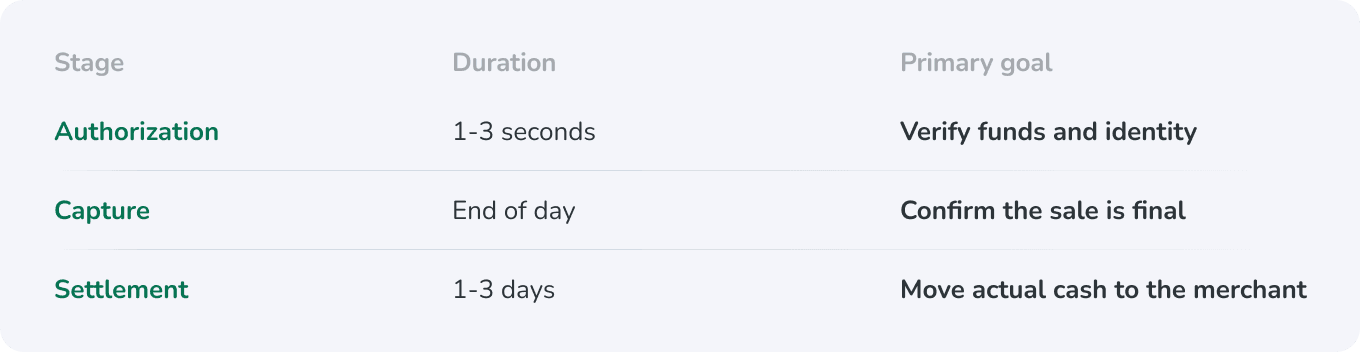
The process happens in three main stages. It looks like one quick moment, but it is actually a very organized three-act play.
Authorization
The customer enters their details. The payment gateway encrypts this info and sends it to the processor. The processor then passes it to the card network, which finds the right issuing bank. The issuing bank checks two things: is the cardholder who they say they are, and is there enough money? If both are "yes," they send back an authorization code. This all happens in about two seconds.
Capture
Just because the bank said "yes" doesn't mean you have the money yet. Authorization just puts a "hold" on the funds. To actually get paid, the merchant must "capture" the transaction. This usually happens automatically at the end of the business day when the merchant sends a big batch of all their authorized transactions to their bank.
Settlement
This is the final stage where the money actually moves. The issuing bank sends the funds to the acquiring bank, which then deposits them into the merchant's account. This is also where everyone takes their small cut of the pie in fees. By the time the money hits your account, it has been through a lot.
Ask us how crypto settlement sidesteps the batch-cycle delays that cause most challenges here.
Main Challenges in Financial Transaction Processing
There are plenty of things that can go wrong in this payment processing race.
Security and fraud
Fraudsters are very creative people, which is a shame because they could probably be great engineers if they used their powers for good. They are always looking for ways to steal card data or trick systems. This is why encryption and tools like 3D Secure are so important. If your security is weak, you will lose money and your reputation. Criminals often test stolen cards with small, "random" transactions before going for a big hit.
Regulatory compliance
The rules for moving money are incredibly strict. You have things like PCI DSS, which is a set of security standards that anyone handling credit cards must follow. Then you have anti-money laundering (AML) and know-your-customer (KYC) laws. If you don't follow these, you can face massive fines or even have your business shut down.
Cross-border complications
Selling to someone in another country adds a whole new layer of mess. You have to deal with currency conversion, different tax laws, and international banking fees. Sometimes, a payment that would be instant domestically gets flagged and held for days just because it crossed a border. A good onramp-offramp service can help here, especially when moving between traditional money and digital assets. Onramp by Inqud is one of the best options out there in the market.
High transaction fees
Every player in the relay race wants a piece of the action. The gateway, the processor, the network, and both banks all take fees. For a small business with tight margins, these fees can be a real pain. Finding ways to lower these costs, perhaps by using a crypto widget for direct payments, can make a huge difference to your bottom line over a year.
Technical downtime
If the payment processor's servers go down, you are out of luck. Even a 30-minute outage on a busy Friday can cost a business thousands of dollars. Relying on legacy technology that hasn't been updated since the 90s is a recipe for disaster. Modern systems need to be redundant, meaning if one part fails, another one takes over immediately without anyone noticing.
Lifehack: The magic of recurring payments
If you have a subscription model, use recurring crypto payments to automate your billing. It reduces the "friction" of asking the customer for money every month, which significantly lowers your churn rate. People are much less likely to cancel if they don't have to manually enter their details every time.
Get your current transaction processing setup reviewed — we'll tell you honestly where the gaps are.
How Inqud Enhances Financial Transaction Processing
The world of money is changing. While credit cards are great, more people and businesses are looking toward digital assets for faster and cheaper ways to move value.
We know that setting up a traditional payment system can feel like trying to solve a Rubik's cube in the dark. That is why we built tools that let you accept crypto with ease. You don't need to be a blockchain genius to use our tech. We handle the hard parts so you can focus on your actual business.
If you are dealing with large volumes and need a more personalized touch, our OTC desk for crypto settlements provides a professional way to handle big moves without affecting market prices. For those who want the simplest possible setup, you can just send a payment link for crypto to your client and get paid in minutes instead of days.
Why localization wins
Customers feel safer when they see their own currency and preferred payment methods. Even in the world of digital assets, providing a familiar interface makes a huge difference. Using a customizable checkout can increase your conversion rates by up to 20% in international markets.
|
Inqud tool |
Best for |
Key advantage |
|
Crypto widget |
E-commerce websites |
Instant integration with zero coding |
|
Payment link |
Freelancers and B2B |
No website needed to get paid |
|
OTC desk |
High-volume traders |
Better rates and private execution |
|
POS terminal |
Physical retail stores |
Connects the physical shop to the digital economy |
The Inqud team will be glad to assist with any questions you have about modernizing your payment stack. We understand that every business is different, and this is why we came up with this comprehensive article. Whether you are a small startup or a growing enterprise, getting your payment processing right is the best investment you can make for your future.
Don't let the technical difficulties scare you off. Once you have the right partners and the right tools, moving money becomes just another part of your success story.
Industries
Web3 payments
Products
Сrypto payment gateway, OTC desk, Crypto widget, Сard2crypto, API
Tags
Payment methods, Payment methods
Author
Inqud Solutions for Your Business

Crypto Payments
Start accepting cryptocurrency payments from customers worldwide

Embedded Crypto Tool
Embed a cryptocurrency payment widget on your website

Auto Billing
Set up automatic subscription and recurring billing in crypto

Pay by Link
Create and share payment links for crypto transactions

Buy Crypto
Enable users to buy crypto with fiat currency seamlessly