


How to Choose a Crypto Payment Gateway
Mar 10, 2026

5 min read
Contents
What Is a Crypto Payment Gateway?
How Does a Crypto Payment Gateway Work?
Types of Crypto Payment Gateways
How to Choose Crypto Payment Gateway for Your Business
Why Choose Inqud for Crypto Payment Gateway Integration
Share
You're seeing crypto at checkout more and more – it's quickly becoming a new standard. But figuring out the tech behind it all? That can feel pretty daunting.
We’re going to break down what a crypto payment gateway for business actually is. We'll also provide a clear plan to help you choose the best crypto payment gateway API for your specific needs.
What Is a Crypto Payment Gateway?
A crypto payment gateway is a piece of technology, a service, that allows businesses to accept digital currencies like Bitcoin, Ethereum, and stablecoins as payment for their products or services. We can compare it to the digital equivalent of a credit card terminal on your shop counter, but for crypto.

It acts as a vital bridge: on one side, you have your customer who wants to pay from their crypto wallet, and on the other side, you have your business, which needs to receive that payment, confirm it, and, in many cases, convert it into familiar currency like USD or EUR. This tool handles all the technical parts of the blockchain transaction – the validation, the confirmation, and the fund transfer – making the whole process much simpler for both the merchant and the customer.
Curious how this plays out with real API docs and a sandbox instead of theory? Talk to the Inqud team and our team will walk you through it. 4-hour reply. 1-day integartion.
How Does a Crypto Payment Gateway Work?
It might seem like a lot is going on, but for your customer, the experience is actually very simple. The payment gateway handles all the complicated bits behind the scenes.
Here's how it unfolds for them:
At the checkout
So, your customer is ready to buy. They get to your checkout page and just pick the "Pay with Crypto" option.
Seeing the payment details
Right away, the gateway shows them exactly what to do. It'll display the precise amount of crypto needed – say, 0.001 BTC – and the specific wallet address they need to send it to. Most of the time, this just pops up as a simple QR code they can scan.
Making the payment
Your customer just opens their own crypto wallet on their phone, scans that code, and hits 'approve.' That's it. Their payment is now on its way, journeying across the blockchain.
Waiting for confirmation
Now, the gateway starts watching the blockchain. It's basically just waiting for the network of computers to give the transaction the official "okay," confirming that the payment is final and can't be reversed.
Getting you paid
As soon as that confirmation comes through, you get a notification: Payment complete! From there, the gateway either drops the cryptocurrency right into your business wallet or, more commonly, it immediately swaps that crypto into your preferred regular money (like dollars or euros). This protects you from any sudden price changes. That cash is then sent straight to your bank account.
Types of Crypto Payment Gateways
Not all gateways are built the same. They primarily fall into two main categories, and the difference is all about who holds the keys and the funds.
Custodial gateways
With a custodial solution, the payment provider holds your funds for you, much like a traditional payment processor. They manage the private keys, secure the crypto, and handle the conversion to fiat. This is generally the simpler, more hands-off option, making it great for businesses that want the benefits of accepting crypto without the technical responsibilities of managing it.
Non-custodial gateways
A non-custodial gateway means you have complete control, because the payments go directly from your customer to a wallet that you own and for which you control the private keys. This eliminates any third-party counterparty risk, but it also means your business is solely responsible for securing those funds and managing any conversions to fiat yourself. This path requires more technical know-how.
|
Feature |
Custodial gateways |
Non-custodial gateways |
|
Control |
Third-party holds the private keys. |
Merchant/User retains full control of the private keys. |
|
Trust |
High trust required in the third-party provider (counterparty risk). |
No trust in a third party; requires self-trust/responsibility. |
|
Security |
Funds are vulnerable to exchange hacks/provider insolvency. |
Risk of permanent loss of funds if private keys/seed phrase is lost. |
|
Ease of use |
Easier to set up and use; often includes recovery options. |
Can be more complex; no "forgot password" option. |
|
KYC/AML |
Typically required as the provider is a regulated custodian. |
Generally not required by the gateway itself. |
|
Transaction flow |
Funds flow into the provider's wallet first, then settled to the merchant. |
Funds flow directly into the merchant's wallet. |
If this section raised more questions than it answered, get in touch with our team; we'll go through the specifics of choosing a crypto payment gateway for your specific setup and requirements.
How to Choose Crypto Payment Gateway for Your Business
Picking the right partner is, without a doubt, the most critical move. A bad choice? That could mean lost cash, serious compliance nightmares, or customers who are just plain furious. Honestly, it's a huge risk.
That's why, as you start looking, you've got to tune out the shiny marketing promises. Focus on the real features.
Security and compliance
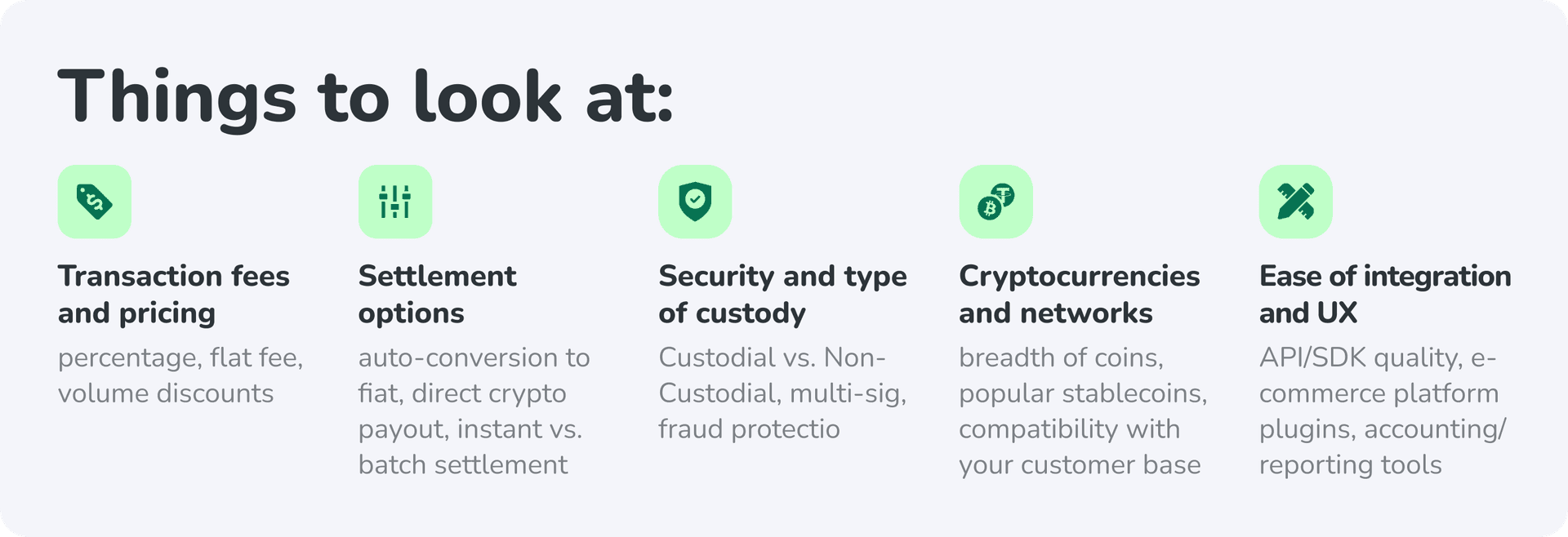
This is non-negotiable. When you're handling other people's money, security has to be everything. You need to know: does the provider use cold storage for the funds? What about two-factor authentication and solid anti-fraud systems? Compliance is just as important, especially since the regulatory world for crypto is always in motion.
A good partner will already be registered and compliant with the right authorities. That means they're doing the necessary Know-Your-Customer (KYC) and Know-Your-Transaction (KYT) checks, which is what protects your business from accidentally dealing with illicit funds.
Supported currencies and tokens
Everyone knows Bitcoin, but the truth is, a huge portion of the market would rather use stablecoins (like USDT or USDC) because their price doesn't swing wildly. Others might prefer popular coins like Ethereum. A good gateway needs to offer your customers this kind of selection.
After all, more choice for them means fewer abandoned carts for you. At the same time, you've got to check how you get paid. Can they settle your funds in USD, EUR, GBP, or whatever your local currency is?
Fee structure and transparency
Fees can absolutely eat into your profits if you're not paying close attention. This is why you must find a provider with a fee structure that is clear, simple, and totally transparent. You're going to see a per-transaction fee (usually a percentage, maybe 0.5% to 1.5%), but that's just the start. You have to hunt for the hidden charges. Are there setup fees? Monthly minimums? What are they going to charge you for withdrawals or conversions? The best partners will be completely upfront about every single cost.
Integration and user experience
How easily can this new tool actually plug into your existing business? If you're running an e-commerce store, you'll want a simple plugin for platforms like Shopify, WooCommerce, or Magento. But if you have a custom-built platform, then choosing the best crypto payment gateway API becomes the top priority.
A well-documented, flexible API is going to save your developers a mountain of time and frustration. And then there's the customer's side of things, which you can't forget. For them, the payment experience just has to be smooth, fast, and easy to understand.
Settlement and volatility management
We all know the price of cryptocurrencies can jump up and down like crazy. Most businesses aren't interested in gambling on those market movements. That's exactly why auto-conversion is such a critical feature. A good gateway will give you the power to instantly convert a customer's crypto payment into a stablecoin or your local fiat currency, locking in the value right at the moment of sale. Just like that, the volatility risk is completely off your plate. You should also ask how fast and flexible their settlements are. Can you get your money paid out daily?
Book a quick call with our team and we'll discuss how Inqud's API and license fit into your build fand your specific challenge. We'll provide the analytics, show a demo and discuss the integration plan.
Why Choose Inqud for Crypto Payment Gateway Integration
When you're weighing your options for how to choose crypto payment gateway, it's worth looking at what a modern, comprehensive solution offers. Inqud is built to address the key challenges businesses face when entering this space.
No chargebacks
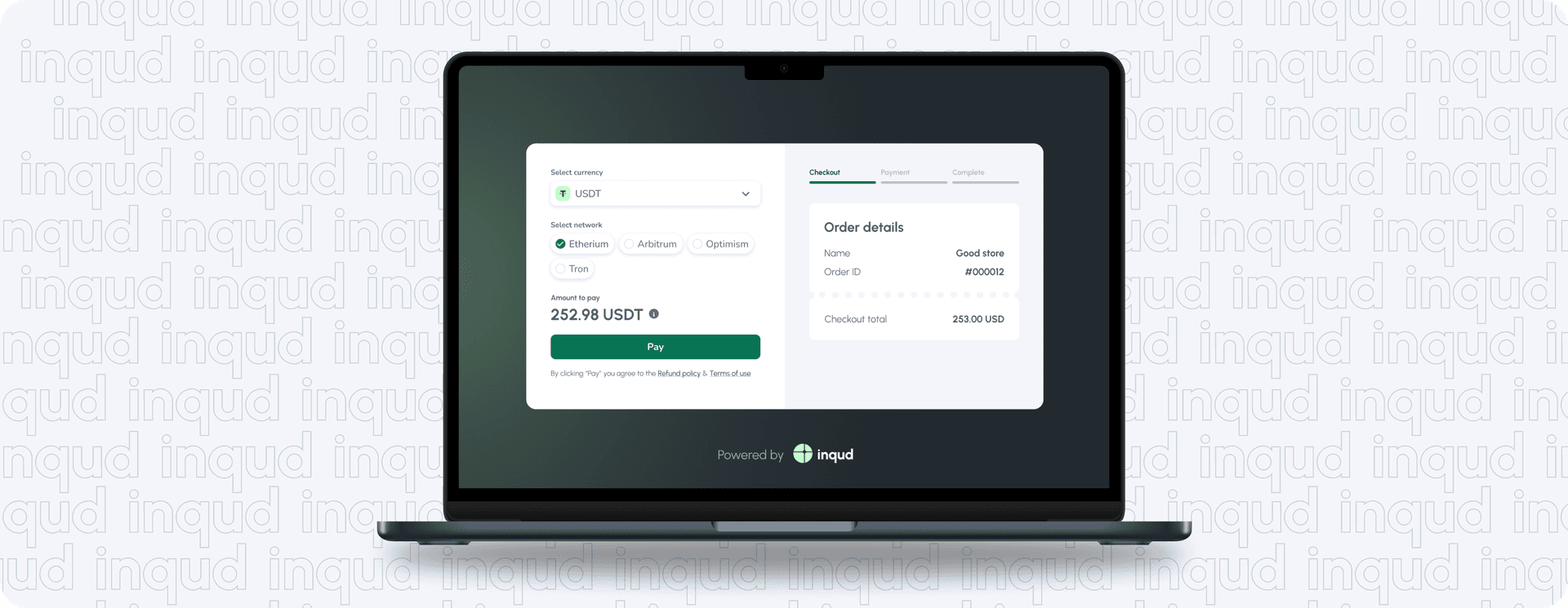
One of the most compelling reasons is the elimination of chargebacks. Crypto transactions are final, which means no more fraudulent chargeback claims that cost traditional e-commerce businesses a significant amount of revenue. This, combined with low transaction fees, means you keep more of your money.
Flexibility and security
With our Crypto Widget, you can get started with a ready-made solution or use the API for a fully white-labeled, custom-branded checkout. It supports a wide array of currencies and networks, giving your customers the choice they expect. Plus, critical features like KYT/AML monitoring and an anti-fraud system are built-in, handling the compliance burden for you.
No volatility risks
The auto-convertion feature lets you automatically convert incoming crypto into your currency of choice, so you're never exposed to market swings. Add in flexible settlement options to your bank account, and you get all the global reach of crypto with the stability of traditional finance.
The process of how to choose the right crypto payment gateway often comes down to finding a partner that simplifies all these complexities, and Inqud is designed to do just that – accept crypto payments easily.
Industries
Web3 payments
Products
Сrypto payment gateway
Tags
Payment methods, Payment methods
Author
FAQ
What are the typical fees for using a crypto payment gateway?
Fees vary, but most providers charge a per-transaction fee, typically between 0.5% and 2%. Some may also have flat setup fees, monthly charges, or different rates for crypto-to-fiat conversion, so it's vital to read their pricing details carefully.
Are crypto payment gateways legal?
Yes, in most of the world, crypto payment gateways are legal. However, the regulatory landscape is different in every country and is changing quickly. It's essential to choose crypto payment gateway that is registered and compliant with the financial regulations in your jurisdiction.
How does the gateway protect against volatility and price fluctuations?
The best gateways offer an "auto-conversion" feature. The moment your customer's payment is confirmed, the gateway instantly converts the crypto into a stablecoin or a fiat currency (like USD). This locks in the exact sale value for you, and the provider takes on the short-term volatility risk.
How to choose between custodial and non-custodial gateways?
A custodial gateway is simpler if you want your provider to handle security and conversions, much like a traditional bank. A non-custodial gateway gives you full control over your funds and keys but requires more technical responsibility. Choosing crypto payment gateway here depends on your comfort with managing digital assets directly.
How do I integrate a crypto payment gateway API?
We'll make it fast and smooth for you. Your team will get API keys from us, follow the documentation to connect the API to your website's backend, and then add the payment option to your checkout flow.

Inqud Solutions for Your Business

Pay in Crypto
Start accepting cryptocurrency payments from customers worldwide

Crypto Checkout Tool
Embed a cryptocurrency payment widget on your website

Subscription Payments
Set up automatic subscription and recurring billing in crypto

One-Click Payment Link
Create and share payment links for crypto transactions

Onramp
Enable users to buy crypto with fiat currency seamlessly