


Banks and Cryptocurrency: How Banks Are Adapting to the Crypto Economy
May 27, 2026

5 min read
Contents
Why Banks Initially Resisted Cryptocurrency
How Banks and Cryptocurrency Are Converging Today
Traditional Banking vs Crypto Infrastructure
The Role of Stablecoins in the Banking System
Challenges of Integrating Cryptocurrency Into Banking
How Fintech Companies Help Banks Work With Crypto
How Inqud Helps Businesses Bridge Fiat and Crypto
The Future of Banks and Cryptocurrency
Share
Have you checked the latest numbers lately? They are quite something. Statistics show that more than 300 million people across the globe now hold some form of digital asset. Even more interesting is that about 40% of these users say they would switch to a bank that offers crypto services.
We see this shift happening right before our eyes. Banks are no longer just watching from the sidelines, they are jumping in. Because of this massive change, our team at Inqud decided to create this guide. We want to share our expertise and help you understand how these two worlds are coming together. If you ever need help to accept crypto payments or want to know more about the tech, we are always here to assist.
Curious how this plays out with real API docs and a sandbox instead of theory? Talk to the Inqud team and we will walk you through it.
Why Banks Initially Resisted Cryptocurrency
For a long time, the relationship between traditional finance and digital coins was cold. You might even say it was hostile. Why are banks against B2B crypto payments integration? The answer usually comes down to three things: control, risk, and rules.
Digital money appeared
Central banks and commercial institutions have spent centuries building a system based on central authority. Then blockchain and digital currency appeared. It was the opposite of everything they knew. It was decentralized, meaning no one person or group was in charge. Naturally, this felt like a threat to the way banks make money and manage transactions.
Volatility
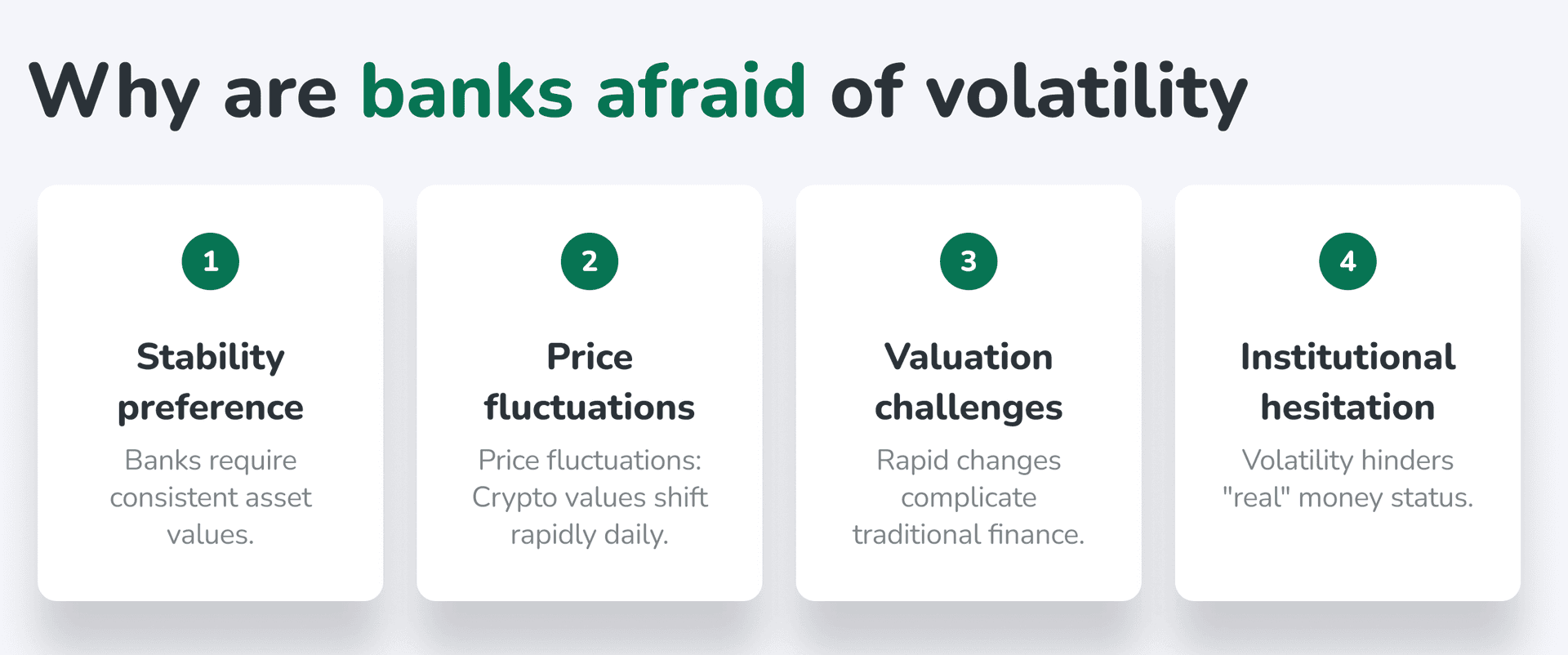
Banks love stability. They want to know that a dollar today is a dollar tomorrow. Cryptocurrency was famous for going up and down by 20% in a single afternoon. This volatility made it very hard for traditional institutions to see it as "real" money.
Regulations uncertainty
Lastly, the rules were not clear. Banks are some of the most regulated businesses on earth. They have to follow strict anti-money laundering laws. In the early days, crypto was complex and unclear, so without clear guidance from governments, banks felt it was safer to just stay away and close the doors to crypto companies.
How Banks and Cryptocurrency Are Converging Today
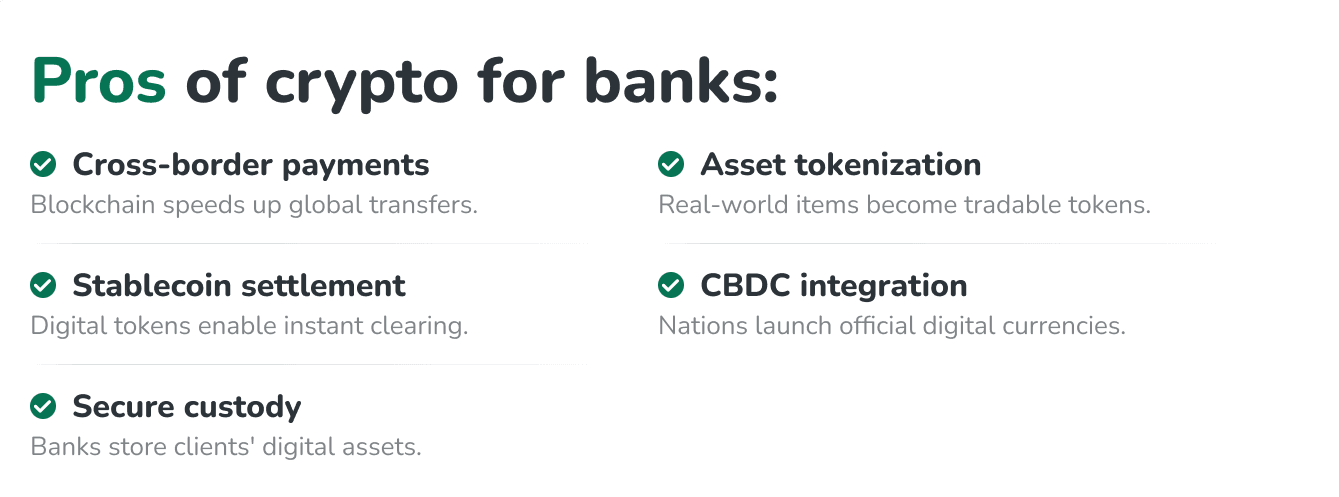
Things look very different now. We are seeing a real meeting of the minds. Here are five ways these two systems are starting to work together.
Faster cross-border payments
Sending money to another country used to be a headache. Before, B2B payment processing took days and cost a lot of money because of all the middle-man banks involved. Now, banks and crypto are teaming up to fix this. By using blockchain, a bank can send value across the world in seconds. They don't have to wait for the old "correspondent banking" system to catch up. It is cheaper for the bank and much faster for the customer.
Stablecoin settlement
Not every bank wants to touch Bitcoin, but many love stablecoins. These are digital tokens tied to the value of the US dollar or the euro. Using these tokens, banks and cryptocurrency can settle big trades instantly. Instead of waiting for hours for a wire transfer to clear, they just move the digital tokens on a ledger. It makes the whole process much smoother.
Secure custody services
People want to own crypto, but they are often afraid of losing their digital keys. They trust their banks to keep their gold and cash safe, so why not their Bitcoin? Many big names in the banking world are now building "custody" solutions. This means the bank cryptocurrency service holds the digital assets for the client. It gives the user peace of mind and gives the bank a new way to earn fees.
Tokenization of real assets
This is one of the most exciting parts of cryptocurrency and banks working together. Banks are looking at how to turn things like real estate, bonds, or even fine art into digital tokens. Once an asset is "tokenized," it can be traded easily on a blockchain. This makes expensive assets more accessible to regular people and helps the bank manage their records more accurately.
Central Bank Digital Currencies (CBDCs)
Many countries are testing their own digital versions of their national currency. This isn't exactly the same as Bitcoin, but it uses the same technology. When we talk about cryptocurrency in banking, CBDCs are a huge part of the conversation. They allow for better tracking of money and can help people who don't have traditional bank accounts get access to financial services.
If your business bridges fiat and crypto — or is planning to — share your setup with us. We work with fintechs doing exactly this: API integration, settlement routing, compliance coverage per jurisdiction. 25-min call, 4-hour reply.
Traditional Banking vs Crypto Infrastructure
To understand why this is such a big deal, we should look at how these two systems actually function. They are built on very different foundations.
|
Feature |
Traditional banking |
Crypto infrastructure |
|
Settlement time |
1 to 5 business days |
Minutes or seconds |
|
Operating hours |
Monday to Friday, 9 to 5 |
24/7/365 |
|
Transparency |
Private ledgers, hidden fees |
Public or shared ledgers |
|
Middlemen |
Many (Clearing houses, brokers) |
Very few (Peer-to-peer or smart contracts) |
|
Control |
Centralized authority |
Decentralized or distributed |
We don’t usually see such a massive change in how money moves. The table shows that crypto offers speed and constant uptime that old banks just cannot match on their own.
If this section raised more questions than it answered, get in touch with our team; we'll go through banks and cryptocurrency against what you're building.
The Role of Stablecoins in the Banking System
Stablecoins have become the favorite tool for banks using cryptocurrency. They act like a digital version of the cash we already use.
Liquidity: They provide a way for traders to move in and out of positions without going back to traditional fiat every time.
Efficiency: Payments made with stablecoins don't require the same heavy paperwork as international bank transfers.
Predictability: Since they are pegged to the dollar, banks don't have to worry about the value dropping overnight.
Integration: They are easy to plug into existing digital wallets and apps.
Challenges of Integrating Cryptocurrency Into Banking
There are some big walls that banks still have to climb. Integrating cryptocurrency used by banks requires a lot of care.
Risks due to unclear rules
Laws are still catching up to the technology. In some countries, the rules change every few months. Banks need a clear map so they don't get hit with huge fines later. Without global agreement on how to treat digital assets, many institutions move very slowly.
Outdated traditional tech
Many banks are running on software that is thirty or forty years old. These systems were never meant to talk to a blockchain. Connecting a modern crypto payment gateway to a legacy bank database is a technical nightmare. It takes a lot of time and money to upgrade these systems without breaking the daily banking operations.
Security and fraud
While blockchain is secure, the points where humans interact with it are not always safe. Hackers are always looking for ways to steal digital keys. Banks have to spend millions on cybersecurity to make sure they are protected. They also have to figure out how to handle "reversing" a transaction, which is easy in a bank but nearly impossible on a blockchain.
Market liquidity
Even with stablecoins, the wider crypto market is still quite jumpy. Banks need to make sure they always have enough cash on hand. If everyone tries to sell their crypto at once, the bank must be ready to handle that volume. Managing this liquidity is a complex math problem that banks are still working to solve.
How Fintech Companies Help Banks Work With Crypto
This is where companies like Inqud offer their expert services. Most banks don't want to build all this tech from scratch. Instead, they partner with fintech providers.
|
Service |
Why it helps the bank |
|
API integration |
Connects old bank ledgers to new blockchains easily |
|
KYC/AML tools |
Handles the heavy lifting of verifying customer identities |
|
Liquidity pools |
Ensures there is always enough crypto or fiat to swap |
|
User interfaces |
Creates easy-to-use apps for the bank's customers |
Fintechs offer specialized tools that make the transition much safer.
They provide a crypto payment widget for easy checkouts.
They help set up recurring payments for subscription services using digital coins.
They offer payment link solutions for businesses that don't have a full website.
They even provide a crypto POS terminal for physical stores.
Tell us which layer you're building on — gateway, on-ramp, custody, or all three. We'll map our API to your architecture and tell you where we fit and where we don't. Honest answer, 4 business hours.
How Inqud Helps Businesses Bridge Fiat and Crypto
At Inqud, we know that moving between paper money and digital tokens can feel complicated. That is exactly why we built our platform – we simply want to make it feel natural. Whether you are a small shop or a large institution, we have tools to help you get started without the stress.
Our OTC desk is perfect for those who need to exchange large amounts of currency without moving the market price too much. We focus on being friendly and transparent. You won't find hidden fees here. Instead, you get a clear partner who understands both the traditional financial world and the new digital economy. We handle the technical side so you can focus on growing your business.
The Future of Banks and Cryptocurrency
Where is this all going next? In the next few years, we expect the line between a "crypto wallet" and a "bank account" to disappear. You will likely log into your banking app and see your checking account right next to your Bitcoin or digital Euro.
|
Prediction |
Estimated timeline |
Impact |
|
Universal CBDCs |
3 to 5 years |
National currencies go fully digital |
|
Mainstream custody |
1 to 2 years |
Most major banks offer crypto storage |
|
Instant global trade |
2 to 4 years |
24/7 settlement becomes the standard |
Only by working together can these two systems reach their full potential. Banks provide the trust and the massive scale. Crypto provides speed and innovation.
We wrote this article because we believe that education is the first step toward a better financial future. If you want to start accepting payments or just need some expert advice on the topic, please reach out to us. We would be more than happy to help your business get ready for the next chapter of money. Together, we can make the most of what the digital economy has to offer.
Industries
Web3 payments
Products
Сrypto payment gateway, OTC desk, Crypto widget, API, Сard2crypto
Tags
Payment methods, Payment methods
Author


Inqud Solutions for Your Business

Crypto Checkout
Start accepting cryptocurrency payments from customers worldwide

Crypto Integration
Embed a cryptocurrency payment widget on your website

Recurring Payments
Set up automatic subscription and recurring billing in crypto

Pay via Link
Create and share payment links for crypto transactions

Crypto Gateway
Enable users to buy crypto with fiat currency seamlessly