


Why Businesses Should Use Stablecoins for Payments
May 22, 2026

5 min read
Contents
What Are Stablecoins?
Why Stablecoin Payments Are Growing Fast
Benefits of Stablecoin Payments for Business
How Stablecoin Payments Work
How to Accept Stablecoin Payments on Your Website
Popular Stablecoins for Payments
Stablecoin Payments vs Traditional Payment Methods
How to Understand You Need to Integrate Stablecoin Payments
Risks and Challenges of Stablecoin Payments
Best Practices for Using Stablecoins in Business
Industries Leading the Stablecoin Shift
Choosing the Right Network for Your Business
Managing the Accounting and Tax Side
How Inqud Enables Stablecoin Payments
Share
The financial landscape is undergoing a massive shift: while traditional banking systems rely on infrastructure built decades ago, a new digital alternative has arrived. In 2026 alone, stablecoin transaction volume exceeded 10 trillion dollars per month, showing that this technology is no longer just for enthusiasts. Large payment processors and global banks are now moving toward these assets because they solve real problems.
Our team at Inqud has spent years building products for this space. We created this article because we want to share our expertise and help you understand how these tools can change your operations. If you want to accept crypto payments, we are always ready to assist with the technical and regulatory complexities.
What Are Stablecoins?
Stablecoins are digital assets designed to maintain a fixed value relative to a specific asset, usually the US Dollar. They appeared as a response to the extreme price swings of Bitcoin. Traders needed a safe place to park their funds without exiting the blockchain ecosystem. Today, they serve as a digital version of cash that moves at the speed of the internet.
Unlike Bitcoin, which changes price based on market sentiment, a stablecoin stays at one dollar. This is achieved through different methods of backing. Some hold real cash in bank accounts, while others use complex math or other digital assets as collateral.
|
Feature |
Stablecoins |
Volatile Crypto (BTC/ETH) |
Traditional Fiat (Digital) |
|
Value Stability |
Very High (Pegged) |
Very Low (Fluctuates) |
High (Regulated) |
|
Settlement Speed |
Minutes |
Minutes to Hours |
Days |
|
Availability |
24/7/365 |
24/7/365 |
Bank Hours Only |
|
Transparency |
High (Public Ledger) |
High (Public Ledger) |
Low (Private Databases) |
|
Transaction Cost |
Low |
Variable (Can be High) |
High (Intermediary Fees) |
|
Programmability |
Fully Programmable |
Fully Programmable |
Very Limited |
Why Stablecoin Payments Are Growing Fast
The push behind stablecoin payments comes from a mix of technological readiness and a desperate need for better corporate financial tools.
|
Growth Driver |
Description |
Impact on Business |
|
Network Maturity |
Faster blockchains like Solana and Layer 2s |
Lower costs for small transactions |
|
Institutional Trust |
Entry of Visa, PayPal, and BlackRock |
Validation for conservative CFOs |
|
Global Access |
No need for a local bank account |
Expansion into emerging markets |
|
Regulatory Clarity |
New laws in EU (MiCA) and Asia |
Reduced legal uncertainty |
Demand for Fast International Payments
Sending money across borders via the legacy banking system is a slow process. It involves multiple banks and can take three to five business days. Stablecoin payments solve this by removing the middleman. You send the digital asset directly to the recipient, and the transaction is finished as soon as the blockchain confirms it.
Lower Fees Compared to Banks
Banks and wire services charge flat fees, percentage cuts, and currency exchange spreads. These costs eat into profit margins, especially for high-frequency or low-value transfers. Using a stablecoin for business allows you to avoid many of these hidden costs. You only pay the network fee, which is often less than a dollar regardless of the amount being sent.
Stability Compared to Traditional Crypto
Most companies cannot handle the risk of a currency dropping 10% in value overnight. If you start to accept crypto payments for your business, you remove this volatility immediately. You get the benefits of blockchain technology, such as security and speed, without the headache of price fluctuations. This makes them a practical tool for daily payroll or vendor payments.
Adoption by Fintech and Enterprises
When companies like PayPal launch their own stablecoins, the market takes notice. Large enterprises are integrating these assets into their back-end systems to move money between subsidiaries. This corporate adoption creates a network effect, making it easier for smaller companies to join the ecosystem.
Improved Liquidity Management
With traditional banks, money is often "trapped" during weekends or holidays. This can create cash flow gaps. With a convenient crypto payment gateway stablecoins allow for real-time liquidity management. You can move funds between accounts or pay suppliers at 2 AM on a Sunday if you need to.
Enhanced User Experience
Customers are looking for more ways to pay. By offering digital options, you cater to a global audience that might not have credit cards but does have a digital wallet. This opens up new revenue streams in regions where traditional financial infrastructure is weak.
Benefits of Stablecoin Payments for Business
Switching to digital assets is a strategic move that affects several departments, from accounting to customer success.
|
Benefit |
Impact on Operations |
Business Value |
|
Real-time Settlement |
No waiting for funds to clear |
Better cash flow management |
|
No Chargebacks |
Transactions are final |
Protection against fraud |
|
Global Reach |
Accept money from any country |
Easy international expansion |
|
Lower Overhead |
Fewer manual reconciliations |
Reduced administrative costs |
Price Stability
As mentioned before, the peg to the dollar is the most important feature. When you accept stablecoin payments, you know exactly how much value you are receiving. There is no need for complex hedging strategies to protect against market crashes.
Faster Cross-Border Transactions
For a company with global contractors, the speed of a payment link is a game changer. Instead of waiting a week for a wire to arrive in another country, the recipient gets the funds in seconds. This builds trust and allows for faster project turnarounds.
Lower Transaction Costs
Credit card networks charge 2% to 4% per transaction. For a high-volume business, this is a massive expense. Stablecoin fees are decoupled from the transaction value. Sending one million dollars costs the same as sending ten dollars on many networks.
24/7 Availability
The blockchain never sleeps. Traditional banking stops on Friday evening and doesn't start again until Monday morning. Stablecoin systems operate 365 days a year. This allows for continuous business operations without being tied to the calendar of a central bank.
If you're currently losing 3–7 business days a week to bank settlement windows — send us your corridor breakdown. We'll show what a USDT/USDC settlement setup looks like for your volume and networks. 4-hour reply, no minimum commitment.
Transparency and Traceability
Every transaction is recorded on a public ledger. This makes auditing much simpler. You can prove a payment was sent or received by simply sharing a transaction hash. This transparency reduces disputes with vendors and clients.
Programmable Money
Stablecoins can be integrated with smart contracts. This means you can set up payments that only release when certain conditions are met, like the delivery of a digital product. This automation reduces the need for manual oversight and escrow services.
Financial Inclusion
Many talented workers and potential customers live in countries with unstable local currencies or restrictive banking. Offering to pay or accept payments in stablecoins allows you to work with anyone, anywhere, regardless of their local economic situation.
How Stablecoin Payments Work
Understanding the technical flow is easier than it sounds. It usually involves a few simple steps that happen behind the scenes.
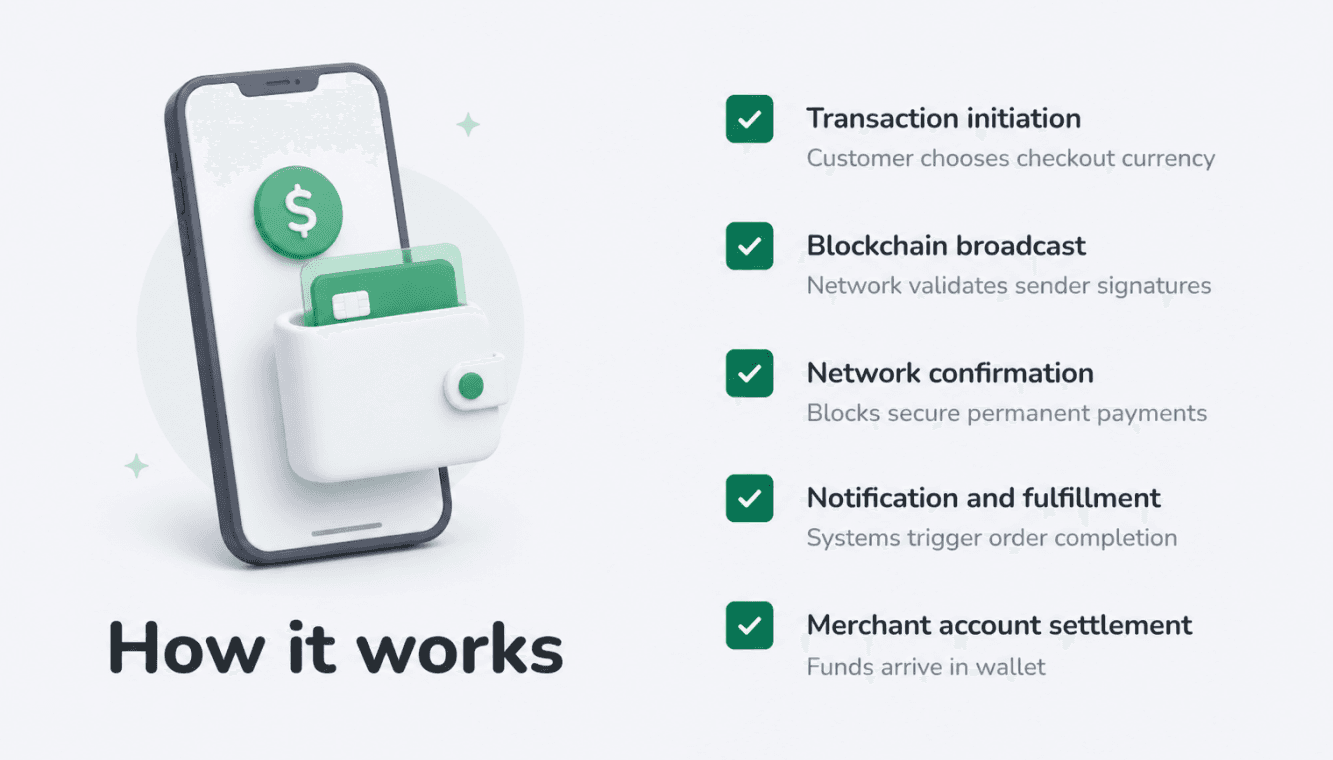
Step 1: Transaction Initiation
The process begins when a customer chooses a stablecoin at checkout. They are presented with a wallet address or a QR code. At this stage, the system calculates the exact amount of the coin needed based on the current exchange rate, if any conversion is involved.
Step 2: Blockchain Broadcast
Once the user sends the funds from their wallet, the transaction is broadcast to the network. Miners or validators check if the sender has enough funds and if the digital signature is valid. This happens in seconds on modern networks.
Step 3: Network Confirmation
The transaction is then added to a block. Depending on the blockchain, you might wait for a few "confirmations" to ensure the payment is permanent. For stablecoin payments, this usually takes between a few seconds and a few minutes.
Step 4: Notification and Fulfillment
Your payment gateway detects the confirmation and sends a signal to your website. The order status changes to "paid" automatically. Your customer gets a receipt, and you can begin fulfilling the order or providing the service.
Step 5: Settlement to Merchant Account
The funds are now in your business wallet. You can choose to keep them as stablecoins to pay your own bills or use an onramp solution to convert them back into traditional bank deposits.
How to Accept Stablecoin Payments on Your Website
Getting started does not require you to be a blockchain developer. You can integrate these tools into your existing workflow quite easily.
Using a Stablecoin Payment Gateway
The simplest way is to partner with a provider. A crypto payment gateway handles the technical complexity for you. They generate the addresses, track the blockchain, and provide you with a clean dashboard to manage your sales.
Integrating APIs
For a more customized experience, you can use recurring payments infrastructure via an API. This allows you to build the payment flow directly into your app or site. It gives you full control over the user interface while the backend manages the crypto logic.
Choosing Supported Stablecoins
You need to decide which coins to accept. Most businesses start with USDT and USDC because they have the most liquidity. You should also consider which networks you want to support, such as Ethereum, Polygon, or Tron, as this affects the fees your customers pay.
Managing Settlements and Conversion
Decide if you want to hold the crypto or convert it to fiat immediately. Some gateways offer "instant settlement" where they take the stablecoins and send USD or EUR to your bank account daily. This is great for businesses that need to pay taxes or rent in local currency.
Setting Up a User-Friendly Checkout
The user experience is key. Using a crypto payment widget makes the process familiar for your customers. It should look and feel like any other checkout process, with clear instructions and mobile compatibility.
Ensuring Security Protocols
You must protect your business from theft. This involves using multi-signature wallets and ensuring your internal processes for handling private keys are strict. Most companies prefer to let a professional custodian or gateway handle the security of the funds.
Advice: Start with a Hybrid Model
You don't have to switch everything at once. Offer stablecoins as an alternative payment method alongside credit cards. This lets you test the demand and get used to the workflow without disrupting your main revenue stream.
Popular Stablecoins for Payments
Not all stablecoins are built the same way. Their reliability depends on who issues them and how they are backed.
|
Token Name |
Ticker |
Primary Network(s) |
Backing Method |
Best Use Case |
|
Tether |
USDT |
Tron, Ethereum, many others |
Fiat & Cash Equivalents |
High liquidity, global trade |
|
USD Coin |
USDC |
Ethereum, Solana, Base |
US Regulated Reserves |
Compliance-heavy businesses |
|
Dai |
DAI |
Ethereum |
Over-collateralized Crypto |
Decentralized finance (DeFi) |
|
PayPal USD |
PYUSD |
Ethereum, Solana |
PayPal Reserves |
Consumer retail payments |
USDT (Tether)
Tether is the giant of the industry. It has the highest trading volume and is used extensively in international trade and Asian markets. If you want to accept crypto payments, USDT is usually the first coin you should look at because almost everyone in the crypto space holds some.
USDC (USD Coin)
Issued by Circle, USDC is often seen as the more "regulated" choice. It is highly popular in the US and Europe. It is fully backed by cash and short-term US Treasuries, and the company undergoes regular audits. Many institutional investors prefer USDC for its transparency.
Other Emerging Stablecoins
New options are appearing constantly. Some are tied to the Euro or Gold. Others, like DAI, are decentralized and managed by code rather than a central company. While these are interesting, they are currently less common for standard commercial payments than the top two.
Stablecoin Payments vs Traditional Payment Methods
To truly understand the value, you have to compare them to what you use now.
|
Feature |
Stablecoin Payments |
Credit Cards |
SWIFT / Bank Wires |
|
Settlement Time |
Near-instant |
2-7 Days |
3-5 Days |
|
Fees |
< 1% (usually) |
2.5% - 4% |
$25 - $50 + FX margin |
|
Chargeback Risk |
Zero |
High |
Low |
|
Global Access |
Universal |
Regional limits |
Network dependent |
|
Complexity |
Moderate (Initially) |
Low |
High (Forms/IBANs) |
Cross-border fees above 2%, chargeback rates above 1%, or settlement delays over 48h — run those numbers by us. We'll build a side-by-side comparison of your current cost vs. a stablecoin setup for your specific corridors. 4 business hours.
How to Understand You Need to Integrate Stablecoin Payments
Why accept crypto payments? Not every business needs this today, but for many, it is becoming a necessity. Here are five signs that you should consider it.
Your Cross-Border Fees are Killing Your Margins
If you are losing a significant chunk of change every time you pay an overseas supplier, you need a better way. Stablecoin for business can cut those costs by 80% or more. The savings go straight to your bottom line.
You Have High Chargeback Rates
Friendly fraud is a real problem for digital service providers. Since blockchain transactions are final, there is no way for a customer to unfairly reverse a payment. This provides a level of security that credit cards simply cannot offer.
You Want to Reach the Unbanked or Underbanked
Millions of people have a smartphone but no bank account. Many of these people use crypto to store their wealth. By offering a crypto POS terminal or online gateway, you open your doors to a massive global demographic that was previously unreachable.
You Need to Move Money Outside of Banking Hours
If your business operates 24/7, your payments should too. Waiting until Monday morning to settle an urgent bill is a relic of the past. If you value speed and flexibility, digital assets are the answer.
Your Competitors are Already Doing It
In many industries, especially tech and gaming, crypto is becoming a standard option. If your competitors offer a faster, modern way to pay, you risk looking outdated. Staying ahead of the curve is better than playing catch-up later.
Risks and Challenges of Stablecoin Payments
While the benefits are great, you should be aware of the hurdles. It is not all smooth sailing yet.
Regulatory Uncertainty
Laws regarding digital assets are still being written. Different countries have different rules about taxes and reporting. You need to stay informed or work with a partner who understands the legal landscape to ensure you remain compliant.
Counterparty Risks
You are trusting the issuer of the stablecoin to keep their promise. If a company says they have a dollar for every token but they actually don't, the token could lose value. This is why sticking to established names like USDT or USDC is critical.
Depegging Risks
In extreme market conditions, a stablecoin might briefly "depeg," meaning its price drops below one dollar. This is rare for the major coins, but it has happened. Using a diverse set of coins can help mitigate this risk.
Compliance Requirements
Just because it's crypto doesn't mean you can ignore the law. You still need to follow Anti-Money Laundering (AML) and Know Your Customer (KYC) rules. A good gateway will have these checks built-in to protect your business.
Best Practices for Using Stablecoins in Business
To succeed, you need a disciplined approach. Do not just jump in without a plan.
|
Best Practice |
Implementation |
Goal |
|
Audit Issuers |
Check the reserves of the coins you use |
Avoid insolvency risk |
|
Whitelist Addresses |
Only send money to known, verified wallets |
Prevent theft |
|
Separate Funds |
Don't mix business and personal crypto |
Clean accounting |
|
Regular Reconciliation |
Sync your crypto wallet with your ERP |
Financial accuracy |
Choose Trusted Stablecoins
Stick to the market leaders. While a new coin might offer lower fees or high interest, the risk of it failing is much higher. For business operations, reliability is far more important than novelty.
Use Secure Wallet Infrastructure
Never keep all your funds on an exchange. Use "cold storage" for large amounts and "hot wallets" only for daily operations. If you aren't comfortable managing this yourself, use a professional OTC desk service for large transactions.
Implement Compliance Checks
Make sure you know who you are doing business with. Use tools that scan wallet addresses for links to criminal activity. This keeps your business clean and prevents issues with your bank when you eventually convert crypto to fiat.
Monitor Transactions
Keep a close eye on your incoming and outgoing flows. Blockchain allows for real-time monitoring, so you should have alerts set up for any large or unusual activity. This helps you spot errors or security breaches immediately.
Train Your Accounting Team
Crypto accounting is different from traditional bookkeeping. Your team needs to understand how to record the value of the coins at the time of receipt for tax purposes. There are software tools that can help automate this.
Establish Clear Internal Policies
Who has the authority to move company crypto? What are the steps for verifying a vendor's wallet address? Having written procedures prevents expensive mistakes and reduces the risk of internal fraud.
Have a Fiat Exit Strategy
Don't get stuck with digital assets if you suddenly need cash for an emergency. Always have a verified account with an exchange or a gateway that can quickly move your funds into your traditional bank account.
Insight: Watch the Gas Fees
Not all blockchains cost the same. While Ethereum is the most secure, its "gas fees" can spike during busy times. For smaller payments, look into networks like Polygon or Tron where fees stay consistently low.
Industries Leading the Stablecoin Shift
It is one thing to talk about tech in general, but seeing where it actually works is much better. Some sectors have moved much faster than others because their old ways were just too broken. It is hard to ignore how much more sense this makes for global trade.
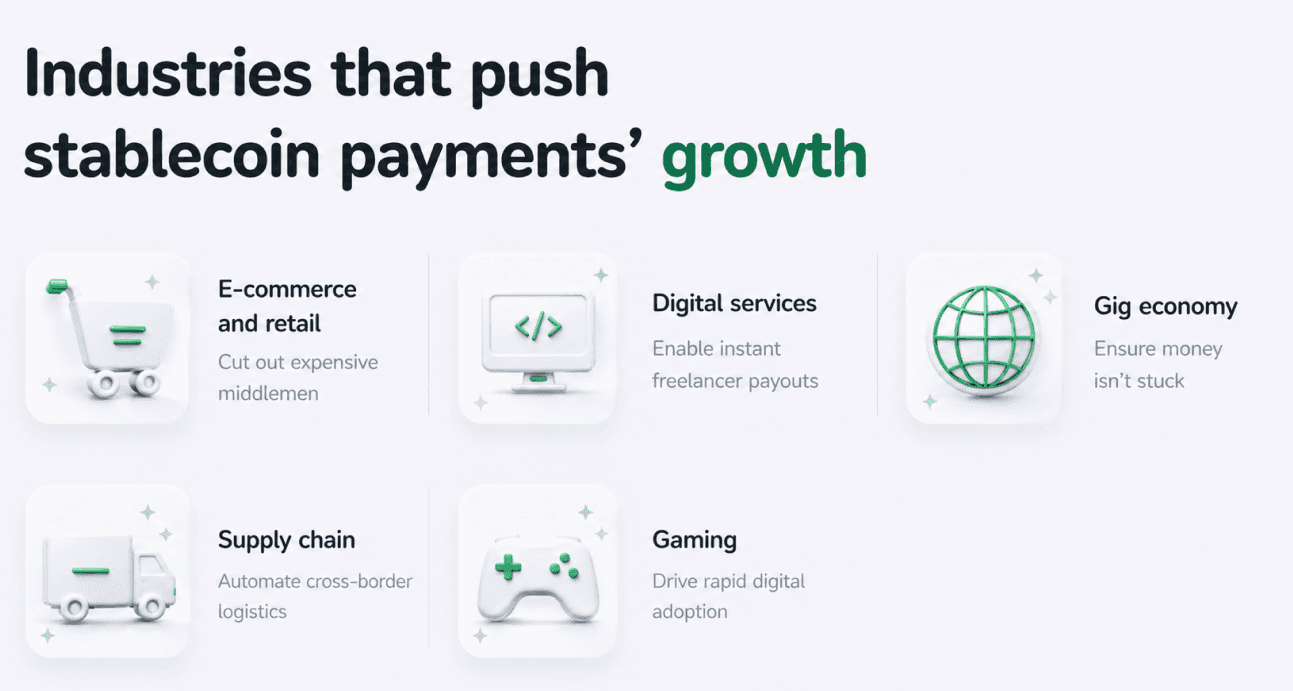
E-commerce and Global Retail
Online stores that sell to a global audience face massive headaches with currency conversion. If a customer in Brazil wants to buy from a shop in Poland, the fees are often a nightmare. By opting to accept stablecoin payments, these stores cut out the middleman.
Digital Services and Gig Economy
Freelancers often wait weeks to get paid through traditional wires. Stablecoins allow for instant payouts once a job is finished. This is why many platforms now offer this as a primary feature. Workers don’t have to worry about whether their money is stuck.
Supply Chain and Logistics
Moving goods across borders involves a mountain of paperwork and slow payments. Using a stablecoin for business in this sector allows for setups where the money moves automatically. For example, a payment can trigger the moment a shipping container is scanned at the dock. This reduces risk for everyone.
|
Industry |
Primary Pain Point |
Stablecoin Solution |
Business Outcome |
|
Retail |
High credit card fees |
Peer-to-peer transfers |
2-4% higher margins |
|
Freelance |
Long payout delays |
Instant wallet transfers |
Better talent retention |
|
Logistics |
Complex escrow |
Smart contract payments |
Reduced legal overhead |
|
Gaming |
Small transaction costs |
Low-fee networks |
Economically viable micro-payments |
Choosing the Right Network for Your Business
Picking the wrong one could mean you pay ten dollars to send a five-dollar payment. You have to be smart about where your assets live. They are different in terms of speed, cost, and safety.
The Cost Factor of Different Chains
Fees fluctuate based on how many people are using the network at that exact moment. While Ethereum is very secure, it can get pricey when the network is busy. Networks like Polygon or Solana offer much cheaper alternatives for stablecoin payments. Small businesses usually prefer these because the cost per transaction is often less than a penny.
Speed and Transaction Finality
Some chains confirm a payment in two seconds. Others take ten minutes. If you are running a retail shop, you can't have a customer standing at the counter for ten minutes while the bank "thinks" about the transaction. Understanding how fast a network settles is vital.
Network Reliability and Security
A cheap network is no good if it goes down twice a month. You need a chain that has a proven track record of staying online. Most companies stick to the top five networks to make sure their funds are safe from technical glitches.
|
Network Name |
Average Transaction Fee |
Confirmation Speed |
Reliability Rating |
|
Ethereum |
$2.00 - $20.00 |
1-5 Minutes |
Very High |
|
Polygon |
$0.01 - $0.05 |
2-5 Seconds |
High |
|
Solana |
< $0.01 |
< 1 Second |
Moderate |
|
Tron |
$0.50 - $1.00 |
1 Minute |
High |
Managing the Accounting and Tax Side
The most common fear for a financial officer is how to handle the books. It looks scary at first. However, the tools available now make it much easier than it used to be. You just need a solid process from the start.
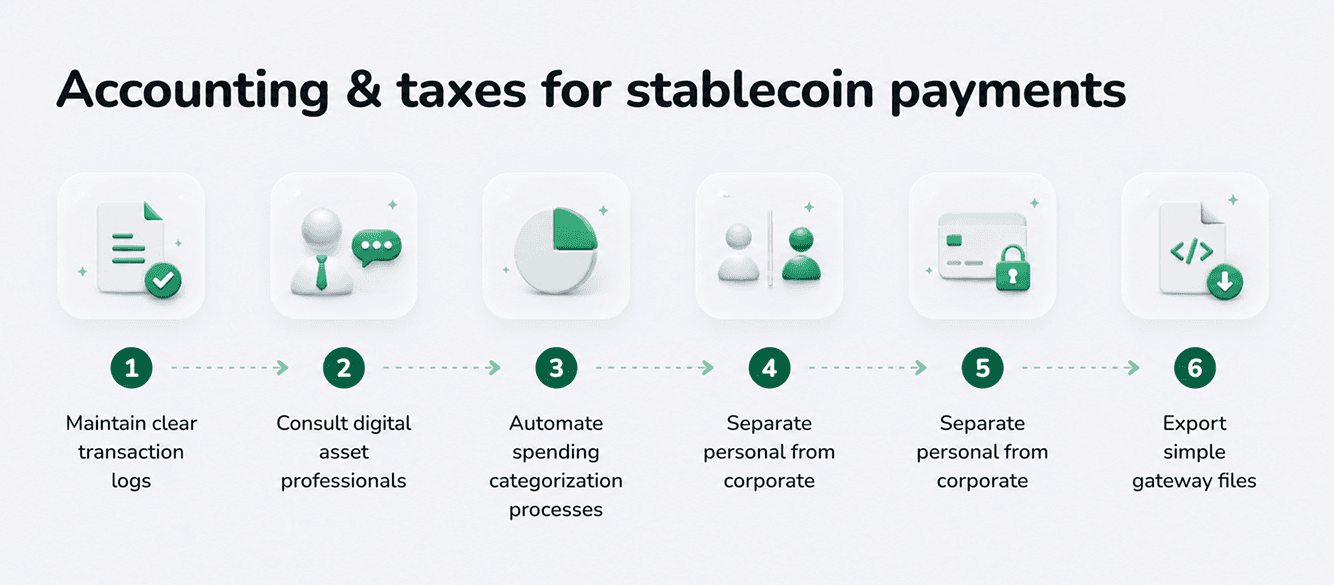
Real-time Valuation Challenges
This is a requirement for tax purposes in many countries. You need to keep a clear log of every transaction. Thankfully, most gateways give you a simple file that you can put right into your accounting software. Clear records make for a happy accountant.
Tax Reporting Requirements
Depending on where you live, receiving crypto might be treated like receiving any other foreign currency. You have to report it correctly to avoid trouble with the government. It is always a smart move to chat with a tax professional who knows the digital asset world well.
Software for Crypto Reconciliation
There are specialized platforms that connect to your wallets and automatically categorize your spending. This saves a lot of time. It also makes sure you don't miss anything when tax season rolls around.
Advice: Keep Business and Personal Wallets Separate
It sounds obvious, but mixing your personal crypto with company funds is a recipe for an accounting disaster. Always use a dedicated business wallet for all client transactions. This makes auditing much faster and keeps your tax records clean.
How Inqud Enables Stablecoin Payments
We believe that every business should have access to modern financial tools. That is why we built a suite of services designed to take the stress out of digital assets. Whether you are a small merchant or a large enterprise, our team is here to help you with this transition.
Our infrastructure allows you to accept stablecoin payments with ease. We handle the security, the network integrations, and the compliance checks so you can focus on growing your business. We provide detailed reporting and seamless conversion options to ensure your accounting stays simple.
We have helped countless companies modernize their payment stacks. We wrote this guide because we want you to feel confident in the future of money. Stablecoins are not a passing trend – they are the new standard for global commerce.
Book a 25-min product call. We'll set up sandbox access within 1 business day, walk through USDT and USDC routing on the networks that fit your volume, and give you transparent pricing on the spot. No commitment required.
Industries
Web3 payments
Products
Сrypto payment gateway, OTC desk, Crypto widget, Сard2crypto
Tags
Educational, Payment methods
Author
FAQ
FAQ
Are stablecoin payments legal for my business?
In most jurisdictions, accepting digital assets for goods and services is perfectly legal. However, you must follow local tax laws and anti-money laundering regulations to stay compliant.
Can I convert stablecoins to my local currency easily?
Yes, you can use a gateway or an exchange to swap your digital coins for USD, EUR, or other fiat currencies. Most services allow for direct bank transfers once the conversion is complete.
What happens if a stablecoin loses its peg?
If a coin drops below its $1 value, the value of your holdings in that coin also drops. This is why it is vital to only use highly liquid and well-backed coins like USDT or USDC.
Do I need a special bank account to accept these payments?
You don't need a special bank to receive the crypto, as it goes into a digital wallet. However, you will need a traditional account to eventually receive the fiat currency after you sell the coins.
Are there any hidden fees when using stablecoins?
The main costs are the network fees (gas) and any processing fees charged by your gateway. Unlike banks, there are usually no monthly maintenance fees or hidden currency conversion spreads.
Inqud Solutions for Your Business

Digital Currency Payments
Start accepting cryptocurrency payments from customers worldwide

Crypto Payment Widget
Embed a cryptocurrency payment widget on your website

Recurring Billing
Set up automatic subscription and recurring billing in crypto

Payment URL
Create and share payment links for crypto transactions

Crypto Purchase Gateway
Enable users to buy crypto with fiat currency seamlessly