

What is Fintech?
May 4, 2026

5 min read
Contents
Why Fintech is Not a Regular Bank
Benefits of Fintech
What Is a Fintech Company?
What Does a Fintech Company Do?
Fintech Industry Overview
How Fintech Works
Types of Fintech Companies
Challenges Facing the Fintech Industry
How Inqud Supports the Fintech Ecosystem
Exploring the Industry
The Role of Innovation in Modern Finance
Final Thoughts on the Future of Money
Share
Money has changed quite a bit lately. You probably noticed that you rarely visit a physical bank branch anymore. Everything happens on your screen now. This shift is what people talk about when they use the term fintech. To understand the current landscape, we need to look at the numbers.
Recent data shows that the global adoption rate of these services reached 75 percent among consumers who are active online. Also, the market value of this sector is expected to go way past 300 billion dollars by the end of 2026. Because these changes are happening so fast, businesses need to keep up. Our team at Inqud wrote this article to share our expertise and help you navigate this industry. We are always ready to help your business with a crypto payment gateway or other modern tools to stay ahead.
Why Fintech is Not a Regular Bank
When we talk about the difference between old-school payments and the new tech-driven version, we are looking at two different worlds. Traditional banks rely on physical buildings and heavy paperwork. They have legacy systems that were built decades ago. What is payment processing in a new era of tech? New financial tech uses the internet and smart algorithms to do the same work much faster.
In the table below, you can see how these two approaches compare across different areas of service.
|
Feature |
TradFi technology |
Fintech |
|
Focus |
Stability and physical presence |
User experience and speed |
|
Regulation |
Very strict and slow to change |
Strict but often more flexible with tech |
|
Customer interaction |
Branch visits and phone calls |
Mobile apps and 24/7 chat |
|
Data usage |
Static historical records |
Real-time data and AI analysis |
|
Speed of service |
Days or weeks for approvals |
Seconds or minutes |
Traditional companies often struggle to change their ways because they have so much history holding them back. Fintech companies start from scratch – they build their software for the phone first, which allows them to be much more agile. If you want to accept crypto payments, you will likely find that a tech company handles this much better than a local bank branch.
Benefits of Fintech
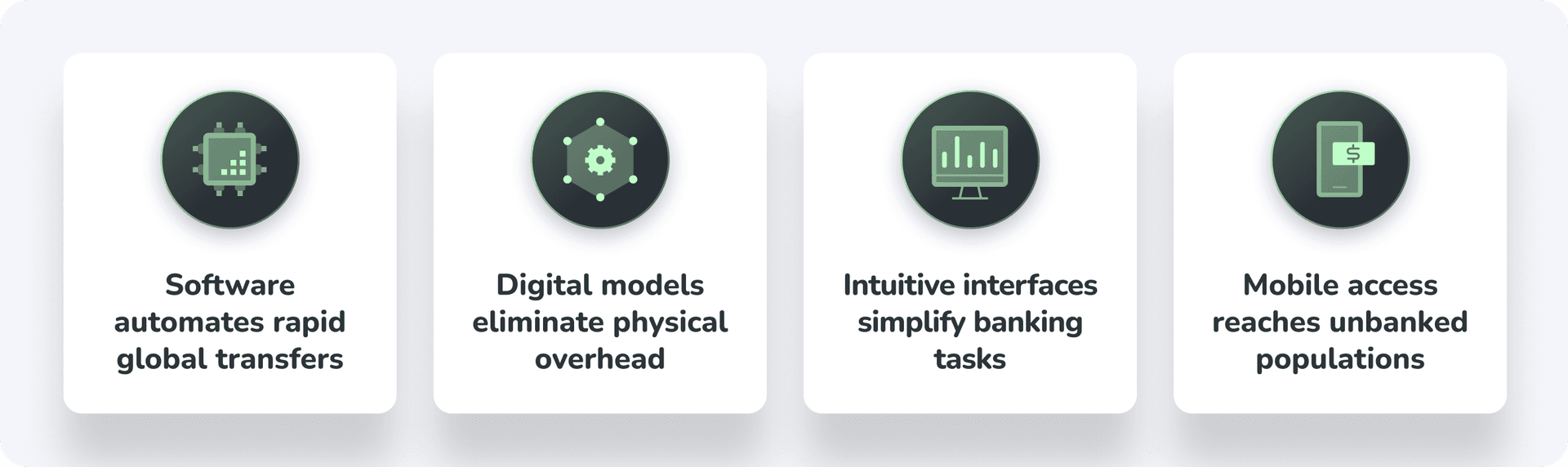
Much faster transactions
Speed is probably the biggest factor here. In the old days, sending money to another country could take a whole week. Now, it happens almost instantly. Software handles the verification instead of a person sitting at a desk. This efficiency saves time for everyone involved.
Costs are way lower
Because these companies don't have to pay for thousands of physical buildings, they save a lot of money on rent and electricity. They pass those savings on to you. Usually, you will find lower fees for international transfers or investment accounts compared to what a big bank charges.
Financial tools for everyone
Many people in the world don't have a traditional bank account because they live in remote areas. These tech solutions only require a smartphone and a signal. Suddenly, millions of people can save money and take out loans who couldn't do it before.
Better user interfaces
Have you ever used a banking app that felt like it was made in 1995? Fintech companies spend a lot of time making their apps look good and work well. They want the experience to be as easy as ordering a pizza or posting a photo online.
Specialized services
Instead of trying to do everything, many of these companies focus on doing one thing really well. Maybe they just handle student loans, or perhaps they only provide a crypto payment widget for websites. This focus leads to better products because they aren't distracted by other banking tasks.
Crypto payment processing is one of these focused specializations — and it changes the economics of international B2B transactions. Talk to our team about what that looks like for your verticals: on-ramp, recurring billing, cross-border settlement. 4-hour reply.
What Is a Fintech Company?
To put it simply, a Fintech definition usually involves any business that uses technology to improve or automate financial services. It is a mix of the words financial and technology. But that is just the surface. What is a Fintech company in the real world? It is a firm that competes with traditional methods by using software that is more efficient.
You can tell a company belongs in this category if it meets these criteria:
It uses cloud computing to handle transactions.
The main way you interact with it is through an app or a website.
It uses big data to decide if you should get a loan or a credit card.
Innovation is at the center of their business model rather than just being an "add-on" feature.
When people ask what are Fintech companies, they are usually looking for names like Stripe, Revolut, or Inqud. These firms don't just provide accounts. They create new ways to think about value and exchange. Understanding Fintech company meaning requires seeing that these aren't just banks with apps. They are tech companies that happen to deal with money.
What Does a Fintech Company Do?
What does a FinTech company do? Fintechs work in many different areas. The industry is not just one big block. It has many specialized branches.
Everyday payments and transfers
This is the most visible part of the industry – it includes digital wallets and systems that let you pay with your phone at a store. Many businesses now set up recurring payments to make sure their subscriptions run smoothly every month without manual work.
Digital lending and credit
The days when you had to bring a stack of papers to a bank to get a small loan are gone. Now, companies use algorithms to check your social media, your spending habits, and your employment history in seconds. They give you an answer almost immediately.
Smart insurance (Insurtech)
Insurance used to be very slow and annoying. New companies use data from wearable devices or car sensors to give you a price that actually fits how you live. If you drive safely, your car insurance might get cheaper automatically.
Wealth management and investing
You don't need a fancy broker in a suit anymore because robo-advisors are software programs that manage your stocks for you based on how much risk you like. They do this for a fraction of the cost that a human would charge.
Regulatory technology (Regtech)
Banks have to follow thousands of rules, and Regtech companies build software that helps these banks stay legal. It automatically checks for money laundering and makes sure all the reports are sent to the government on time.
Cryptocurrency and blockchain
Companies in this space allow people to buy, sell, and store digital assets. Many merchants now send a payment link to their customers so they can pay in Bitcoin or other digital currencies.
Fintech Industry Overview
When we look at what is the Fintech industry today, we see a massive push toward decentralization. By 2026, the focus will shift even more toward these areas:
Artificial Intelligence will handle almost all basic customer service questions.
Hyper-personalization means your app will know you need a loan before you even ask for one.
Open banking will let different apps talk to each other so you can see all your money in one place.
Sustainable finance will help people invest only in companies that are good for the planet.
Embedded finance will put banking features inside non-financial apps, like a car app that lets you pay for gas automatically.
This growth shows that “what is financial technology” is a question with an answer that changes every year. It is a moving target because the tech keeps getting better.
How Fintech Works
Understanding how a Fintech is actually built can be complicated, but let's keep it simple. It usually follows a specific path to handle your money safely.
The user interface: You enter your details into an app or a website.
The API layer: This is like a messenger that carries your request to the servers.
Verification: The system checks your identity and your balance using automated tools.
The ledger: A digital record is updated to show that money moved from point A to point B.
Security check: Encryption makes sure that nobody can steal your data while it travels.
Most people don't see these steps. They just see a green checkmark on their screen. But behind that checkmark, thousands of lines of code are working to keep things moving.
Payments, lending, wealth management — fintech spans a lot of ground, and crypto infrastructure is only relevant to some of it. Tell us where your product sits and we'll tell you honestly if we're relevant.
Types of Fintech Companies
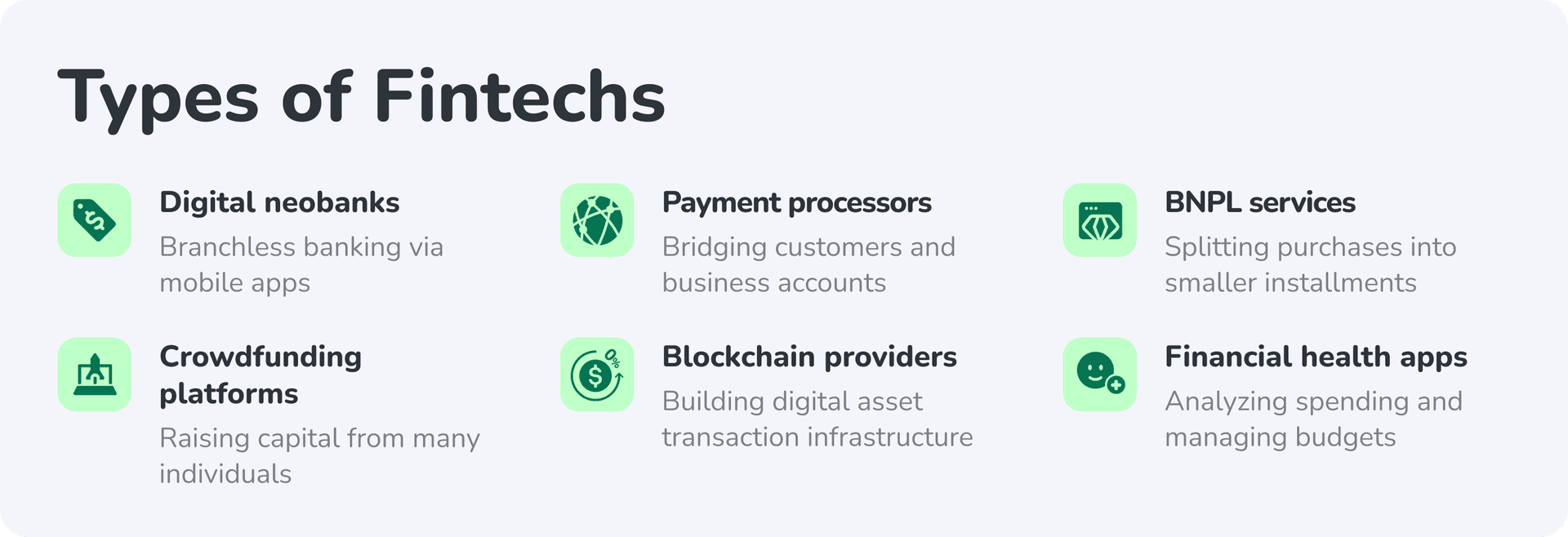
There are many types of FinTech companies out there. We can group them into six main categories to make them easier to understand.
Neobanks
These are banks that have no physical branches. Everything is digital. They offer checking accounts, debit cards, and savings tools all inside an app. They are very popular with younger people who hate waiting in lines.
Payment processors
These companies help businesses take money from customers. They handle the connection between the customer's card and the store's bank account. Some focus on traditional cards, while others provide an OTC desk for larger digital asset trades.
Buy now, pay later (BNPL)
You have probably seen this at checkout screens lately. It lets you split a purchase into four or more small payments. It is a new way of looking at credit that doesn't feel like a scary credit card.
Crowdfunding platforms
If you have a great idea for a new product, you can ask thousands of people for ten dollars each. These platforms manage the money and make sure everyone gets what they were promised.
Blockchain service providers
These firms build the infrastructure for digital assets. They make sure that transactions on the ledger are valid. For many businesses, using a crypto POS terminal in their physical store is the best way to enter this space.
Financial health apps
These apps don't hold your money. Instead, they look at your spending and tell you where you are wasting cash. They might suggest a better savings plan or remind you when a bill is due.
Crypto payment gateways sit in this landscape as the infrastructure layer for B2B value transfer. Send us your use case — whether it's e-commerce settlement, SaaS billing, or iGaming payouts — and we'll show you exactly where Inqud fits in your stack. 25-min call, sandbox within 1 business day.
Challenges Facing the Fintech Industry
Even though the financial transaction processing industry is growing, it isn't always easy. There are several types of Fintech challenges that companies must solve if they want to survive.
Keeping data safe
Cybersecurity is a massive worry. Since these companies handle money, they are big targets for hackers. One mistake can lead to millions of dollars being lost and a total loss of trust from the public.
Changing government rules
Laws about money are very old. Sometimes, the government doesn't know how to handle a new Fintech startup that doesn't fit into the old categories. This creates a lot of legal confusion and can slow down innovation.
Winning over public trust
Many people still feel safer keeping their money in a big building with a vault. Getting people to trust an app with their life savings takes a long time and a lot of good marketing.
Finding the right people
To build these tools, you need people who understand both banking and high-level coding. There aren't enough of these experts to go around, so companies have to fight to hire the best talent.
Dealing with competition
Every day, a new Fintech startup appears. It is hard to stand out when so many companies are offering similar services. Only those with the best tech and the best customer support will stay around for the long haul.
How Inqud Supports the Fintech Ecosystem
At Inqud, we understand that all this can feel a bit overwhelming. That is why we focus on making the complex parts of B2B payments for fintech simple for you. We provide the expertise needed to integrate modern payment methods into your existing business model without any headaches.
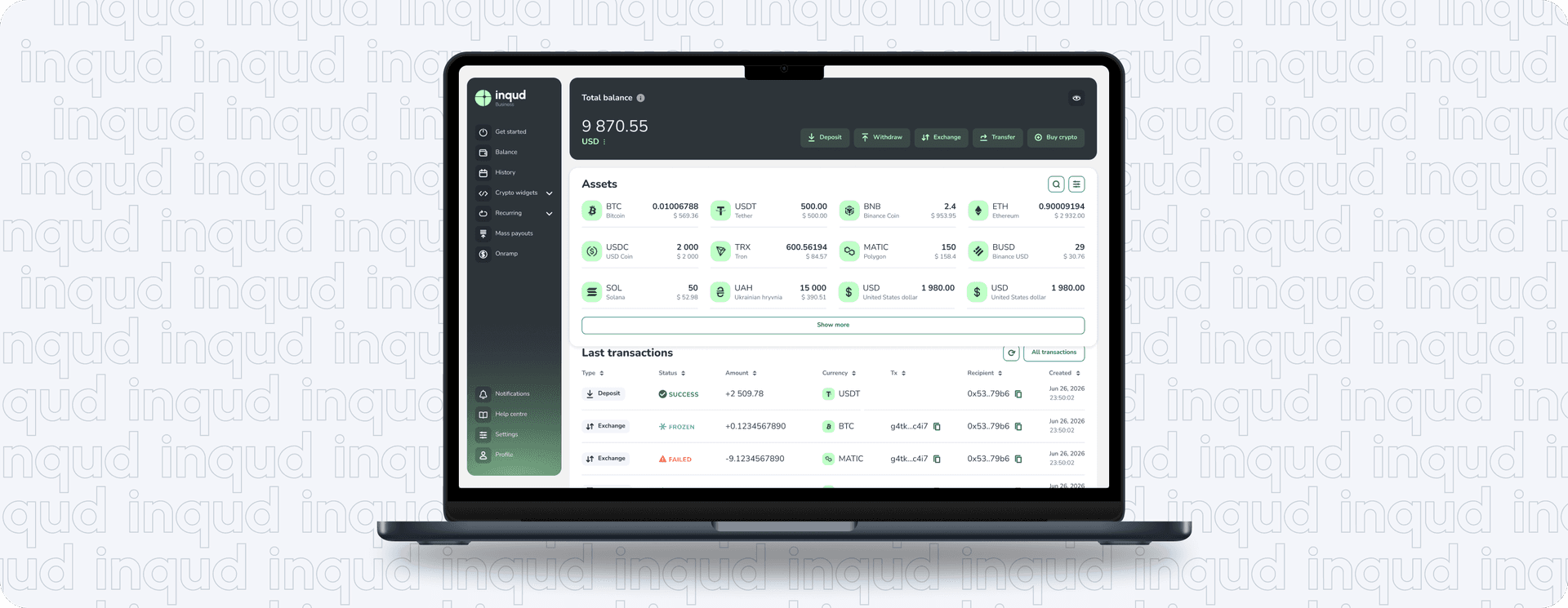
Our team offers several ways to help you grow:
We provide secure gateways for various digital assets.
Our tools are built to be easy to install and even easier to use.
We stay on top of all the latest regulations so you don't have to worry about the legal side.
Our support team is always available to answer your questions.
Whether you are just starting to look at Fintech examples or you are ready to change your entire payment system, we are here to assist.
Book a 25-min product call. We'll map our crypto payment infrastructure to your business model, give you honest pricing, and set up sandbox access within 1 business day if it's a fit.
We believe that everyone should have access to the best financial tools, and we work hard to make that a reality.
Exploring the Industry
When people talk about what are Fintech companies, they often forget how diverse the sector really is. Below is a breakdown of the common types of businesses you might encounter.
|
Category |
Description |
Key focus |
|
Personal finance |
Apps that help you budget |
Saving money |
|
B2B fintech |
Tools for other businesses |
Improving workflow |
|
Capital markets |
Platforms for stock trading |
Investment access |
|
Wealthtech |
Digital portfolio management |
Long-term growth |
So, you see, It is a whole ecosystem of different payment processing companies working together.
The Role of Innovation in Modern Finance
What does a FinTech company do to stay relevant? The answer is always innovation. They are constantly looking for a better way to solve an old problem. Maybe that means using your voice to authorize a payment or using your face to unlock your bank account.
Common types of Fintechs you see today are often trying to solve the problem of payment processing for startups. Friction is anything that makes it harder or slower to spend or save your money. By removing these barriers, they make life easier for everyone.
To help you visualize the different directions the industry takes, look at this table:
|
Direction |
Main goal |
Technology used |
|
Inclusion |
Reaching the unbanked |
Mobile networks |
|
Efficiency |
Reducing transaction time |
Smart contracts |
|
Security |
Preventing fraud |
Biometrics |
|
Transparency |
Showing fee breakdowns |
Open APIs |
Final Thoughts on the Future of Money
Because we have spent years working in this field, we know how to spot the trends that matter for those who wants to accept cryptocurrency payments. We wrote this comprehensive article because we want to share that knowledge with you. If you are looking for a team that understands the crypto payment gateway space and beyond, our team at Inqud will be glad to assist with accepting crypto payments and providing our expertise.
The move away from traditional systems is well underway. Embracing these new ways of crypto payments integration is not just a good idea for the future, it is necessary for today. We hope this guide has helped you understand the big picture of this exciting industry. If you have more questions about Fintech examples or how to start, just reach out to us. We are here to help you succeed in this new digital economy.
Industries
Web3 payments
Products
Сrypto payment gateway
Tags
Educational, Payment methods
Author
Inqud Solutions for Your Business

Cryptocurrency Acceptance
Start accepting cryptocurrency payments from customers worldwide

Cryptocurrency Plugin
Embed a cryptocurrency payment widget on your website

Auto Payments
Set up automatic subscription and recurring billing in crypto

Instant Payment Link
Create and share payment links for crypto transactions

Buy Digital Assets
Enable users to buy crypto with fiat currency seamlessly