


What Is Payment Processing and How It Works
Apr 21, 2026

5 min read
Contents
What Is Payment Processing?
Why Reliable Infrastructure Is Critical for Modern Businesses
The Standard Payment Processing Workflow
How Does Credit Card Processing Work?
What Is a Payment Processing Center?
Digital Payment Processing
Crypto Payment Processing
How Blockchain Changes Payment Processing Technology
Payment Processing for Financial Institutions & Fintech Companies
Inqud’s Expertise in Payment Processing Infrastructure
Your Payment Journey
Share
Imagine you are standing at a coffee shop. You tap your card or scan a QR code. Within two seconds, a tiny "Approved" message pops up. It feels like magic, but behind that beep is a complex process involving half a dozen companies and thousands of miles of fiber optic cable.
The Inqud team will be glad to assist you in making sense of this invisible world. We deal with the gears and bolts of money movement, and exchange the expertise with top payment processing companies every day. Because we want your business to thrive without the technical headaches, our experts have put together this detailed guide. We will look at the old ways, the new ways, and the "magic internet money" ways of getting paid.
Card processing and crypto processing solve the same problem through completely different mechanics. Ask us where the two actually diverge for your use case.
What Is Payment Processing?
At its heart, what is payment processing but a digital handshake? It is a series of automated steps that move money from a buyer to a seller. When you sell a product, you aren't just handing over an item. You are initiating a complex verification process. The system has to check if the buyer has the money, if the card is real, and if the transaction is safe from thieves.
This involves three main players: the merchant (that is you), the customer, and the payment processor. The processor acts as the translator between your shop and the banks. Without this bridge, you would have to call every bank individually to ask if a customer's check is good. In the modern era, electronic payment processing handles this in the blink of an eye.
Most people think the money lands in their bank account instantly. It does not. The process involves authorization, capturing the funds, and finally, settlement. It is a game of relay racing where the baton is your customer’s data, and if any player drops the baton, the sale fails.
The core participants
|
Participant |
Their function |
|
The merchant |
Sells the goods and initiates the request |
|
The customer |
Provides the payment method and authorization |
|
The processor |
Routes the data between all parties |
|
The issuing bank |
The customer's bank that says "Yes" or "No" |
|
The acquiring bank |
The merchant's bank that receives the loot |
Why Reliable Infrastructure Is Critical for Modern Businesses
In the past, you could just put a "Cash Only" sign in your window and survive. Today, that is a recipe for bankruptcy. Modern customers expect to pay with cards, phones, and even watches. If your digital payment processing fails for even ten minutes on a Friday night, you lose more than just sales. You lose the trust of your customers.
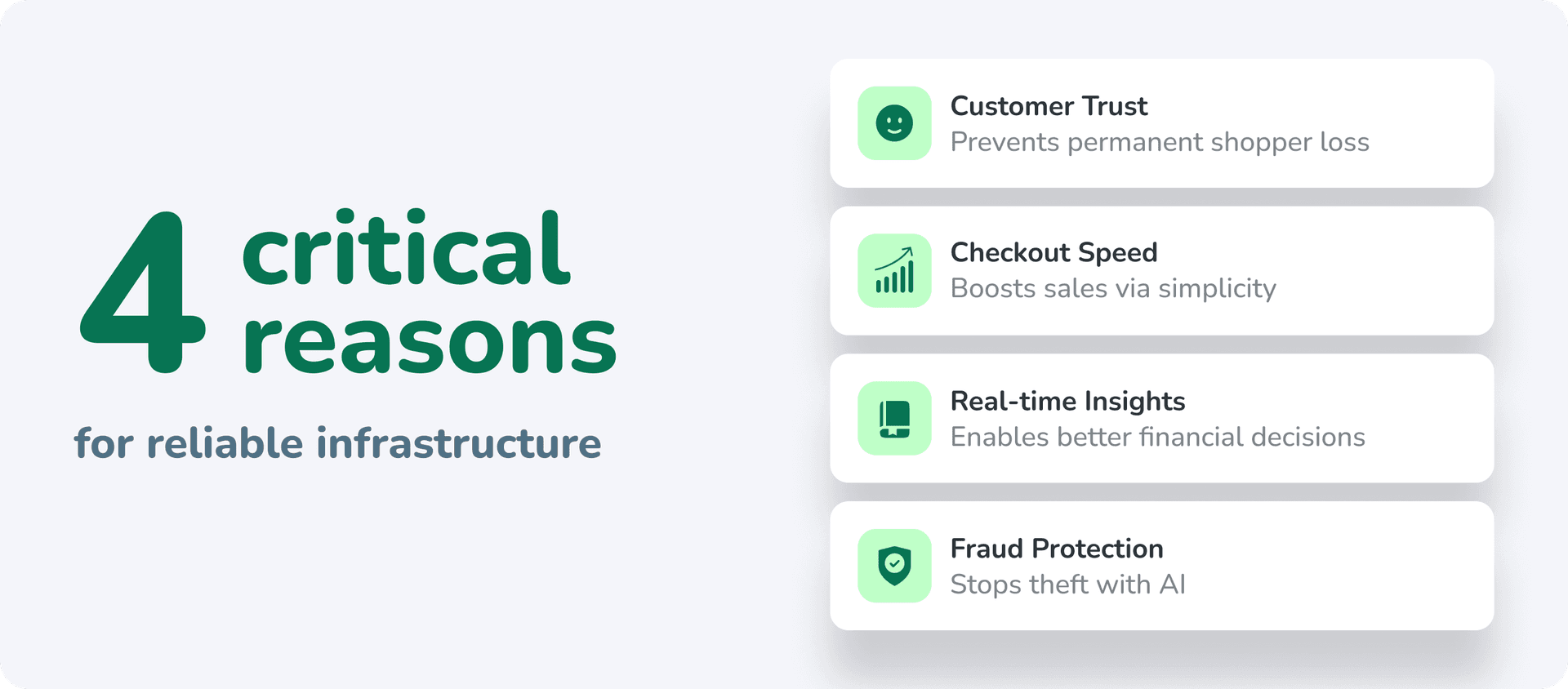
Recent studies show that about 41% of shoppers will never return to a site if their payment is declined for no apparent reason. This is why having a robust crypto payment gateway and business solutions setup is so important. You need a system that works every single time.
Furthermore, a good system protects you from fraud. Online theft cost businesses over $10,5 trillion globally last year. A smart processor uses machine learning to spot a thief before they can hit the "Buy" button. It also helps you manage your cash flow. Seeing your sales in real-time allows you to make better decisions about hiring or buying more stock.
Insight: The abandonment lifehack
Many businesses lose money because their checkout page has too many fields. By using a "One-Click" payment method, you can increase your conversion rate by nearly 30%. People are lazy. The fewer things they have to type, the more they spend.
If 41% of shoppers never return after a failed payment, your gateway choice is a revenue decision — not just a technical one. Tell us your current setup and monthly volumes and we'll show you what a modern crypto payment infrastructure looks like for your stack. 4-hour reply.
The Standard Payment Processing Workflow
Understanding the payment processing workflow is like learning how an internal combustion engine works. You don't need to know it to drive, but it helps if the car breaks down. There are typically five main payment processing steps that happen every time a transaction occurs.
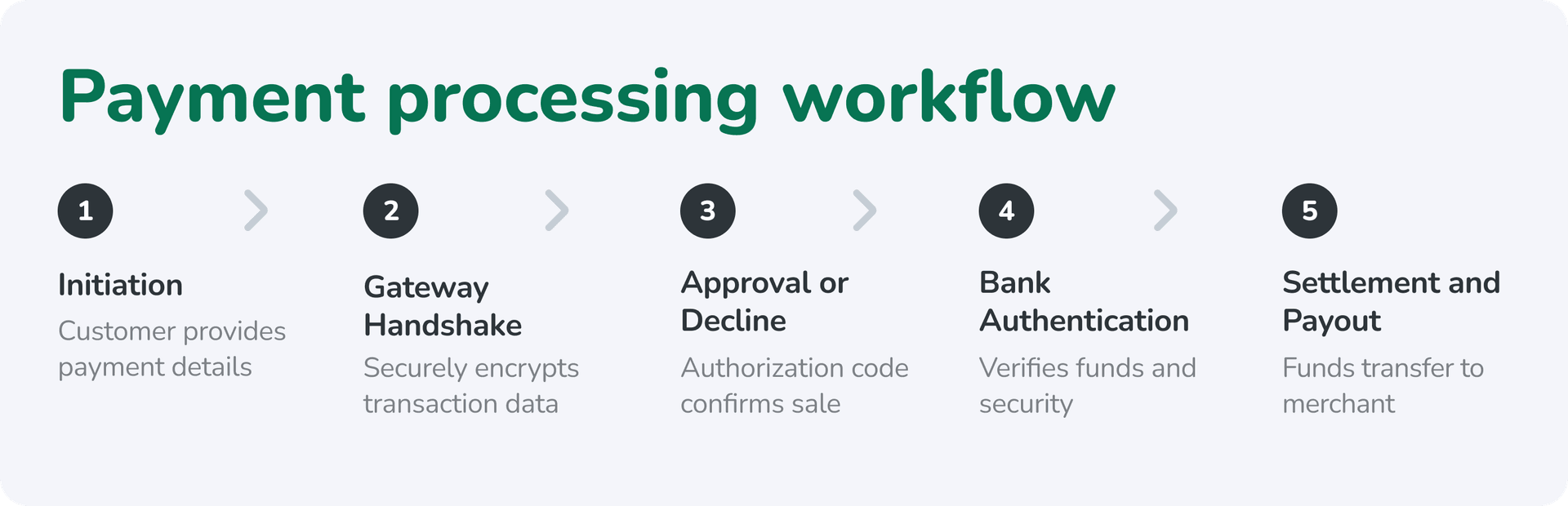
Step 1: Initiation
The customer picks their items and goes to the checkout. They enter their card details or choose a digital wallet. This is the moment the "request" is born. It is the merchant's job to collect this data securely.
Step 2: The gateway handshake
The data is sent to a payment gateway, it works like a secure tunnel. It encrypts the information so that hackers cannot see it. It then sends this encrypted package to the payment processor.
Step 3: Bank authentication
The processor takes the data and asks the customer's bank for permission. "Does this person have $50? Is this card stolen?" The bank checks its records in milliseconds.
Step 4: Approval or decline
The bank sends back a code. This code tells the merchant if the sale is a go or a no-go. If approved, the merchant gives the customer their receipt. The money is now "reserved" but not yet moved.
Step 5: Settlement and payout
At the end of the day, the merchant "batches" all their approvals. The processor then moves the actual money from the customer's bank to the merchant's bank. This usually takes 24 to 48 hours to complete.
Transaction speed comparison
|
Payment type |
Authorization time |
Settlement time |
|
Credit card |
2 seconds |
1-3 days |
|
Wire transfer |
Hours |
3-5 days |
|
Crypto (e.g. BTC) |
10-60 minutes |
Instant (once confirmed) |
|
Stablecoins |
5-10 seconds |
Instant |
How Does Credit Card Processing Work?
Credit cards remain the base of the payments processing industry, but they are also the most complex. When people ask how credit card processing works, they are often surprised by the number of hands the money passes through. It is a web of fees and verifications.
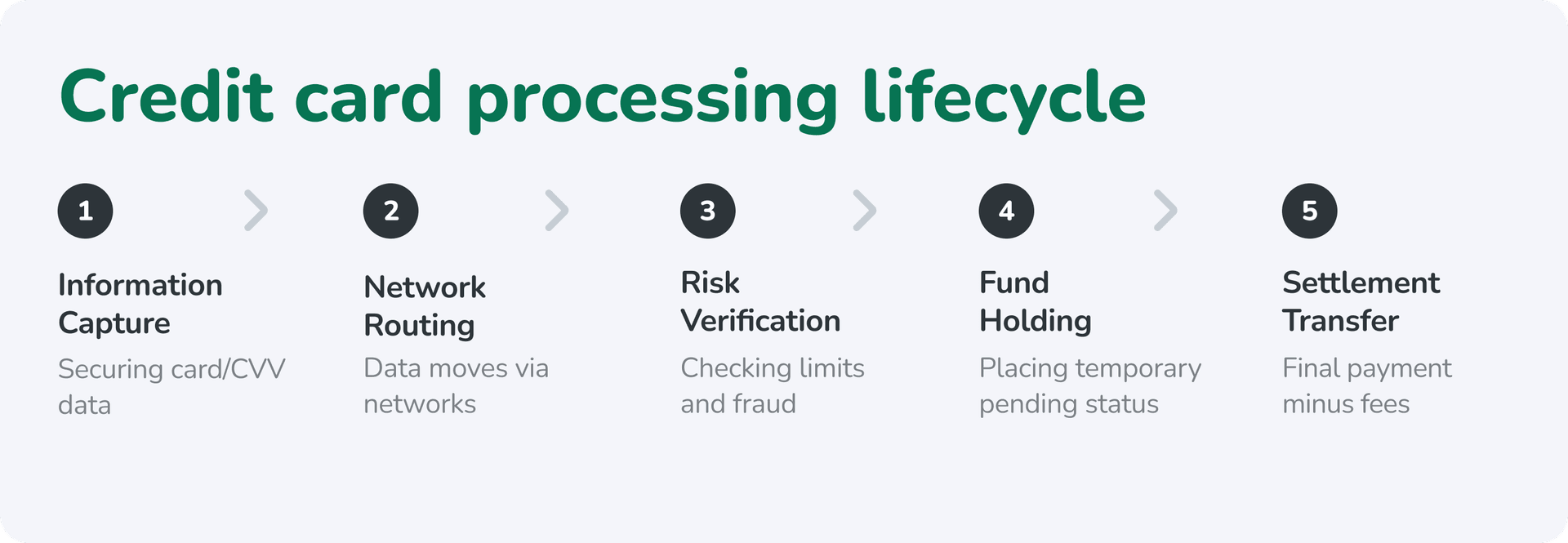
Entering info
The process begins at the Point of Sale. Whether it is a physical crypto POS terminal or a digital checkout page, the primary goal is capturing the 16-digit card number and the CVV code.
Routing through the networks
Visa, Mastercard, or Amex are not banks. They are networks. They act as the highway patrol, ensuring the data moves safely from the merchant to the correct bank. They charge a "toll" for this service, known as an interchange fee.
The risk check
The issuing bank runs a quick check on the customer's credit limit. They also look for red flags. If a card usually spends $20 in London and suddenly tries to spend $5,000 in Dubai, the bank might block it.
The hold
Once approved, a "hold" is placed on the customer's funds. This ensures they don't go and spend that same $50 somewhere else before the transaction clears. This is why your bank balance sometimes shows "pending" transactions.
The final transfer
During the settlement phase, the banks swap the actual cash. The merchant receives the amount minus the various fees for the processor, the network, and the banks. It is a complex dance of tiny percentages.
Insight: The chargeback trap
Always keep your shipping receipts, because customers can sometimes claim they never got an item to get their money back. This is called a chargeback. Without proof, the banks will almost always side with the customer, and you will lose both the product and the money.
What Is a Payment Processing Center?
You might hear the term and imagine a giant warehouse full of servers. What is a payment processing center? In reality, it is more of a digital hub. It is a service provider that handles the heavy lifting of communicating with different financial networks.
These centers are the muscle of the payment processing technology world. They maintain connections to thousands of banks globally. They ensure that when you want to take a payment from a customer in Japan while you are in Portugal, the currency conversion and the data routing happen without a hitch.
They also handle the security compliance (PCI-DSS) that would be a nightmare for a small business to manage alone. By using a centralized processor, you are essentially "renting" their massive infrastructure. This allows even a one-person shop to have the same payment power as a global retail giant.
Digital Payment Processing
Modern electronic payment processing is about the features that make life easier for the business owner. One of the most powerful tools is the payment link for crypto. This allows you to send a simple URL to a customer via email or WhatsApp. They click it, pay, and you are done. No website needed.
Another vital feature is the ability to handle onramp-offramp services. This is where the old world of cash meets the new world of digital assets. Being able to convert your crypto earnings into "real" money (fiat) easily is what keeps a business liquid.
Security features are also a major part of the package. Tokenization is a big word for a simple concept. It means the processor swaps the customer's real card number for a random string of digits. If a hacker breaks into your system, all they find is useless gibberish. This keeps your financial transaction processing safe and your customers happy.
Essential digital features
|
Feature |
What it does |
Why you need it |
|
Tokenization |
Hides real card data |
Prevents data breaches |
|
Recurring billing |
Automatically charges every month |
Great for subscriptions |
|
Fraud scoring |
Checks every sale for risk |
Stops stolen cards |
|
Multi-currency |
Lets people pay in their own money |
Boosts global sales |
Crypto Payment Processing
We are witnessing a massive shift in how the world thinks about value. Crypto payment processing is no longer just for tech enthusiasts, it is becoming a standard way for international businesses to settle debts. Because there are no middle-man banks in the middle of a blockchain, the fees can be significantly lower.
When you decide to accept crypto with ease, you are opening your doors to a global audience. There are millions of people who prefer to pay with digital assets because it is faster and more private. For a merchant, it means no more waiting three days for a bank transfer to clear.
Using a crypto widget on your site makes the process feel familiar to your customers. They see a button, they click it, and their wallet app opens. It is a seamless experience. If you have a subscription model, you can even set up recurring crypto payments to ensure your revenue keeps flowing without manual invoices.
Settlement in minutes, no chargebacks, no bank intermediaries. Send us your current payment mix — card volumes, geographies, settlement windows — and we'll show exactly where crypto rails save the most for your business. 25-min call, 4-hour reply.
How Blockchain Changes Payment Processing Technology
Rarely does a technology come along that actually simplifies things, but blockchain payment processing does exactly that. In the traditional world, you need a ledger at your bank, a ledger at the customer's bank, and a ledger at the processor. They all have to agree.
With cryptocurrency payment processing, there is only one ledger – the blockchain. This "shared truth" eliminates the need for most of the middle-men we talked about earlier.
Transparency: Every transaction is recorded publicly and cannot be deleted.
Speed: Cross-border payments that used to take a week now take minutes.
Lower costs: Fewer hands in the cookie jar means more money for the merchant.
No boundaries: A wallet in Argentina is exactly the same as a wallet in Sweden.
Insight: The stablecoin lifehack
If you are worried about the price of Bitcoin jumping up and down, use Stablecoins. These are digital tokens tied to the US Dollar. You get all the speed and low fees of a blockchain without the "rollercoaster" of price changes.
Payment Processing for Financial Institutions & Fintech Companies
The payment processing for financial institutions sector is currently going through a massive renovation. Older banks are realizing that their 40-year-old systems cannot keep up with the demands of the modern world.
Fintech companies provide the "API" layers that allow old banks to talk to new apps. For a fintech company, having a solid crypto payment processing infrastructure is a competitive advantage. It allows them to offer products that the "dinosaurs" of the banking world simply can't match.
By integrating these modern systems, financial institutions can reduce their operational costs. They don't need hundreds of people manually checking transfers. Automation does the work. This leads to better rates for the end-users and faster service for everyone. It is a win-win situation that is reshaping the entire global economy.
Inqud’s Expertise in Payment Processing Infrastructure
At Inqud, we don't just talk about the future of money, we build it. Our team has spent years perfecting a system that brings together the best of traditional finance and the speed of the blockchain. We know that every business is different, which is why our solutions are modular.
Whether you need a high-volume OTC desk for crypto settlements or a simple way for your retail store to take digital assets via a crypto POS terminal, we have you covered. Our infrastructure is built to be "invisible." It should just work, allowing you to focus on your products and your customers.
We pride ourselves on our transparency and our support. Navigating the world of digital finance can be intimidating, but it doesn't have to be. From simple onramp-offramp tools to complex global settlement systems, we provide the tools that help you scale. We are not just a service provider. We are your technical partner in the world of modern commerce.
Sandbox keys within 1 business day. Tell us which layer you want to tackle first — widget, recurring billing, OTC, or POS — and we'll run the integration walkthrough with your team. 4 business hours to first reply.
The Inqud solution suite
|
Solution |
Best For... |
Key benefit |
|
Crypto widget |
E-commerce websites |
Fast, 5-minute integration |
|
Payment links |
Freelancers and B2B |
No tech skills required |
|
Recurring payments |
SaaS and Subscriptions |
Predictable monthly cash flow |
|
OTC desk |
Large-scale settlements |
Best rates for big volumes |
Your Payment Journey
Understanding how payment processing works can feel like trying to learn a new language. There are so many acronyms and hidden fees that it is easy to get frustrated. But at the end of the day, it is all about making the exchange of value as smooth as possible and choose the best payment processor for your business.
You want your customers to feel safe. You want your money to arrive quickly. And you want the whole thing to cost as little as possible. By choosing the right partners and understanding the basics of blockchain payment processing, you are setting your business up for long-term success. The "pipes" might be hidden, but they are the most important part of your digital storefront.
The Inqud team will be glad to assist you as you transition into this new era of finance. We believe that knowledge is the best tool for any entrepreneur. If you have questions about which setup is right for you, bottlenecks of payment processing for startups or if you just want to talk about the latest trends in the industry, our doors are always open – book a call to discuss your project.
Industries
Web3 payments
Products
Crypto widget, Сrypto payment gateway, OTC desk, Сard2crypto, API
Tags
Payment methods, Educational
Author

Inqud Solutions for Your Business

Accept Crypto
Start accepting cryptocurrency payments from customers worldwide

Crypto Checkout Tool
Embed a cryptocurrency payment widget on your website

Subscription Payments
Set up automatic subscription and recurring billing in crypto

Payment link
Create and share payment links for crypto transactions

Fiat-to-Crypto
Enable users to buy crypto with fiat currency seamlessly