


Agentic AI Commerce: How AI Agents Are Transforming Ecommerce
Jun 18, 2026

5 min read
Contents
What Is Agentic Commerce?
How AI Is Changing Ecommerce
Traditional Ecommerce vs Agentic Commerce
Key Use Cases of Agentic AI in Online Shopping
Benefits of Agentic Commerce
Benefits of Agentic Commerce for Customers
How Inqud Helps Businesses Build AI Commerce Solutions
Share
A few years ago, ecommerce personalization meant showing a "you might also like" widget. Today, an AI agent can browse your catalog, compare prices across platforms, apply a promo code it found in a browser extension, and complete checkout, all while you're in a meeting.
That's exactly what agentic AI commerce is bringing to online retail. Not smarter chatbots, not better recommendation carousels. A fundamental shift in who (or what) makes purchasing decisions, and how fast those decisions happen.
A lot of merchants ask us this exact question — get in touch with our team and we'll go through agentic AI Commerce using your real transaction data.
What Is Agentic Commerce?
So, what is agentic commerce, in plain terms?
It's an ecommerce model where AI agents take autonomous action on behalf of users: researching products, comparing options, initiating purchases, and completing payment without waiting for step-by-step human confirmation at each stage.
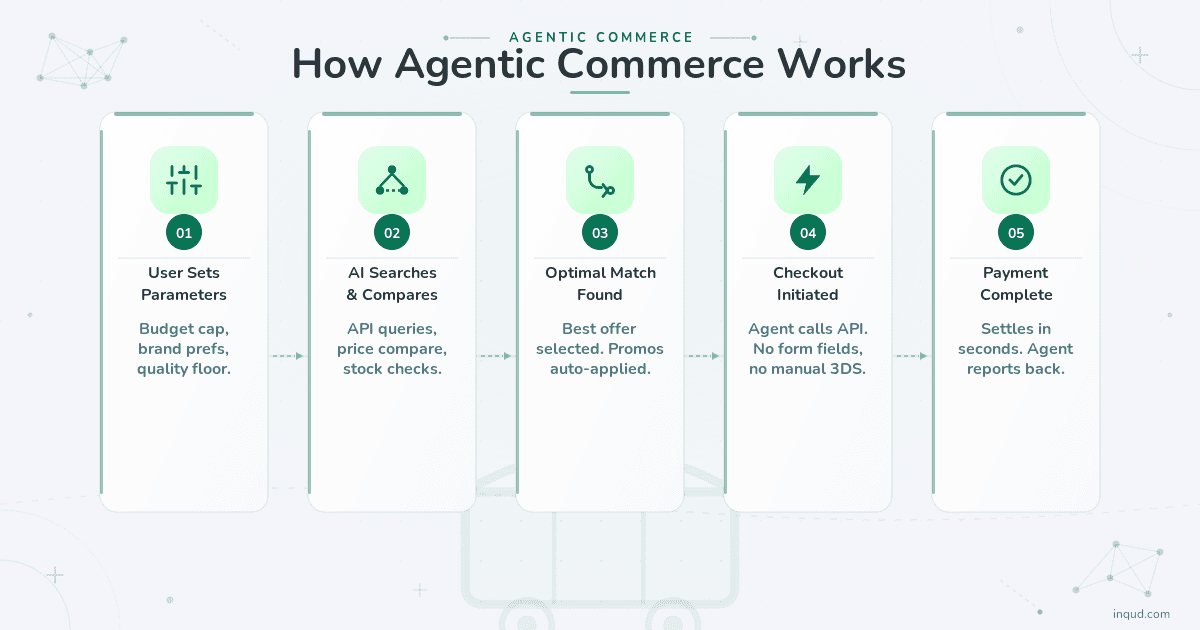
Traditional ecommerce puts the customer in control of every micro-decision: enter a search query, click a filter, open a product page, add to cart, fill in shipping details, confirm payment. Agentic commerce delegates most of that to a system that understands a user's preferences, goals, and constraints, and then acts on them.
The agent doesn't just recommend. It executes.
How AI Is Changing Ecommerce
AI for eCommerce has been layered in gradually over the past decade, starting with search improvements, moving through personalized recommendations, and now crossing into fully autonomous purchasing flows.
Here's where the shift is most visible right now:
AI-Powered Product Recommendations
Classic recommendation engines run on collaborative filtering: "people who bought X also bought Y." AI-powered commerce goes several layers deeper. Modern systems analyze purchase history, session behavior, real-time inventory levels, margin data, and external signals like seasonal demand or competitor pricing — all at once, to surface the right product at the right moment.
The practical result: conversion rates on AI-curated pages consistently run 20–30% higher than on manually merchandised ones (McKinsey, 2025).
Intelligent Search and Discovery
Keyword search is increasingly obsolete in AI-based eCommerce. Semantic search (where the engine understands intent, not just string matches) has taken over. A user who types "something warm to wear hiking in Scotland in November" gets relevant layering options, not just results with the tag "jacket."
Multimodal search is the next step: a user uploads a photo of a product they saw on Instagram, and the system finds exact or near-exact matches in your catalog — no text query needed.
Automated Price Optimization
AI-powered commerce tools are making real-time dynamic pricing accessible across categories that used to rely on fixed price lists. Agents continuously monitor competitor pricing, stock levels, demand curves, and customer segment data, adjusting prices without human input. Well-implemented systems protect margin rather than racing to the bottom.
Autonomous Checkout and Payment
This is where AI for eCommerce crosses into genuinely new territory: agents that can initiate and complete a transaction without a human touching "confirm purchase."
A B2B procurement agent, for example, can receive a low-stock alert, query alternative suppliers, compare total landed costs, and submit a purchase order, all within parameters the buyer set in advance. The checkout funnel as we know it starts to break down. What replaces it is a machine-to-machine transaction initiated by an agent with payment authorization built in.
For merchants, the implication is stark: if your payment flow requires 6 form fields and a manual 3DS confirmation, an AI agent won't complete it. It'll move on.
Traditional Ecommerce vs Agentic Commerce
|
Dimension |
Traditional Ecommerce |
Agentic Commerce |
|---|---|---|
|
Who decides |
Human, step by step |
AI agent, within user-defined limits |
|
Search |
Keyword-based |
Intent-based, multimodal |
|
Personalization |
Segment-level (demographics, purchase history) |
Individual-level, real-time |
|
Checkout |
User-initiated, form-driven |
Agent-initiated, API-driven |
|
Price discovery |
Static or scheduled discounts |
Dynamic, real-time |
|
Payment |
Human confirms |
Agent authorizes (within preset limits) |
|
Speed |
Minutes to hours |
Seconds for pre-authorized scenarios |
|
Merchant touchpoint |
User opens browser, browses, exits |
Agent queries API — no page load |
|
Brand loyalty |
Driven by emotional connection |
Driven by outcome (price, speed, specs) |
The loyalty row matters strategically. When an AI agent handles purchasing, brand affinity gets compressed and the agent optimizes for stated parameters, not emotional preference. Merchants who compete only on brand recognition, without offering machine-readable product data and a clean payment API, will find themselves excluded from the agentic buying flow entirely.
Book a quick call with our payments team — we'll show you where the fee savings actually land for agentic AI Commerce.
Key Use Cases of Agentic AI in Online Shopping
The clearest way to understand agentic AI commerce is through real scenarios, not abstract definitions.
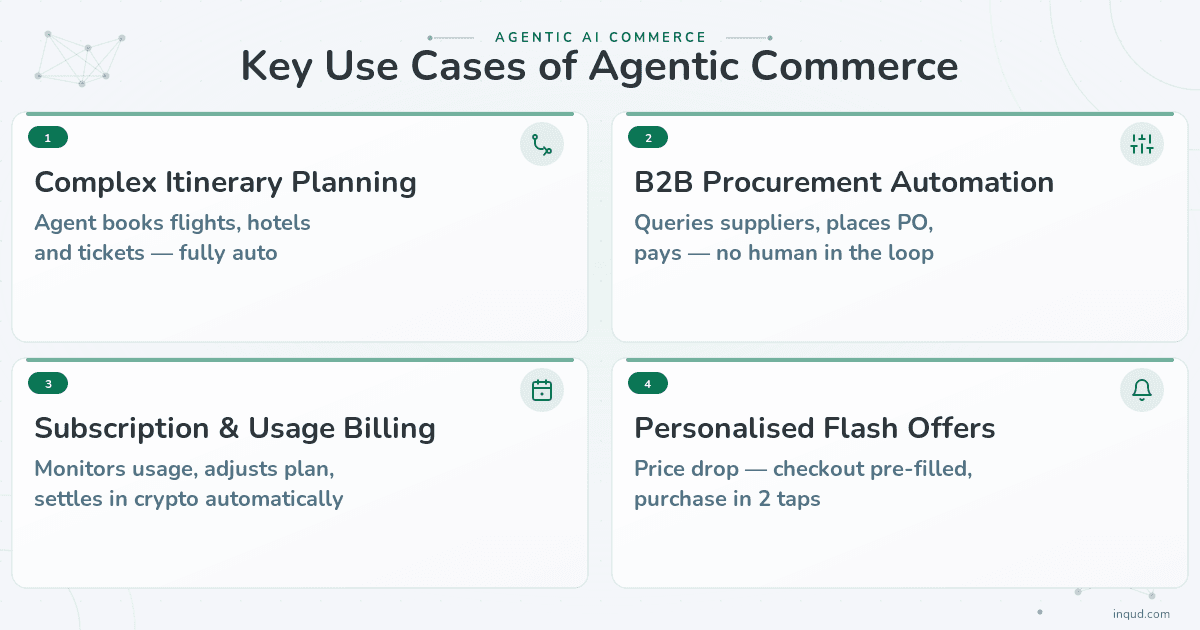
Complex Itinerary Planning
A user gives one instruction: "Plan a budget weekend in Paris for two: flights from Warsaw, hotel with an 8+ rating, Louvre tickets, total under €600."
An agentic system handles everything: searches multiple booking platforms simultaneously, filters hotels by rating and proximity, checks Louvre ticket availability for those dates, cross-references the running total against the budget cap, and either presents a confirmed itinerary or if the user has pre-authorized spending, books it outright.
This isn't hypothetical, current AI systems built on large language models can execute this kind of multi-step task today. What they need from the merchant side: a machine-readable API with live inventory and pricing, and a payment endpoint that accepts programmatic authorization.
B2B Procurement Automation
A logistics company runs low on warehouse labels. Their procurement agent detects stock below the reorder threshold, queries the primary vendor's API for current pricing, compares it against two pre-approved alternatives on lead time and unit cost, generates a purchase order, routes it for approval (or auto-approves if below a set dollar limit), and submits payment.
The vendor's team never interacted with a person because the order arrived in their system automatically.
|
Stage |
Action / Requirement |
Key Benefit / Detail |
|
1. Detection & Sourcing |
Inventory agent checks stock, queries vendor APIs, and compares lead times/costs. |
Data-driven, multi-vendor comparison. |
|
2. Order & Approval |
Generates PO; routes for approval or auto-approves if under dollar limit. |
Zero human interaction needed from the vendor. |
|
3. Infrastructure |
Requires structured product data (SKUs, bulk tiers) and programmable payments. |
Essential for AI-driven eCommerce. |
|
4. Settlement |
Cross-border payments utilize crypto rails (stablecoins). |
Settles in hours instead of 2–3 days; avoids SWIFT fees. |
AI for eCommerce operating in B2B like this requires structured product data (consistent SKUs, bulk pricing tiers, live inventory) and payment methods that work programmatically. Cross-border B2B procurement, in particular, benefits from crypto rails — stablecoin payments settle in hours, not 2–3 business days, and without the opaque correspondent banking fees of a SWIFT transfer.
Subscription and Usage-Based Billing
An AI-powered commerce system managing SaaS subscriptions doesn't blindly charge on a fixed date. It monitors usage data: if a user is below 20% of plan capacity, the agent proactively offers a downgrade before renewal (reducing churn risk). If usage has spiked in the past 14 days, it surfaces an upgrade at the right moment.
|
Usage Scenario |
System Action |
Business Goal |
|
< 20% of plan capacity |
Proactively offers a downgrade before renewal |
Reduces churn risk |
|
Spiked in past 14 days |
Surfaces an upgrade at the right moment |
Maximizes expansion revenue |
Personalized Flash Offer Delivery
An agent monitoring a user's wishlist detects that a tracked item just dropped in price by 22%, with only 4 units remaining. It sends a push notification, holds one unit for 8 minutes, and pre-fills checkout with the user's saved payment method. The user's actual decision window: two taps.
This is agentic AI commerce working as a retention mechanism: collapsing the gap between intent and purchase to near zero, at exactly the moment motivation is highest.
Benefits of Agentic Commerce
The commercial case for building AI commerce infrastructure isn't speculative. Here's where returns show up:
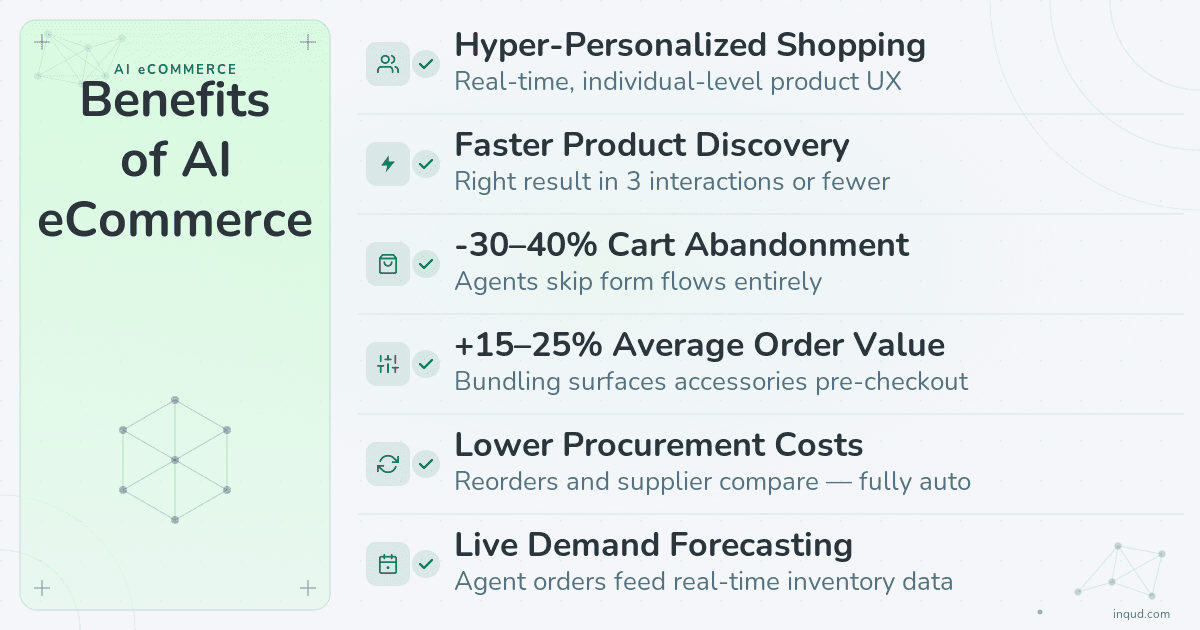
Hyper-Personalized Shopping Experiences
Mass personalization has always been a contradiction. Agentic systems actually deliver on it: every user gets a version of the experience (pricing, product ordering, content) tuned to their specific behavior and active goal. Not their demographic segment. Them. This directly affects average order value and repeat purchase frequency.
Faster Product Discovery
When the search engine understands intent, users don't wade through irrelevant results. AI-based eCommerce that delivers accurate discovery in under three interactions consistently outperforms traditional browse-and-filter flows on conversion. Less time-to-product means less time for the customer to second-guess the purchase.
Reduced Friction in Checkout
Every additional step is a leak. Agentic checkout (pre-authorized credentials, agent-handled form completion) can reduce cart abandonment by 30–40% in early implementations (Bain, 2025). For merchants with complex payment flows (multi-step shipping, address verification, mandatory 3DS), this is the highest-impact optimization currently available.
Higher Cart Values Through Proactive Bundling
Agentic systems don't wait for users to discover that a product pairs well with an accessory. They build bundles proactively, based on actual usage patterns and co-purchase data. Merchants running agent-driven bundling report 15–25% higher average order values compared to standard recommendation widgets.
Lower Operational Cost in Procurement
When agents handle reorder decisions, supplier comparison, and inventory monitoring autonomously, the procurement operations function shrinks or shifts entirely toward strategic sourcing. For B2B businesses with high-volume purchasing, this is a measurable headcount and time saving, not just an efficiency claim.
|
Traditional Procurement |
Autonomous (Agent-Driven) Procurement |
|
High headcount spent on reorders, monitoring, and comparison |
Shift to strategic sourcing with a smaller, focused team |
|
High operational costs and manual time investment |
Measurable time and cost savings via automation |
Demand Forecasting That Actually Learns
AI-powered commerce systems that manage purchasing feed demand signals back into forecasting automatically. The agent placing 500 orders per day has better, more current data on fast-moving SKUs, seasonal demand patterns, and accumulating dead stock than any human buyer operating on weekly reports.
Benefits of Agentic Commerce for Customers
Merchant-side benefits are real but benefits of agentic commerce for customers go further: they change the relationship between consumers and purchasing decisions entirely.
More Relevant Recommendations
Spending an hour browsing a category that yields one useful result is a near-universal frustration. An agentic system that understands the user's context (purchase history, active session behavior, explicit goal) surfaces relevant options in the first few results. Less noise at the top of the funnel means more confidence at the bottom.
Faster Buying Decisions
The cognitive load of online shopping is real: compare specs, check reviews, calculate shipping, evaluate promo timing, decide on size. When an AI agent handles the research phase and presents a pre-vetted shortlist, decision time drops significantly. For repeat purchases of known products, the decision can become near-instantaneous.
Personalized Pricing and Offers
AI commerce enables pricing that reflects a customer's actual value and price sensitivity, not just their tier label. A customer who buys high-margin items consistently might receive a targeted discount on something they've browsed repeatedly but not purchased. A dormant user might see a reactivation offer at exactly the right moment. Both happen automatically, without anyone on the merchant side setting it up manually per user.
Control Without Cognitive Load
Counterintuitively, well-designed agentic systems give users more control, not less. Instead of micromanaging every decision, users set parameters like budget cap, preferred brands, quality floor and delegate execution to the agent. It's structured delegation, not loss of agency.
Reduced Risk of Overpaying
An agent that monitors prices continuously doesn't get tired, doesn't forget to check, and doesn't miss a discount window. Users with AI-powered commerce tools available to them consistently pay less for the same products over time compared to those navigating purchase decisions manually.
Walk through it with our team. We'll walk through settlement speed, fees, and how agentic AI Commerce changes with Inqud in the mix.
How Inqud Helps Businesses Build AI Commerce Solutions
Agentic commerce doesn't run on inspiration, it runs on payment infrastructure that can keep pace with automated, high-frequency, cross-border transactions.
The gap most merchants hit when entering this space: their payment layer was built for humans clicking "confirm." It wasn't designed for agent-initiated transactions, programmatic payment authorization, or multi-currency settlement across jurisdictions, all of which agentic checkout requires.
Inqud's infrastructure is built API-first — which matters directly when the party initiating payment is a software agent:
|
Feature |
Primary Use Case for Agents |
Key Advantage |
|
Crypto Payment API |
Agent-initiated checkout |
Direct REST API access with no human UI required. |
|
Crypto Payment Widget |
Hybrid checkouts (human + agent) |
Embeds crypto acceptance with auto-conversion to stablecoins/fiat. |
|
Recurring Payments |
Autonomous subscription billing |
Handles fixed-plan and on-demand billing without manual action. |
|
Payment Links |
B2B agentic procurement |
Lightweight, URL-based initiation without merchant-side UI. |
|
Fiat-to-Crypto Onramp |
Multi-currency user platforms |
Lets users buy crypto with cards/local methods for agent checkouts. |
Crypto Payment API — Full REST API access to crypto payment processing. An AI agent can call the endpoint directly: create an invoice, poll payment status, trigger settlement. No human-facing UI required in the flow. This is the core building block for agent-initiated checkout.
Crypto Payment Widget — For merchants that still serve human buyers alongside agentic ones, the widget embeds crypto acceptance into any checkout page. Works with programmatic integration. Supports auto-conversion of incoming crypto to stablecoins or fiat, removing volatility risk from the merchant's settlement.
Recurring Crypto Payments — Web3-based subscription billing. When agents manage renewal cycles autonomously, the underlying payment mechanism needs to match. Inqud's recurring solution handles both fixed-plan and on-demand billing in crypto, running without per-cycle manual action.
Payment Links — For B2B agentic scenarios where a procurement agent generates a payment request and routes it to a buyer for settlement, payment links provide a clean, lightweight URL-based initiation method that works without any merchant-side UI integration.
Fiat-to-Crypto Onramp — For platforms serving both crypto-native and fiat users, onramp lets end users buy crypto with cards or local payment methods, connecting directly into an agent-managed crypto checkout.
The future of agentic commerce runs on payment rails that handle cross-border settlement without the 3–5 day delays and non-transparent fees of traditional banking. Stablecoin settlement (USDT or USDC) aligns naturally with the speed and predictability that autonomous purchasing systems need.
Payment infrastructure that requires human steps is a bottleneck for agentic checkout, not a security feature. With Inqud you'll get the direct answer on where crypto payment rails fit your specific agentic commerce stack.
Industries
Web3 payments
Products
Сrypto payment gateway
Tags
Educational, Payment methods
Author
FAQ
FAQ
What is the difference between Generative AI and Agentic AI?
Generative AI produces content when a human prompts it. Agentic AI takes action autonomously: it makes decisions, calls external tools (APIs, databases, browsers), and completes multi-step tasks without waiting for human input at each stage. In ecommerce: generative AI writes a product description; agentic AI places the order.
What industries can benefit from AI commerce?
What is agentic AI commerce relevant for in practice? Any category where purchasing is repetitive, data-driven, or high-volume: B2B procurement, SaaS subscription management, travel and hospitality, iGaming, financial services, and any marketplace where buyers typically compare options before committing.
Can AI agents manage complex B2B procurement?
Yes, and this is one of the strongest near-term applications of AI eCommerce. B2B procurement involves predictable criteria (spec matching, price comparison, lead time), structured data, and recurring orders. These are exactly the kinds of tasks current AI agents handle reliably. The constraint is usually on the merchant side: if your catalog isn't machine-readable and your payment API isn't programmatic, agents struggle to interact with you at all.
How does agentic commerce differ from AI shopping assistants?
AI shopping assistants answer questions and make recommendations, the human still clicks "buy." Agentic commerce completes the purchase autonomously, within parameters the user has pre-approved. The distinction matters for merchants: assistants drive traffic to your site; agents interact with your payment API directly, often without the user ever loading a page.
Is agentic commerce compliant with GDPR and privacy laws?
It depends on implementation. GDPR compliance in AI commerce requires clear user consent for data processing, transparent logic for automated decisions (especially where pricing or personalization is involved), and opt-out rights. None of this is a blocker for AI-based eCommerce, it just needs to be designed in from the start, not retrofitted once the system is live.
What is "Agent-to-Agent" (A2A) commerce?
A2A commerce is what happens when a buyer's AI agent communicates directly with a seller's AI agent — no human interface involved. The buyer's agent requests a quote; the supplier's agent checks inventory and returns a current offer; the buyer's agent accepts or counter-proposes. Protocols for A2A communication (Anthropic's MCP, Google's A2A spec) are developing rapidly, and early B2B implementations are already live.
When will agentic commerce become mainstream?
Narrow applications are already mainstream: B2B reordering systems, hotel revenue management, dynamic pricing in ride-sharing. Broad consumer-facing AI for eCommerce (where a personal agent manages a meaningful share of individual purchasing) is likely 2–4 years from mass adoption. The AI capability exists. The bottleneck is infrastructure: API-first merchants, programmatic payment authorization standards, and consumer trust in autonomous spending within set parameters.


Inqud Solutions for Your Business

Pay in Crypto
Start accepting cryptocurrency payments from customers worldwide

Crypto Checkout Tool
Embed a cryptocurrency payment widget on your website

Subscription Payments
Set up automatic subscription and recurring billing in crypto

Payment link
Create and share payment links for crypto transactions

Fiat-to-Crypto
Enable users to buy crypto with fiat currency seamlessly