


Agentic Payments: How AI Agents Are Transforming Digital Payments
Sep 29, 2026

5 min read
Contents
What Are Agentic Payments?
How Do Agentic Payments Work?
Main Types of Agentic Payment Models
Key Benefits of Agentic Payment Solutions
Security Considerations for Agentic Payments
Real-World Use Cases of Agentic Payments
How Inqud Helps Build Agentic Payment Solutions
The Road Ahead for Agentic Payments
Share
For most of the past decade, "payment automation" meant scheduled transfers and saved card details. Convenient, but still fundamentally human-directed – you set the rules, and the system executes them on cue. Agentic payments are a different animal entirely. Here, an AI agent doesn't just follow a script you wrote last Tuesday. It reads the situation, weighs the options, and completes a transaction on your behalf, sometimes before you even thought to ask.
That shift is happening now, not in some distant fintech future. And for businesses building on payment infrastructure, the implications are significant enough to pay close attention.
What Are Agentic Payments?
Agentic payments are transactions initiated, managed, and completed by AI agents operating with a degree of autonomy granted by the user or business. The AI agent acts as an intermediary between a person (or a system) and the payment infrastructure – it perceives the context, makes a decision about how and when to pay, and executes the transaction through an API.
The definition matters because it's easy to conflate agentic payments with regular automation. A recurring subscription charge isn't agentic, it fires on a fixed date regardless of context. An agentic payment system, by contrast, might delay a supplier payment if it detects a cash flow issue, route a transaction through a different rail to reduce fees, or split a payment across wallets based on current balances. The agent reasons, it doesn't just run.
At the infrastructure level, agentic payments require a few things to work: a reliable payment API that can be called programmatically, clear permission and authorization frameworks so the agent only acts within defined boundaries, and real-time event signaling (typically webhooks) so the agent knows what happened and what to do next.
This is where the connection to crypto payment infrastructure becomes particularly relevant. Blockchain-based rails offer programmable settlement, on-chain logic, and 24/7 availability – properties that map naturally to the needs of AI-driven payment flows. An agent working with a crypto payment gateway doesn't need to wait for a bank batch cycle. It can initiate, confirm, and record a transaction within seconds, at any hour.
How Do Agentic Payments Work?
The mechanics of agentic payments aren't magic, they're a structured sequence of steps, each of which can be designed and controlled. Here's how a typical flow breaks down.
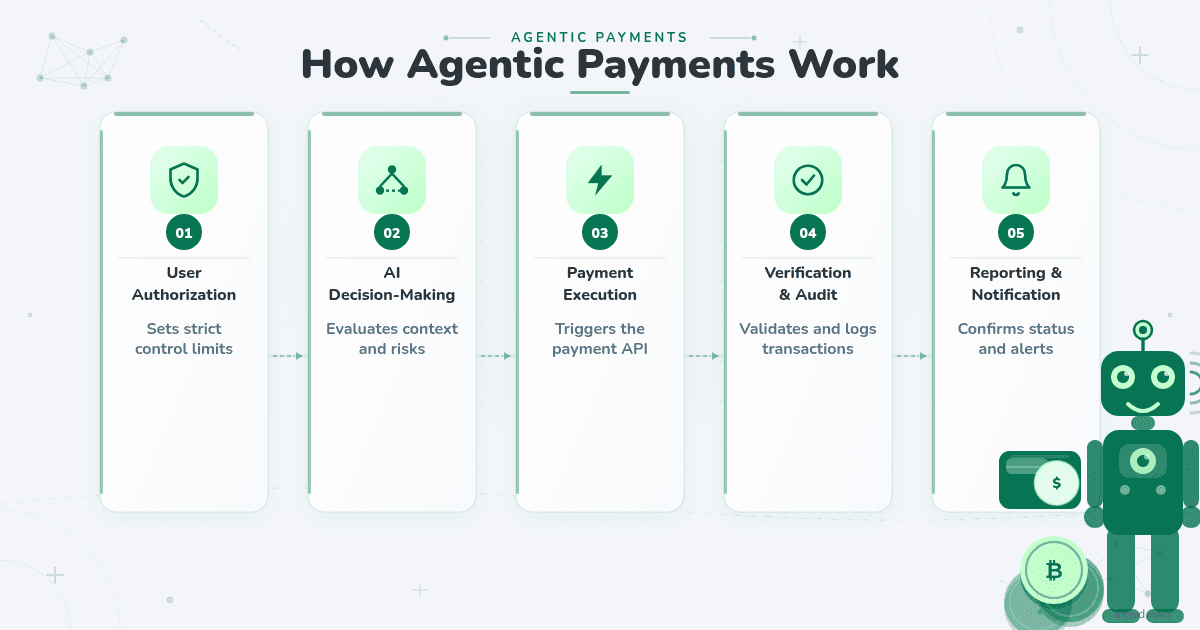
User Authorization
Before an AI agent can touch a payment, it needs explicit permission. This is the single most important design principle in agentic payments, and any serious implementation treats it as non-negotiable.
Authorization defines the scope: what amounts the agent can move, which wallets or accounts it can access, which currencies or tokens it's allowed to use, and under what conditions it can act without additional confirmation. Think of it as a standing instruction set, not a blank check.
In practice, this step usually happens at onboarding: the user or business administrator configures the agent's mandate through a dashboard or API call, and that configuration is stored and enforced at the platform level.
AI Decision-Making
With permissions in place, the agent starts doing what it's actually built for: evaluating context and choosing a course of action.
This can range from simple rule-based logic ("pay this invoice when it's due") to more sophisticated reasoning that factors in multiple variables at once – current liquidity, exchange rates, available payment rails, risk signals, counterparty history. The more complex the business process, the more valuable this layer becomes.
A well-designed AI decision layer will also know when not to act. If conditions fall outside its authorized scope, it should flag the situation for human review rather than improvise. That guardrail matters enormously for compliance and trust.
Payment Execution
Once the agent has made its decision, it calls the payment API. This is where the underlying payment infrastructure does the heavy lifting: routing the transaction, handling currency conversion if needed, applying compliance checks, and broadcasting to the relevant network.
The quality of the API matters here. Agents need responses they can act on – clear status codes, structured error messages, real-time confirmation. An API that returns ambiguous states forces the agent to make assumptions, which is exactly what you don't want in a payment context.
Verification and Fraud Checks
After execution, the transaction is verified. In a crypto context, this typically means waiting for the required number of block confirmations. For fiat-adjacent flows, it might involve reconciliation against an expected amount or a KYT (Know Your Transaction) check.
Agentic systems should log this step in detail. Every decision the agent made, every API call it placed, every confirmation it received – all of it should be auditable. Regulators expect it because good product design demands it.
Reporting and Notification
The final step is closing the loop. The agent sends a notification (via webhook, email, or in-app event) confirming what happened, and logs the transaction in the relevant system of record. If something went wrong, it escalates to the appropriate person.
This reporting layer is often underrated in early implementations, but it's what makes agentic payments trustworthy at scale. A business running hundreds of automated transactions a day needs to know, at a glance, that everything settled correctly and to know fast when it didn't.
Main Types of Agentic Payment Models
Not all agentic payment systems work the same way. The level of autonomy, the decision-making complexity, and the human oversight required vary significantly depending on the use case. Here are the four models you're most likely to encounter.
|
Model |
Who Initiates |
Autonomy Level |
Typical Use Case |
|
Autonomous Agent |
AI acts independently within set rules |
High |
Invoice processing, scheduled B2B settlements |
|
Delegated Agent |
AI acts on explicit per-interaction user request |
Medium |
Shopping assistants, expense approvals |
|
Embedded Agent |
AI is invisible, built into a platform flow |
Medium-High |
In-app checkout, gaming rewards, marketplace payouts |
|
Multi-Agent System |
Network of AI agents coordinating |
High |
Complex supply chain payments, cross-border treasury |
Autonomous Agents
These agents operate largely on their own within a predefined mandate. A procurement system that automatically pays verified supplier invoices below a certain threshold is a good example. The human sets the rules upfront, the agent handles the execution indefinitely until the rules change.
The risk here is scope creep because what happens when an invoice comes in that's slightly outside the defined parameters? Good autonomous agent design includes explicit fallback logic for edge cases, not just a happy path.
Delegated Agents
Delegated agents require a trigger which is typically a user request in natural language or a specific action in an interface. A user types "pay the freelancer invoice from last week" into an AI assistant, and the agent identifies the correct invoice, confirms the amount, and processes the payment. The human is involved, but not doing the mechanical work.
This model is growing quickly in consumer fintech and enterprise expense management, where the goal is to reduce friction without removing human intent from the equation.
Embedded Agents
Here the AI is invisible by design. The user checks out on a marketplace, and an embedded agent silently selects the optimal payment method, applies available discounts, and routes the transaction, all in milliseconds. The user just sees "payment successful."
Embedded agents are already common in iGaming and e-commerce, where speed and conversion rates matter enormously. The agent's job is to remove every possible point of hesitation between the user and the completed transaction.
Multi-Agent Systems
The most complex configuration. Multiple AI agents (each responsible for a different part of a business process) communicate with each other to coordinate payments across departments, entities, or even organizations. A procurement agent might negotiate terms, a finance agent might approve the spend, and a payment agent might execute the transfer, all without a human touching any individual step.
Multi-agent systems are still early in real-world deployment, but they're the logical endpoint of the agentic payments trajectory for large enterprises.
Key Benefits of Agentic Payment Solutions
The business case for agentic payments is practical, not philosophical. Here's where the actual gains show up.
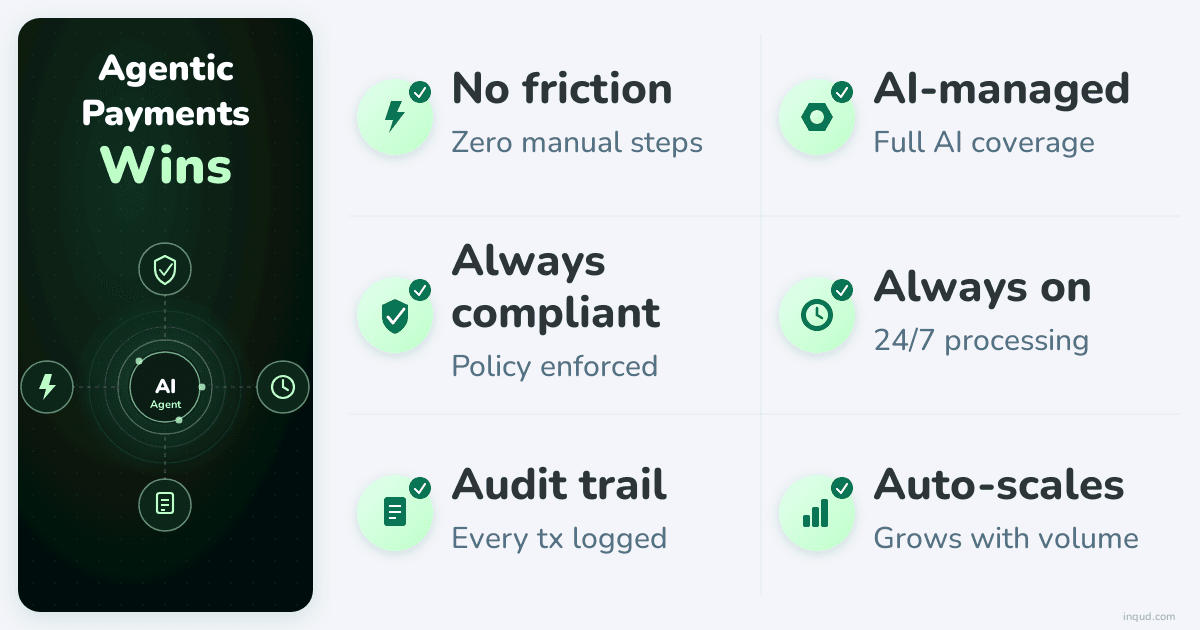
Faster Checkout Processes
Manual payment flows have friction built in at every step – form fields, authentication prompts, confirmation clicks. Agentic systems can collapse that process to near zero for returning users or authorized flows. In high-volume contexts like gaming platforms or subscription businesses, the cumulative effect on revenue is measurable.
Research from Baymard Institute consistently shows that checkout friction is one of the primary drivers of cart abandonment. Removing the human from repetitive payment steps doesn't just save time because it directly affects conversion.
Reduced Operational Costs
Finance teams spend a disproportionate amount of time on tasks that are fundamentally mechanical: matching invoices to payments, chasing approvals, reconciling accounts. Agentic systems handle all of this without headcount. For a business processing thousands of transactions per month, that's a meaningful reduction in operational overhead.
It's also worth noting the error cost. Manual payment processing introduces mistakes like wrong amounts, duplicate transfers, missed due dates. Automated agents, operating within a well-defined rule set, make far fewer of these errors. The cost of a single significant payment error often exceeds the cost of implementing an agentic system.
Consistent Compliance Coverage
AI agents apply compliance rules uniformly, without the variability that comes from human judgment or fatigue. Every transaction gets the same AML screening, the same KYT check, the same documentation. For businesses operating in regulated environments, particularly in EU markets under MiCA and AML6, that consistency is valuable both operationally and as evidence of a functioning compliance program.
24/7 Availability Without Staffing Costs
Payment needs don't follow business hours, especially for businesses operating across time zones or serving global customer bases. An AI agent will process a payment at 3am on a Sunday the same way it does at 11am on a Tuesday. No overtime, no delays, no "we'll sort it Monday."
This is particularly relevant for accepting crypto payment flows, where the underlying networks operate continuously and counterparties may be anywhere in the world.
Fewer Reconciliation Issues
One of the least glamorous but most painful parts of financial operations is reconciliation, making sure what the system says actually matches what the bank or blockchain shows. Agentic systems that log every decision and API call create a built-in audit trail that makes reconciliation dramatically faster and more reliable.
The infrastructure underneath is where agentic payment systems hit problems — not the AI layer. Book a 25-min technical review and we'll map our API against your agent flow: what decisions it needs to make, what responses it needs to handle, where we fit and where we wouldn't.
Security Considerations for Agentic Payments
The benefits are real, but agentic payments introduce security and compliance questions that need to be addressed before deployment. Ignoring these doesn't make them go away, it just means you discover them at the worst possible moment.
|
Risk |
Description |
Practical Mitigation |
|
Unauthorized scope |
Agent acts beyond its mandate |
Strict permission scoping at the API level; hard limits on amounts and asset types |
|
Compromised agent |
Agent is manipulated by malicious input |
Input validation, sandboxed execution environments, anomaly detection |
|
Data exposure |
Payment credentials or transaction data leaked |
End-to-end encryption, minimal data retention, secrets management |
|
Regulatory non-compliance |
Agent takes actions that violate AML/KYC rules |
Licensed payment rails, real-time KYT screening on all transactions |
|
Accountability gaps |
Unclear who is responsible when an agent makes a wrong decision |
Full audit logs, human escalation protocols, defined liability frameworks |
The authorization model deserves special attention. A common mistake in early agentic payment designs is treating authorization as a one-time event: you get the user's permission once, then give the agent free rein. A better approach is granular, revocable permissions that are re-evaluated regularly and can be adjusted as business needs change.
From a regulatory standpoint, the EU's evolving framework around AI systems (the AI Act, MiCA, PSD3) will increasingly require businesses to demonstrate that their AI-driven financial processes are auditable and controllable. Building that capability in from the start is significantly cheaper than retrofitting it later.
Real-World Use Cases of Agentic Payments
The following examples illustrate where agentic payments are already creating tangible value, and where the growth is happening fastest.
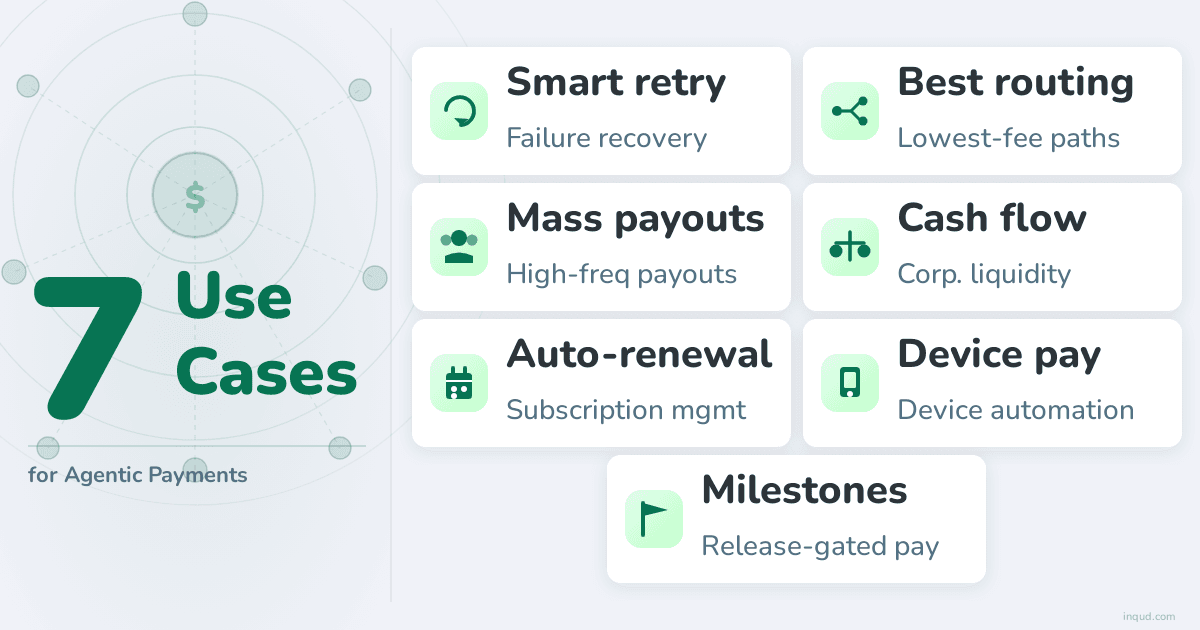
Subscription Management with Smart Retries
Subscription businesses deal with a persistent problem: failed payments. A card expires, a balance runs low, a bank blocks an unfamiliar charge. Traditional systems retry at fixed intervals and eventually churn the customer. An agentic system can do better, it identifies the failure reason, selects an alternative payment method if one is available (crypto wallet, a different card, a bank transfer), and retries at the moment most likely to succeed. Some businesses report meaningful reductions in involuntary churn using this approach alone.
Cross-Border B2B Settlements
International supplier payments are slow, expensive, and opaque through traditional banking rails. An agentic payment system can evaluate the available options in real time (SWIFT, stablecoins, local payment networks) and route the transaction through the most efficient path, subject to the business's defined parameters. The agent doesn't need a finance manager to make that call for every transaction.
iGaming and Marketplace Payouts
High-frequency payout environments (gaming platforms, creator marketplaces, gig economy apps) need to move money fast, at scale, at all hours. Agentic payment systems are a natural fit. The agent handles individual payout decisions within defined limits, escalates unusual requests for human review, and maintains a complete transaction log throughout.
Treasury and Cash Management
For larger businesses managing multiple accounts and currencies, an agentic treasury layer can continuously optimize where funds sit, moving balances between accounts based on interest rates, upcoming payment obligations, and liquidity forecasts. This is the domain where multi-agent systems start to show their value – the complexity is high enough that manual management becomes genuinely impractical.
How Inqud Helps Build Agentic Payment Solutions
Building agentic payment flows requires more than a capable AI layer because you need payment infrastructure that was designed to be called programmatically, behaves predictably under load, and operates within a compliance framework that holds up to regulatory scrutiny.
Inqud provides the payment infrastructure layer for businesses building AI-driven financial products. The platform is built around an API that gives developers full control over payment flows (OTC desk transactions, checking statuses, managing wallets, and handling settlement) without needing to navigate a proprietary dashboard for every operation.
API-first architecture
Every function available in Inqud's merchant dashboard is also available via API. That means an AI agent can do anything a human operator can do, within the permissions it's been granted. Transaction initiation, status polling, refund triggering, balance checks – all of it is accessible programmatically with consistent response structures that agents can parse reliably.
Webhook infrastructure for real-time event handling
Agentic systems need to know what happened immediately, not when they next check. Inqud's webhook system delivers real-time event notifications for recurring payments confirmations, failures, and status changes, giving agents the signals they need to make their next decision without delay.
Multi-currency and crypto support
Agentic payment flows often need to work across currencies and rails. Through a convenient crypto widget Inqud supports major cryptocurrencies alongside fiat conversion, with auto-conversion options that let businesses settle in their preferred currency regardless of what the counterparty sends.
Sandbox environment for development and testing
Building and testing agentic payment logic requires a safe environment to experiment without touching real funds. Inqud's sandbox replicates production behavior, so the agent can be tested against realistic payment scenarios before going live.
|
Inqud Capability |
Why It Matters for Agentic Payments |
|
REST API with full coverage |
Agents can programmatically control every aspect of payment flow |
|
Real-time webhooks |
Agents get instant event signals to trigger next actions |
|
Multi-currency + crypto support |
Agents can route across rails and currencies based on conditions |
|
Sandbox environment |
Safe space to build and test agentic logic before production |
|
Auto-conversion |
Agents can settle in any supported currency without manual conversion |
For businesses that want to move quickly or set up mass payouts with payment links, Inqud also offers integration documentation and technical onboarding support, so development teams can get agentic payment flows working without having to reverse-engineer API behavior from sparse documentation.
Skip the evaluation spreadsheet. Send us your agent architecture — what decisions it makes, what APIs it calls, what currencies you need — and we'll set up sandbox access within 1 business day. 4-hour reply.
The Road Ahead for Agentic Payments
A few years ago, the phrase "AI agent" in a payments context would have drawn blank looks from most fintech practitioners. Today, it's a genuine product category with real implementations and real money moving through them.
The trajectory is clear enough: as large language models and autonomous AI systems become more capable and more trusted, the scope of what AI agents are permitted to do with money will expand. Spending limits will increase. The types of decisions agents can make without human confirmation will broaden. The infrastructure they rely on will need to keep up.
For businesses building now, the competitive advantage isn't in waiting to see how the technology matures – it's in understanding what agentic payment systems actually require at the infrastructure level, and building on rails that support those requirements from day one.
That means programmable APIs, real-time event systems, multi-currency capability, and a compliance framework that doesn't require constant manual intervention. The AI layer is increasingly the easy part, the payment infrastructure underneath it is where the complexity lives.
If you're building agentic payment flows now — talk to our team. 25-min technical call, sandbox keys within 1 business day, custom pricing on your volume.
Industries
Web3 payments
Products
Сrypto payment gateway
Tags
Educational, Payment methods
Author
FAQ
FAQ
What is an agentic payment?
An agentic payment is a transaction initiated and completed by an AI agent on behalf of a user or business, operating within a defined permission scope. Unlike scheduled payments or simple automation, an agentic payment involves real-time decision-making where the agent evaluates conditions and chooses how to act, rather than following a fixed script.
What are the key benefits of agentic payment solutions?
The main benefits are speed (agents process payments without manual steps), cost reduction (fewer staff hours on routine payment tasks), consistency (compliance rules applied uniformly), and 24/7 availability. For high-volume businesses, the cumulative impact on operational efficiency can be significant.
How do AI agents handle payment authorization?
Authorization happens at setup, not at the moment of each transaction. Users or administrators define a mandate – the amounts the agent can move, the accounts it can access, the conditions under which it can act. The agent operates within those limits; anything outside the scope triggers an escalation to a human.
Are agentic payments secure?
They can be, if designed correctly. The key risk factors are overly broad permissions, weak input validation, and inadequate audit logging. Well-designed agentic systems use granular, revocable permissions, run in sandboxed environments, and maintain complete records of every decision and API call for auditability.
What infrastructure do agentic payments require?
At minimum: a programmable payment API with reliable, structured responses; a real-time event notification system (webhooks); multi-currency support if operating across markets; and compliance tooling (KYT, AML screening) either at the payment infrastructure level or integrated separately.
How does Inqud support agentic payment integrations?
Inqud provides an API with full coverage of payment functions, real-time webhooks, multi-currency and crypto onramp support, and compliance infrastructure. Developers can integrate Inqud as the payment layer beneath an agentic system, with all compliance and settlement handled at the infrastructure level.

Inqud Solutions for Your Business

Accept Digital Assets
Start accepting cryptocurrency payments from customers worldwide

Crypto widget
Embed a cryptocurrency payment widget on your website

Subscription Billing
Set up automatic subscription and recurring billing in crypto

Link-Based Payment
Create and share payment links for crypto transactions

Fiat Onramp
Enable users to buy crypto with fiat currency seamlessly