

B2B Crypto Payments Integration: A Complete Guide
Apr 29, 2026

5 min read
Contents
Why Businesses Are Integrating Crypto Payments
Benefits of Cryptocurrency in Business
Common B2B Use Cases for Crypto Payments
How B2B Crypto Payments Work
A Step-by-Step Guide to Integrating Crypto Payments
How Inqud Supports B2B Crypto Payments Integration
Wrapping It Up
Share
Moving money from point A to point B used to be a simple game of banks and wires but nowadays, the game has changed. For many business owners, the word "blockchain" still sounds like something new. However, digital assets are proving to be much more than a hobby for tech enthusiasts – they are becoming a vital tool for trade.
The Inqud team spends every day looking at how value travels across the globe. Because we want to make this transition easier for you, our experts put together this B2B crypto payments integration guide to help you navigate the new financial landscape.
Wondering how this looks for your own transaction volume? Talk to the Inqud team and we'll run the numbers together.
Why Businesses Are Integrating Crypto Payments
The pressure to adapt is real: if you look at the numbers, you will see a massive shift in how companies think about their treasury. According to a study by Deloitte, roughly 85% of merchants in the US see accepting digital currency payments as the way of attracting new customers. They understand that the old ways are getting slower and more expensive. When you send a traditional international wire, you often lose a chunk of change to "intermediary banks" that you didn't even know existed.
Adding crypto payments for business is a way to skip those middleman fees. It gives you a direct line to your partners and customers. Aside from the cost, there is the matter of speed. Waiting three to five business days for a payment to clear is a long time in the fast-paced world of startups. With modern solutions, you get your funds fast, and you can put them to work immediately.
Rarely do we see a technology that levels the playing field so effectively. Small companies can now trade globally just as easily as the giants. You no longer need a massive legal team to set up bank accounts in every country where you do business. Instead, you can integrate crypto payments and start accepting value from anyone with an internet connection. It is about removing the friction that stops companies from growing.
Traditional Banking vs. crypto for B2B
|
Feature |
Traditional bank wire |
B2B crypto payment |
|
Transfer speed |
3–5 Business days |
Minutes to hours |
|
Average fees |
3% – 5% + Fixed costs |
Often under 1% |
|
Availability |
Bank hours only |
24/7/365 |
|
Settlement |
Reversible/High risk |
Final and secure |
Benefits of Cryptocurrency in Business
When we talk about the benefits of cryptocurrency in business, people often focus on the price of Bitcoin. But the real value lies in the infrastructure.
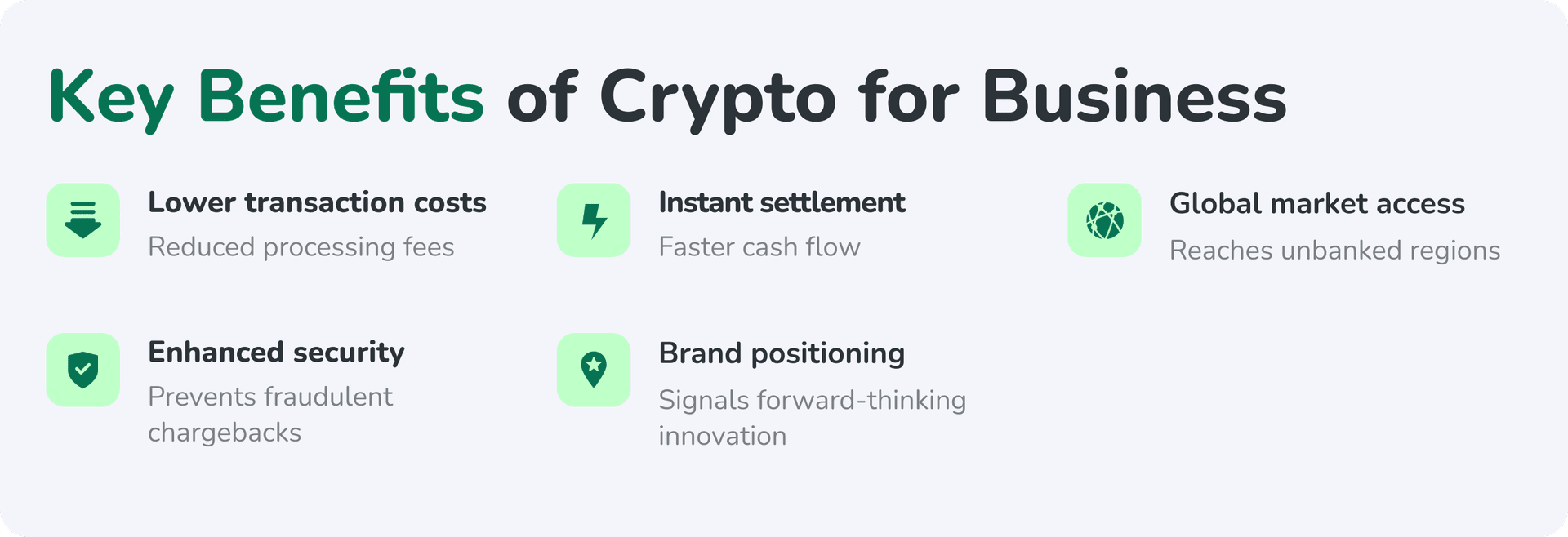
Lower transaction costs
Every time you swipe a card or send a wire, someone is taking a bite out of your profit. For a business with thin margins, these fees can be the difference between a good year and a bad one. Digital assets operate on decentralized networks, which means the overhead is much lower. You pay a small fee to the network miners or validators, and that is usually it.
Instant settlement
In the standard financial world, "paid" doesn't always mean the money is yours. It can take days for funds to actually settle in your account. With blockchain technology, once a transaction is confirmed, it is final. This helps your cash flow immensely. You don't have to worry about the money "disappearing" because a bank decided to hold it for a week.
Global market access
The internet made it easy to find customers in Japan or Brazil, but the banking system didn't keep up. Many regions are still "unbanked" or difficult to reach with standard wires. By using crypto payments for business, you open your doors to the entire world. You can accept crypto with ease from a client in any corner of the globe without worrying about currency pairs or local banking holidays.
Enhanced security and privacy
Credit card chargebacks can be a nightmare for B2B companies. When you use crypto, the customer must authorize the transaction with their private key. There is no "pulling" of funds, only "pushing." This means you don't have to store sensitive credit card numbers that hackers love to steal.
Brand positioning
Showing your clients that you understand modern finance says something about your company. It suggests that you are forward-thinking and ready for the future. For many partners, the benefits of cryptocurrency in business include the ability to work with a vendor that is technically proficient, it builds a different kind of trust.
Lower fees, instant settlement, global reach without new bank accounts in each country — tell us which of these is your primary bottleneck. We'll show how B2B crypto payments address it for your specific volume and corridors. 25-min call, 4-hour reply.
Insight: The stability secret
Many businesses worry about volatility. A simple trick is to use stablecoins like USDT or USDC. These are pegged to the dollar, so you get the speed of crypto without the price swings. It is the smartest way to start if you are risk-averse.
Common B2B Use Cases for Crypto Payments
Where does this fit in your day-to-day operations? It isn't just for buying coffee.
International supplier payments
If you buy parts from a factory in Asia, you know the headache of currency conversion. By using a crypto widget or a direct wallet transfer, you can pay in a universal currency. This saves both you and the supplier a lot of money on exchange rates.
Remote team payroll
Hiring globally is the new norm. Paying someone in a different country can be a logistical mess. Sending digital assets directly to their wallet is often faster and cheaper for them to receive. They can then use an onramp-offramp service to get their local currency if they need it.
High-value asset purchases
For large B2B transactions, like buying machinery or bulk inventory, bank limits can be a hurdle. Blockchains don't care if you are sending ten dollars or ten million. As long as the network fee is paid, the transaction goes through.
SaaS and subscription services
Software companies are finding that many of their users prefer to pay with digital assets. Setting up recurring crypto payments allows these businesses to automate their billing while tapping into a tech-savvy customer base.
Professional service fees
Lawyers, consultants, and marketing agencies are increasingly accepting digital assets. It simplifies the billing process for international clients. Instead of sending a complicated invoice with IBAN and SWIFT codes, you just send a payment link for crypto and get paid in minutes.
Top industries using B2B crypto
|
Industry |
Primary use case |
Preferred asset |
|
IT services |
Global payroll |
Stablecoins (USDC/USDT) |
|
Manufacturing |
Supply chain |
Bitcoin (BTC) |
|
E-commerce |
Merchant settlement |
Ethereum (ETH) |
|
Logistics |
Cross-border fees |
Stablecoins |
If B2B crypto payments integration is a live question for your business, get in touch with our team; we'll show you what changes with a crypto payment gateway in the mix.
How B2B Crypto Payments Work
You don't need to be a coder to understand the flow, it is quite logical once you see it in action.
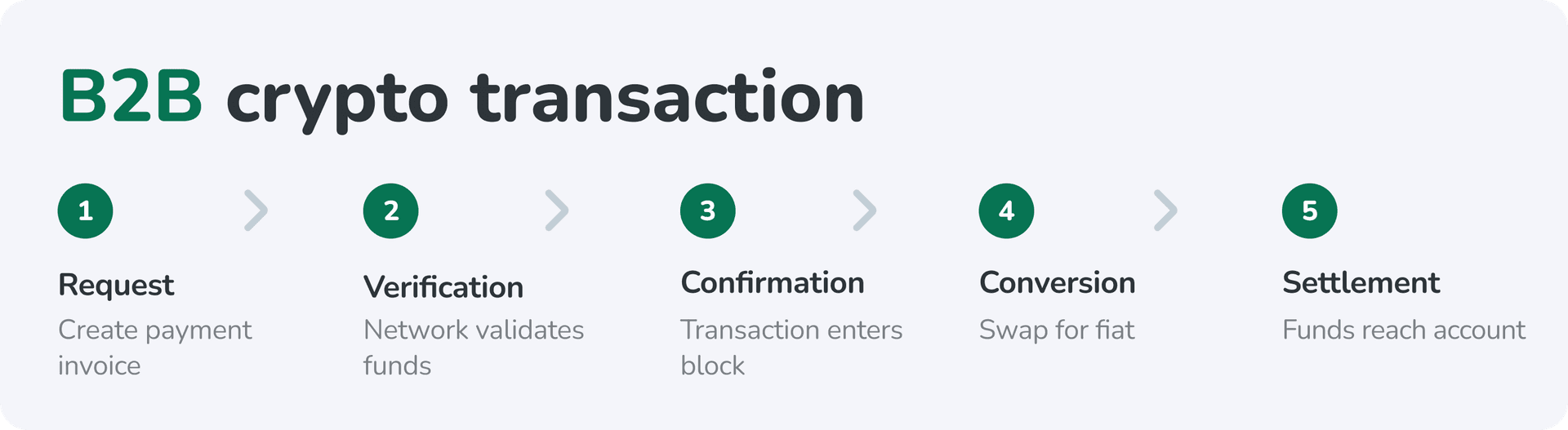
Request
First, you create an invoice or a payment request. This includes the amount and the type of currency you want. You provide the payer with a wallet address, which is just a long string of letters and numbers, or a QR code.
Verification
The payer sends the funds from their wallet. The transaction is broadcast to the network. Here, thousands of computers check that the payer actually has the money. No single person is in charge, which makes it very hard to cheat.
Confirmation
Once the network agrees the transaction is valid, it gets added to a "block." Depending on the blockchain, this can take a few seconds or a few minutes. Most businesses wait for a couple of confirmations to be 100% sure the money is locked in.
Conversion
If you don't want to keep the crypto, you can have it converted to fiat (like USD or EUR) immediately. This happens through your provider. It protects you from any price drops that might happen later in the day.
Settlement
The final step is moving that value into your main business account. Whether you keep it in a digital wallet or move it to a bank, the process is now complete. You have successfully navigated B2B crypto payments integration.
Insight: The "gas" tip
Always check the network fees, often called "gas." Some blockchains are very cheap, while others can be pricey during busy hours. Choosing the right network for your transaction size can save you hundreds of dollars over time.
A Step-by-Step Guide to Integrating Crypto Payments
Ready to get started? Follow these steps to integrate crypto payments into your existing workflow.
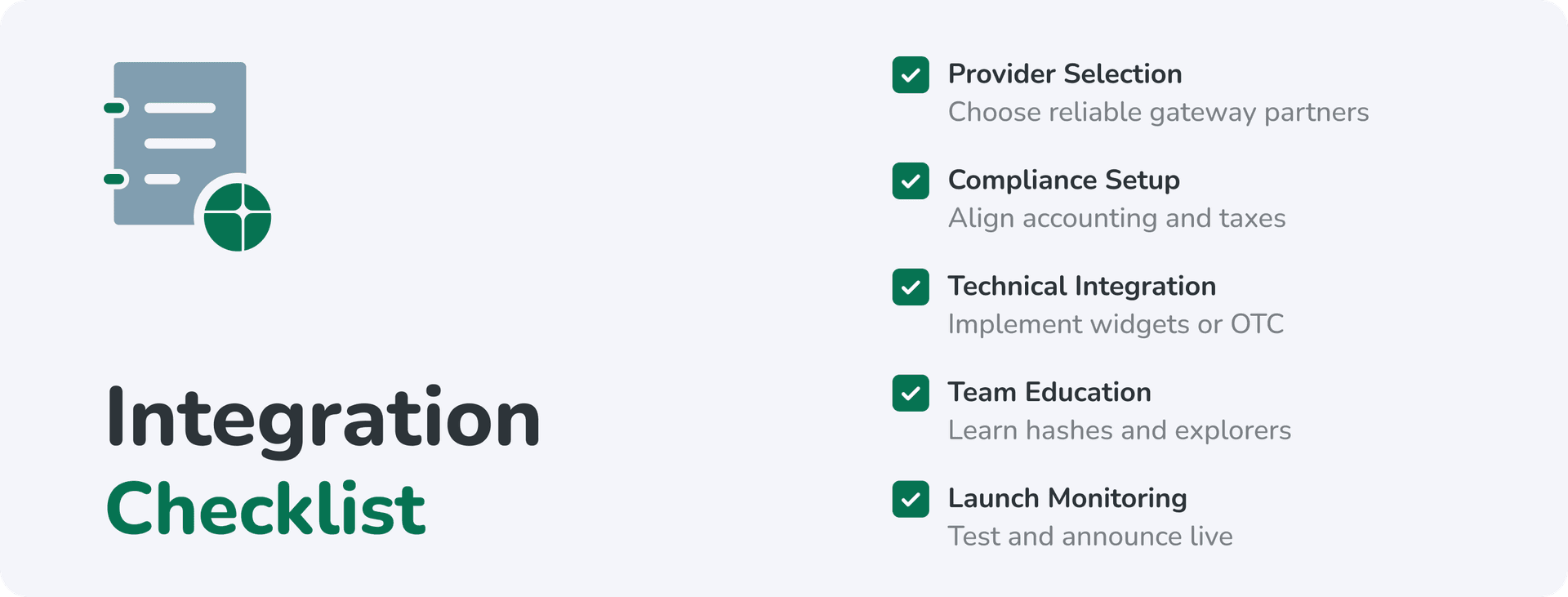
Choose a reliable provider
You need a partner that understands the legal and technical side. Look for a team that offers a solid crypto payment gateway and business solutions. You want someone who provides a dashboard, reporting tools, and clear documentation.
Set up your compliance
Before you take your first payment, make sure your accounting team is on board. You will need to track these transactions for tax purposes. Most good platforms provide exports that plug right into software like QuickBooks or Xero.
Technical implementation
Decide how you want to collect the money. You might want a crypto widget on your website for small sales. For larger B2B deals, you might prefer an OTC desk for crypto settlements to handle big volumes without moving the market price.
Train your team
Your sales and finance teams need to know how to verify a payment. They should understand what a "hash" is and how to check a block explorer. It isn't hard, but a little bit of education goes a long way in preventing mistakes.
Go live and monitor
Start with a few test transactions. Send a small amount to make sure everything lands where it should. Once you are comfortable, announce it to your clients. You might be surprised by how many of them have been waiting for this option.
Integration timeline is ~1 week for most teams. Book a 25-min technical call — we'll walk through the checklist above with your dev lead, identify blockers upfront, and set up sandbox access the same day. 4 business hours to first reply.
Integration timeline
|
Step |
Time estimate |
Complexity |
|
Provider selection |
1–2 Days |
Low |
|
Compliance setup |
3–5 Days |
Medium |
|
Tech integration |
2–7 Days |
Medium/High |
|
Team training |
1 Day |
Low |
|
Total |
~1 Week |
Manageable |
Ready to see the numbers for your own business? Book a quick call with our payments team — 25 minutes, real figures for B2B crypto payments integration.
How Inqud Supports B2B Crypto Payments Integration
We know that every business is unique. A small agency has different needs than a large logistics firm. That is why the Inqud team has built a variety of tools to fit different styles of work. If you need a physical presence, we can even help you set up a crypto POS terminal for your office or storefront.
Our platform is designed to handle the heavy lifting of B2B crypto payments integration. We provide the infrastructure so you don't have to build it from scratch. We also understand that sometimes you need to move large amounts of capital.
For those moments, Inqud provides a personalized service that ensures you get the best rates with total privacy. We are here to make sure that B2B crypto payments integration is a growth driver for you, not a technical burden.
Sandbox keys within 1 business day. Custom pricing based on your volume, written setup guide for your dev team, and a dedicated point of contact from day one. 4 business hours to first reply.
Insight: The multi-sig lifehack
For business accounts, never use a wallet that only one person can access. Use "multi-signature" setups. This means two or three people must approve a move of funds. It prevents internal theft and ensures the money is safe even if one person loses their password.
Wrapping It Up
The world of finance isn't going back to the way it was. Digital assets are here to stay, and the companies that embrace them early will have a significant advantage.
The Inqud team will be glad to assist you in this journey. We want to see your business thrive in this new era. If you have questions about how to get started or which tools are right for your specific model, don't hesitate to reach out. The future of money is digital, and we are excited to help you lead the way.
By taking the time to integrate crypto payments now, you are setting your company up for success for years to come. It might feel like a big leap, but with the right partner and the right information, it is actually a very smooth walk.
Industries
Web3 payments
Products
Crypto widget, Сrypto payment gateway, OTC desk
Tags
Payment methods, Payment methods
Author
Inqud Solutions for Your Business

Pay in Crypto
Start accepting cryptocurrency payments from customers worldwide

Crypto Checkout Tool
Embed a cryptocurrency payment widget on your website

Auto Payments
Set up automatic subscription and recurring billing in crypto

One-Click Payment Link
Create and share payment links for crypto transactions

Onramp
Enable users to buy crypto with fiat currency seamlessly