


How Fintech Is Transforming Business Payments
Apr 23, 2026

5 min read
Contents
What Is the B2B Payments Landscape?
How B2B Payments Differ from Consumer Payments
The Current State of the B2B Payments Market
The Role of Fintech in Modern B2B Payments
B2B Payments Automation
B2B Marketplace Payments
Key B2B Fintech Trends
Crypto Assets in B2B Payments
Why the Inqud Team is Your Best Bet
Bringing It All Together
Share
Sending money to a friend for pizza is easy. You open an app, tap a button, and the job is done. But when a company needs to pay a supplier for ten tons of steel or a year of cloud hosting, things usually get messy. For a long time, business payments felt like they were stuck in the era of fax machines and floppy disks.
The Inqud team noticed that many founders and financial officers spend way too much time chasing paper trails instead of growing their brands. Because we want to make your life easier, our team wrote this guide to help you navigate the new world of moving money. We believe that professional tools should be as simple as the ones you use at home.
What Is the B2B Payments Landscape?
When we talk about the B2B payments landscape, we are looking at the massive network of how companies exchange value and how payment processing providers make it convenient and easy to manage. It is a world filled with invoices, wire transfers, and credit terms. Unlike buying a coffee, these transactions involve multiple steps of approval. One person orders the service, another approves the cost, and a third person actually hits the "send" button. This landscape is currently shifting away from traditional bank checks and moving toward digital-first platforms.
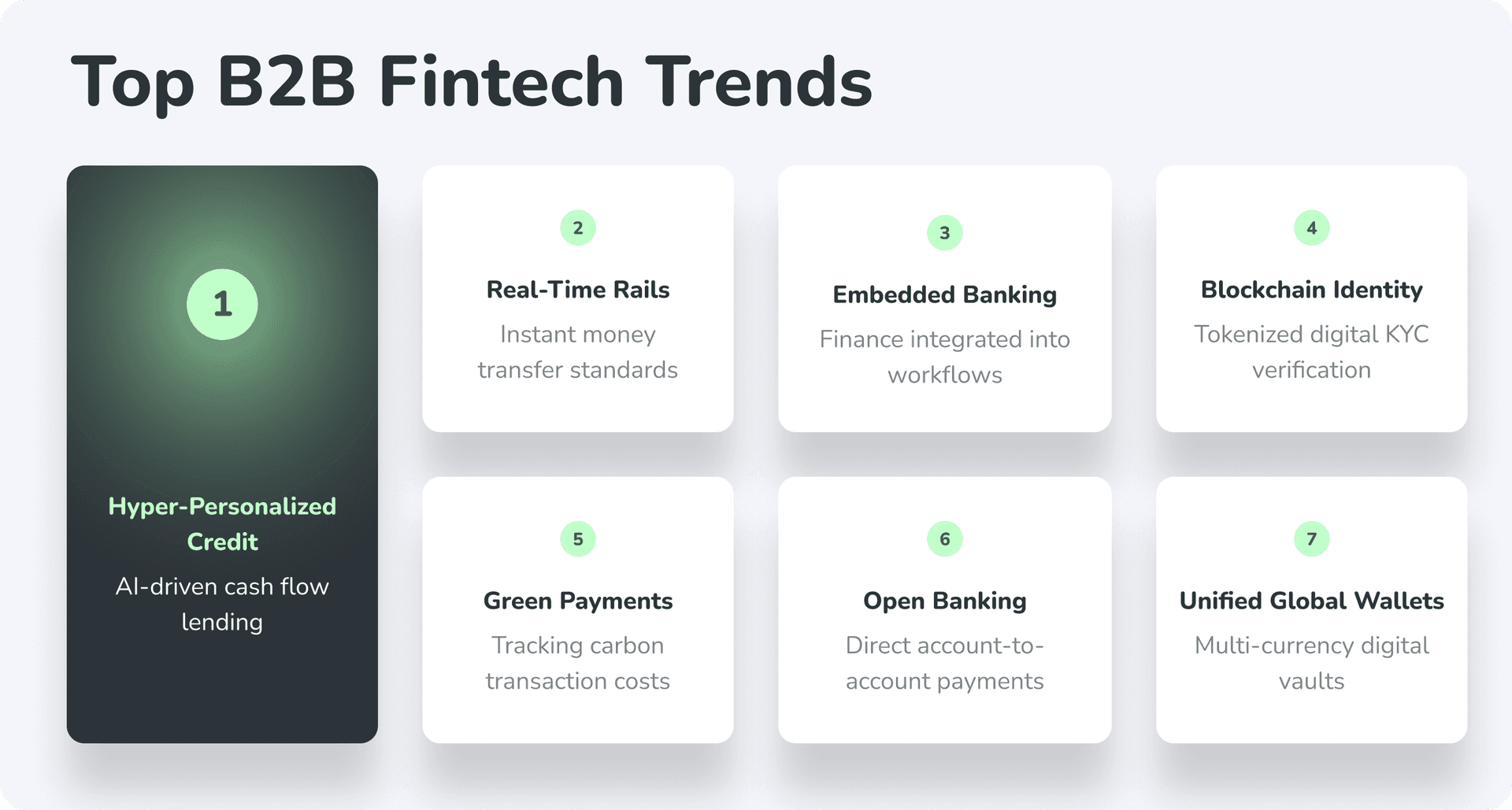
Historically, this space was slow and expensive. You had to worry about "days sales outstanding," which is just a fancy way of saying how long it takes for you to actually get your cash. Recent data shows that the global B2B payment volume is expected to hit over $200 trillion by 2028, according to Juniper Research. That is a lot of zeros. Managing this requires more than just a bank account. It requires a crypto payment gateway and business solutions that can handle the speed of modern trade.
Evolution of the B2B payments landscape
|
Era |
Primary method |
Speed |
Main pain point |
|
The "Old School" |
Paper checks |
7–10 days |
Lost mail & manual errors |
|
The Digital Shift |
Basic wire transfers |
3–5 days |
High fees & opaque tracking |
|
The Modern Era |
Fintech & blockchain |
Real-time |
Integration complexity |
How B2B Payments Differ from Consumer Payments
Why can’t we just use Venmo for everything? Well, business payments have layers of complexity that consumer payments lack. First, there is the volume. A person might spend $50, and a business might spend $500,000. Large sums mean banks and regulators watch much more closely. You have to prove where the money came from and where it is going. This is where you might need to accept crypto with ease while still staying on the right side of the law.
Then there are the terms. Most people pay for things instantly. Businesses, however, love "Net 30" or "Net 60" agreements. This means they get the goods now but pay in thirty or sixty days. Managing these delayed payments requires a lot of bookkeeping. If the system fails, the whole supply chain breaks. A simple error in an invoice number can stop a multi-million dollar shipment. Consumers don't have to deal with tax withholding or specialized accounting codes, but for a CFO, these are daily realities.
Insight: The trust factor
In the consumer world, the brand provides trust. In B2B, the payment system provides the trust. If your payment method is sketchy, your partners will worry about your company's stability. Using a professional, transparent system is a signal of your business health.
The Current State of the B2B Payments Market
The B2B payments market is currently in a state of high-speed growth. For decades, this sector was ignored by tech giants because it was "boring." Now, investors realize that the plumbing of the global economy is actually where the most interesting things happen. We are seeing a massive move toward "embedded finance." This is when a software you already use, like your accounting tool or your shipping platform, lets you pay right inside the app.
Statistically, the shift is undeniable. Reports suggest that the B2B payments market is ripe for disruption because manual processes still cost businesses billions in lost productivity. Companies are tired of paying $30 for a single cross-border wire transfer. They want the efficiency of a crypto widget that works instantly. This demand is pushing old-school banks to either upgrade their tech or lose their best clients to nimble startups.
Cross-border B2B payments are where the gap is widest — and where crypto rails save the most. Tell us your current corridors and wire costs. We'll build a comparison showing what the same volume costs on stablecoin rails vs. your current setup. 4-hour reply.
Projected growth in B2B market segments
|
Segment |
Current status |
5-year outlook |
Growth driver |
|
Domestic transfers |
Mature |
Steady |
Real-time rails |
|
Cross-border |
Fragmented |
High growth |
Blockchain & stablecoins |
|
Trade finance |
Manual |
High growth |
AI and smart contracts |
The Role of Fintech in Modern B2B Payments
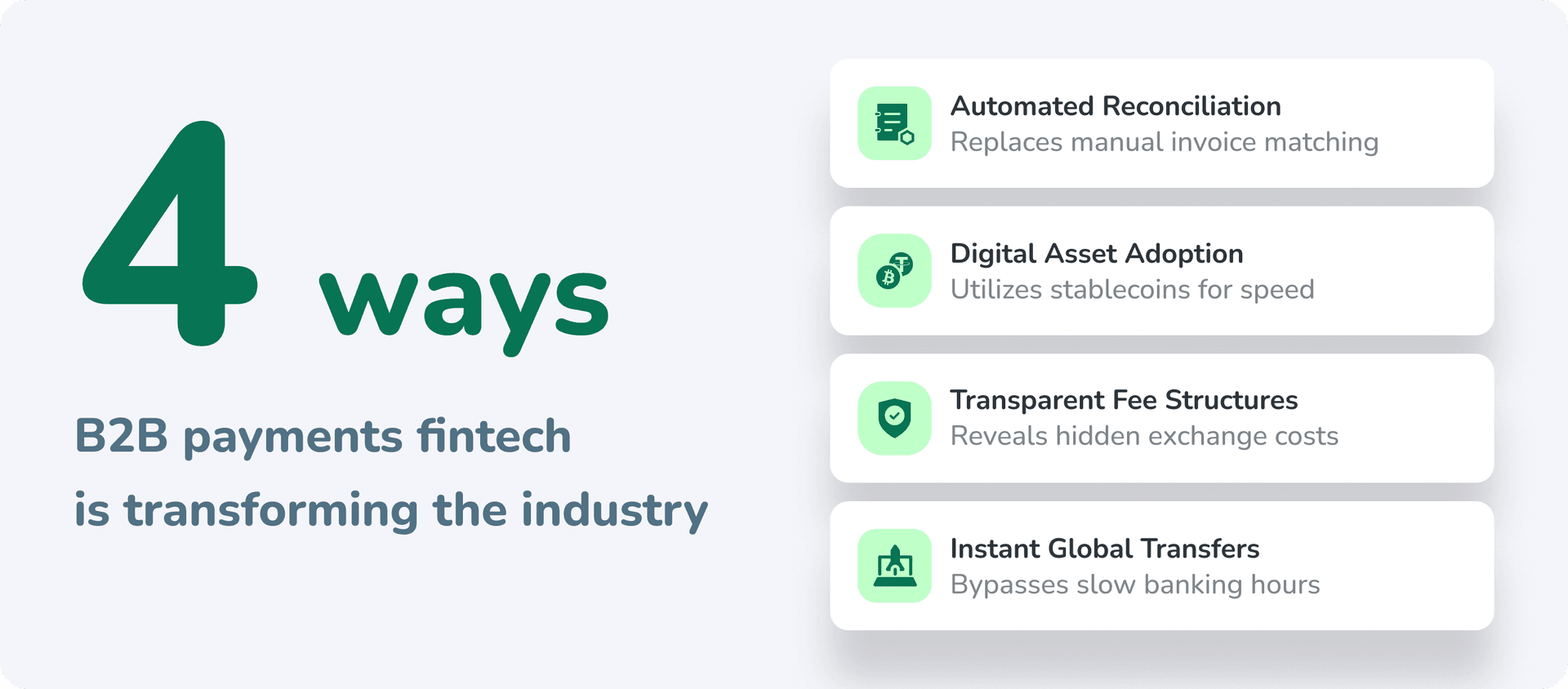
The rise of B2B payments fintech means we are finally seeing tools built for the way we actually work. Modern fintechs act as a bridge: they take the old banking infrastructure and wrap it in a layer of smart code. This allows for things like instant verification and automated reconciliation. You no longer have to hire three people just to match payments to invoices.
A huge part of this is the move toward digital assets. Many companies now prefer to use stablecoins for international deals because they don't want to wait for the weekend to end before a transfer clears. By adopting B2B payments fintech, a company in Berlin can pay a developer in Buenos Aires in seconds. They might use recurring crypto payments to handle monthly salaries without ever touching a slow, traditional bank. This is about saving the 3% to 5% usually lost to currency conversion and hidden bank fees.
Insight: The hidden cost of "free"
Some banks claim they don't charge for transfers, but they hide the cost in a terrible exchange rate. Fintechs are usually more honest, they show you the fee upfront. Always look at the "mid-market rate" to see how much you are actually losing in the background.
B2B Payments Automation
Automation is the holy grail of back-office work. If a machine can do it, a human shouldn't have to. In the world of fintech B2B payments, automation means your system "knows" when an invoice is due. It can send reminders, calculate late fees, and even suggest the best time to send the money based on your current cash flow. This keeps your relationships with suppliers healthy because you are never the "slow payer."
Think about the time saved – instead of manually entering data, your systems talk to each other. When a payment arrives via a payment link for crypto, your accounting software automatically marks that invoice as paid. No more spreadsheets. No more "where is this $500 from?" questions. This level of clarity allows founders to make decisions based on real-time data, not on a bank balance that is three days out of date.
Manual vs. automated processing costs
|
Task |
Manual cost (Est.) |
Automated cost (Est.) |
Time saved |
|
Invoice matching |
$15.00 |
$0.50 |
20 mins |
|
Payment inquiry |
$10.00 |
$0.00 |
15 mins |
|
Data entry |
$5.00 |
$0.05 |
10 mins |
B2B Marketplace Payments
Amazon changed how we shop, and now B2B marketplaces are changing how businesses source materials. Whether it is a platform for wholesale fabrics or a site for freelance engineers, B2B marketplace payments need to handle a "three-way" relationship. The buyer pays, the marketplace takes a fee, and the seller gets the rest – doing this manually is a nightmare.
For these platforms to succeed, the payment flow must be friction-free. They need a reliable onramp-offramp to move between traditional money and digital assets. This allows users from all over the world to participate. High-quality B2B marketplace payments systems also handle "escrow." This means the money is held safely until the buyer confirms they got what they paid for. It protects everyone and makes the marketplace a safe place to do business.
Marketplace split payments, escrow, and multi-party settlement — send us your architecture. We'll map our API to your marketplace model and tell you what's live vs. what needs custom work. 25-min technical call, 4-hour reply.
Insight: The "Split payment" hack
If you run a platform, look for a provider that allows "split payments" at the API level. This means the money is divided the moment it hits the gateway. It saves you from having to do massive payouts at the end of the month and keeps your liability low.
Key B2B Fintech Trends
The industry never sits still. Here are the top B2B fintech trends that are currently reshaping how we think about corporate wallets.
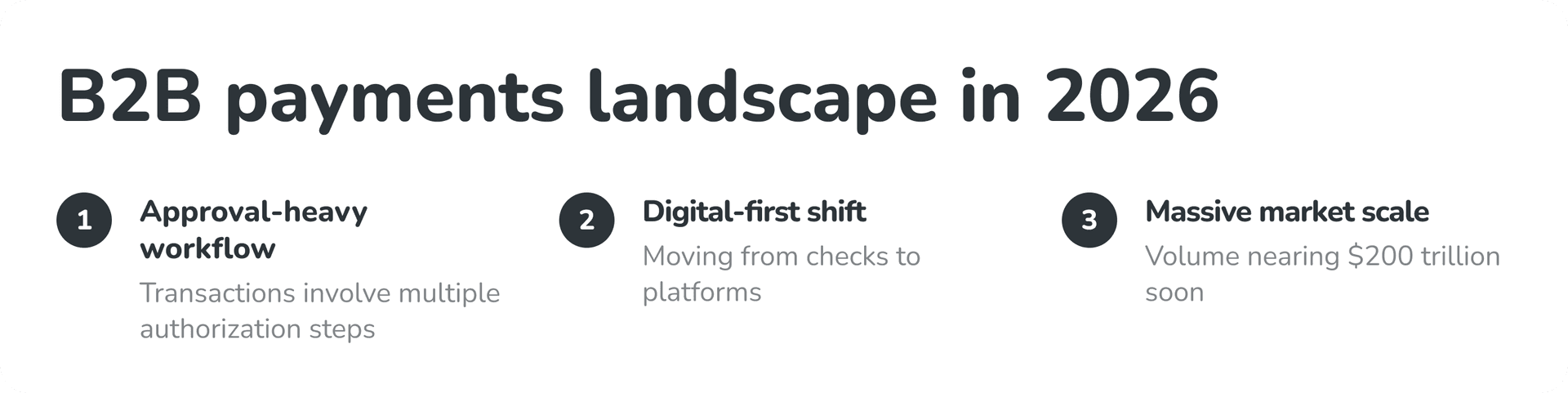
Embedded banking for all
Every company is becoming a fintech company. Your ERP software will soon offer you a credit line and a checking account. You won't go to a bank website. You will just manage your money where you manage your work.
The rise of real-time rails
The U.S. has FedNow, and Europe has SEPA Instant. Waiting days for money to move is becoming socially unacceptable in the business world. Real-time is the new standard.
Hyper-personalized credit
AI is now looking at a company’s real-time cash flow to offer loans. Instead of a flat "no" from a bank, you might get a specific credit line based on your actual sales data from the last hour.
Blockchain-based identity
No more sending scanned copies of your passport ten times. In the future, your business identity will be a digital token that you "show" to payment providers to instantly pass KYC checks.
Green payments
Companies now want to see the carbon footprint of their supply chain. New B2B fintech trends include tools that track the environmental cost of every transaction you make.
Pay-by-bank (open banking)
Credit cards are expensive for big B2B deals. "Pay-by-bank" uses APIs to move money directly from one account to another, skipping the card networks and their high fees.
Unified global wallets
Having a "Euro account" and a "USD account" is old news. The new trend is a single digital vault where you can hold any currency or asset and spend it anywhere instantly. You might use an OTC desk for crypto settlements to move large volumes without moving the market price.
Crypto Assets in B2B Payments
Crypto is becoming a serious tool for fintech B2B payments. When you use a stablecoin like USDC or USDT, you are basically using a digital dollar that moves at the speed of an email. For a business, this is a massive advantage. You don't have to worry about bank holidays or the "correspondent banking" system where five different banks take a small cut of your money as it travels.
Some companies even use a crypto POS terminal at trade shows to take instant payments from international partners. It avoids the 3% credit card fee and the risk of chargebacks. Since crypto transactions are final, once you have the money, it's yours. This certainty is worth a lot in the fast-paced world of international trade. It is a key part of the modern B2B payments fintech ecosystem.
Crypto vs. traditional wire transfers
|
Feature |
SWIFT wire |
Crypto transfer |
|
Settlement time |
1–5 Days |
Seconds/Minutes |
|
Weekend access |
No |
24/7/365 |
|
Transparency |
Limited |
Full (Public Ledger) |
|
Cost |
$25–$50 + % |
Network fee (often < $1) |
Lifehack: The "One-percent" rule
Try to move just 1% of your slowest payments to a digital-first or crypto-based system this month. You will quickly see how much time and money you save, and it makes the transition for the rest of your business much less intimidating.
Why the Inqud Team is Your Best Bet
Inqud is not just another payment provider. We are a team of people who actually understand how to integrate crypto payments in B2B fast and smoothly. We have built an infrastructure that combines the reliability of traditional finance with the speed of the blockchain. Whether you need a simple way to pay your global team or a complex setup for a marketplace, we have the tools to make it happen.
Our expertise covers everything from high-volume settlements to simple "buy now" buttons. We focus on compliance, security, and uptime, so you can focus on the exciting stuff. We believe that your payment system should be your biggest competitive advantage, not your biggest headache.
Sandbox keys within 1 business day. We'll walk your team through the integration on a 25-min call, provide custom pricing for your volume, and give you a dedicated point of contact from day one. 4 business hours to first reply.
Bringing It All Together
The way we move money between companies is finally catching up to the rest of our digital lives. From the expanding B2B payments landscape to the clever use of automation, the goal is the same: less friction and more growth. Whether you are a small startup or a large enterprise, the tools are now available to make your financial operations a breeze.
We want to see a world where a business in one corner of the globe can trade with another as easily as sending a text message. If you are ready to stop chasing invoices and start scaling your vision, we are here to help you bridge that gap. The future of business is digital, and it's time your payments were too.
Industries
Web3 payments
Products
Сrypto payment gateway, OTC desk, Сard2crypto, Crypto widget
Tags
Payment methods, Educational
Author

Inqud Solutions for Your Business

Pay in Crypto
Start accepting cryptocurrency payments from customers worldwide

Crypto Checkout Tool
Embed a cryptocurrency payment widget on your website

Auto Payments
Set up automatic subscription and recurring billing in crypto

One-Click Payment Link
Create and share payment links for crypto transactions

Onramp
Enable users to buy crypto with fiat currency seamlessly