


How Recurring Crypto Payments Work: Subscription Models Explained
Oct 1, 2026

7 min read
Contents
What Are Recurring Crypto Payments?
How Crypto Subscriptions Differ from Traditional Subscription Payments
Why Businesses Are Exploring Crypto Subscription Models
Common Types of Crypto Subscription Services
How Recurring Crypto Payments Work
Best Cryptocurrencies for Subscription Payments
Why Stablecoins Are Becoming the Foundation of Crypto Subscriptions
Crypto Subscriptions vs Traditional Subscription Billing
Industries Most Likely to Adopt Crypto Subscription Services
How Inqud Helps Businesses Evaluate Crypto Payment Opportunities
Share
More companies now bill their customers in digital coins instead of cards. It started with a handful of Web3 apps, and today it reaches software firms, streaming platforms, and even small newsletters. This guide walks you through how billing in coins actually works, why businesses like it, and where the money moves behind the scenes.
We will keep things simple. No heavy jargon, no hype. Just a clear look at how billing in coins works for a modern subscription business.
Curious whether crypto billing fits your product? Let's map it out together. Talk to our team and get a plan built around your case.
What Are Recurring Crypto Payments?
Recurring crypto payments are charges that repeat on a set schedule, paid in cryptocurrency. Think of a monthly plan, but the customer pays in USDT or another coin instead of a bank card. The billing cycle stays the same, only the money rail changes.
A crypto plan can run weekly, monthly, or yearly. The business sets the amount and the interval, and the system pulls or requests the money when it is due. That is the whole idea in one sentence.
The tricky part is that blockchains were not built for automatic billing. A card network can charge you again next month without asking. Coins need a different setup to make that repeat charge happen, and we will get to those methods soon.
For now, remember this. The familiar subscription rhythm can live on a crypto rail. That is why a well built billing flow can feel as smooth as any card based plan.
How Crypto Subscriptions Differ from Traditional Subscription Payments
With cards, a bank sits in the middle. It stores your card details, approves the charge, and can reverse it later. The merchant trusts the bank to move the money each cycle.
Coins work without that middle bank. The customer holds their own funds in a wallet, and payments settle on a blockchain. There is no card number saved on file, so the repeat charge needs the customer's permission in a different form.
This changes a few practical things. Chargebacks mostly disappear, since blockchain transfers are final once confirmed. Settlement is faster too, because funds do not wait on banking hours or borders.
There is a trade off, of course. The customer has to keep enough balance in their wallet, or approve a smart contract that handles the charge. It feels new at first, but once it is set up, the experience is quite close to a normal plan.
Crypto Billing vs Card-Based Subscription Payments
|
Feature |
Crypto Subscription Payments |
Card-Based Subscription Payments |
|
Intermediary |
None (Direct peer-to-peer on blockchain) |
Banks, Card Networks, Payment Processors |
|
Chargebacks / Disputes |
Virtually non-existent (Transactions are final) |
Possible (Risk of fraud and forced reversals) |
|
Settlement Speed |
Minutes / Seconds (24/7/365 continuous rail) |
1-3 Business days (Delayed by banking hours) |
|
Processing Costs |
Low (Fraction of a dollar on scalable chains) |
High (Interchange fees, cross-border markup, 1.5%-3.5%+) |
|
Global Accessibility |
Universal (Anyone with a wallet can pay) |
Restricted (Geographic limits, cross-border bank blocks) |
|
Authorization Model |
Smart contracts, wallet limits, or manual pushes |
Card tokenization on file (Implicit auto-pull) |
Why Businesses Are Exploring Crypto Subscription Models
The pull is not just about being trendy. A crypto subscription solves real problems that card billing has struggled with for years. Let's look at the main reasons companies test the waters.
Many teams start small. They add a crypto option next to their card checkout, watch how customers react, then expand. If you want a deeper take on where this is heading, this piece on the potential of the recurring crypto payments is a good next stop.
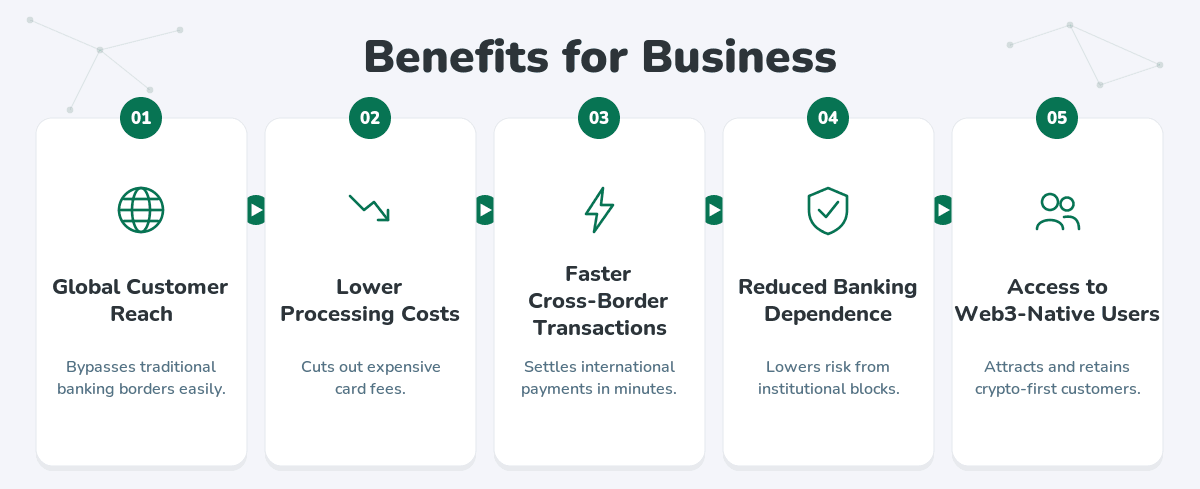
Global Customer Reach
Cards do not work everywhere. Some regions have low card adoption, and some banks block cross border charges outright. Coins ignore those lines on the map.
A customer in one country pays the same way as a customer on the other side of the world. That opens your plan to people who could never subscribe before. For a digital product, that reach can matter a lot.
Lower Payment Processing Costs
Card fees stack up. You pay the network, the issuing bank, and sometimes a currency conversion on top. Over thousands of monthly charges, those cents turn into real money.
Coin billing cuts out several of those layers. Stablecoin transfers often cost a fraction of a card charge, especially on cheaper networks. That saving goes straight back into your margin.
Faster Cross-Border Transactions
A bank wire can take days to clear across borders. Coins settle in minutes, sometimes seconds, no matter the distance. For a subscription business, that speed means cleaner cash flow.
You are not waiting on a settlement batch or a weekend delay. The money shows up, the plan renews, and you move on.
Reduced Dependence on Banking Infrastructure
Some businesses get shut out of banks through no fault of their own. High risk sectors, new markets, and young startups all know this pain. Crypto billing gives them a way to charge customers without begging a bank for approval.
That independence is a quiet but powerful reason to switch. If your revenue depends on one bank's mood, you are exposed. Spreading onto a coin rail lowers that risk.
Access to Web3-Native Users
There is a whole crowd that already lives in crypto. They hold wallets, they pay in stablecoins, and they prefer products that speak their language. Offering coin billing meets them where they are.
These users often churn less when the payment feels native to them. For Web3 tools especially, this group can become your most loyal base.
Common Types of Crypto Subscription Services
Coin based billing is not tied to one industry. Any business that charges on a schedule can use it. Here are the formats where a crypto subscription service shows up most often.
Subscription Business Types That Use Crypto Billing
|
Business Segment |
Use Case Description |
Real-World Examples |
|
SaaS Platforms |
Software access billed monthly/annually without card payment blocks. |
VPN providers, cloud storage, hosting services |
|
AI Tools & Software |
Global user bases paying for high-compute AI generation products. |
AI text writers, image generators, coding assistants |
|
Streaming Services |
Low-margin digital entertainment platforms serving unbanked regions. |
Music streaming, niche video platforms, web indie films |
|
Creator Memberships |
Direct fan backing with high payout retention for the creators. |
Patreon-style platforms, private fan clubs |
|
Newsletters & Content |
Micro-payments handled efficiently via low-fee networks. |
Substack-like premium posts, independent financial reports |
|
Online Communities |
Decentralized access control based on active recurring wallet states. |
Premium Discord groups, private forums, mastermind hubs |
|
Cloud Infrastructure |
Cross-border payment for technical infrastructure, compute, and VPS. |
Developer tools, specialized compute, node hosting |
|
Gaming & Web3 Apps |
In-game monthly passes or native dApp subscriptions. |
MMORPG season passes, Web3 analytics premium tiers |
SaaS Platforms
Software sold by the month is the classic subscription. Adding a coin option lets a global user base pay without card friction. Many SaaS teams keep their normal checkout too, so nobody is forced to switch.
AI Tools and Software Products
AI apps grew fast, and so did their billing needs. Users worldwide want the same tools, and cards often get in the way. Coin billing solves that for AI writing, image, and coding products.
Streaming Services
Music and video platforms live on monthly plans. Coin billing helps them reach viewers in regions where cards fail. It also trims the fees that eat into thin streaming margins.
Creator Membership Platforms
Creators sell access to their work through recurring fees. Fans in any country can back them, no bank barrier in the way. The creator keeps more of each payment too.
Newsletters and Premium Content
Paid newsletters and premium articles run on small, steady charges. Coins handle those micro plans well, especially with low fee options. Writers get a global audience without a processor picking winners.
Online Communities
Private groups, forums, and Discord style memberships charge monthly dues. Coin billing fits this model neatly. Members pay from anywhere, and the community owner avoids card headaches.
Cloud Infrastructure Services
Hosting and compute providers bill by usage and by plan. A coin rail lets developers pay for servers across borders. It suits a technical crowd that already trusts digital assets.
Gaming and Web3 Applications
Games with season passes and in game memberships are a natural fit. Web3 apps already run on wallets, so coin billing feels obvious there. Players fund their access without leaving the crypto world.
How Recurring Crypto Payments Work
Now the useful part. Since blockchains do not auto charge like banks, developers built several ways to make repeat billing happen. Each method trades convenience for control in its own way.
You can even accept these charges through a simple crypto payment widget on your site, so the customer never leaves your checkout. Below are the main models behind recurring crypto payments.
Manual Recurring Payments
This is the most basic form. The customer gets a reminder and sends the money themselves each cycle. It is simple to set up, but it leans on the customer remembering.
Manual billing works for small crowds and loyal fans. It struggles at scale, since even keen customers forget. Most businesses treat it as a starting point, not a finish line.
Recurring Invoices
Here the system sends a fresh invoice every cycle with a payment request inside. The customer clicks and pays, often from a saved wallet. Tools like crypto payment links make this quick and clean.
Invoices give the customer a clear record and a gentle nudge. They still need a click, so they are semi automatic. For many plans, that is a fair balance.
Wallet Authorization Models
In this model, the customer approves the business to charge their wallet up to a set limit. The wallet holds the permission, and charges pull against it. It feels closer to how cards work.
The customer stays in control, since they set the cap and can revoke it. The business gets smoother billing without chasing each payment. It is a popular middle ground.
Smart Contract-Based Payments
Smart contracts are small programs on the blockchain. They can hold the rules of a plan and release payment on schedule automatically. Once signed, they run without anyone pressing a button.
This is where the flow starts to feel truly hands off. To see how this is built in practice, our recurring payments SDK guide breaks down the developer side in plain steps.
Pull Payment Architectures
A pull payment lets the business request funds from an approved wallet, rather than waiting for a push. The customer grants that right up front. After that, each cycle pulls the amount due.
This mirrors the classic direct debit that card users know. It removes the reminder step entirely. For a busy service, pull models keep billing hiccups from driving churn.
Escrow-Based Subscription Systems
Escrow locks funds in a neutral spot and releases them as the service is delivered. It adds trust for both sides. The customer knows money only moves when they get value.
This suits higher value or longer plans where trust matters more. It is less common for small monthly fees. Still, it is a useful tool in the kit.
Crypto Recurring Payment Models Compared
|
Payment Model |
Setup Effort |
Automation Level |
Best Use Case |
|
Manual Recurring Payments |
Very Low |
Manual (Customer pushes funds) |
Small loyal audiences, test pilots |
|
Recurring Invoices |
Low |
Semi-Automatic (User clicks to pay) |
B2B SaaS, high-ticket consulting plans |
|
Wallet Authorizations |
Medium |
Automatic (Within pre-approved budget) |
Standard SaaS, consumer app plans |
|
Smart Contract Payments |
High |
Fully Automatic (Code executes schedule) |
Pure Web3 dApps, trustless protocols |
|
Pull Payment Architectures |
High |
Fully Automatic (Merchant pulls funds) |
High-scale platforms, high-volume products |
|
Escrow-Based Systems |
High |
Conditional (Released upon delivery) |
Milestone services, high-value contracts |
Best Cryptocurrencies for Subscription Payments
Not every coin suits regular billing. You want stable value, low fees, and wide support. Here are the coins that fit a monthly plan best.
USDT
Tether is the most used stablecoin, pegged close to one dollar. Its value barely moves, so a plan price stays predictable. It runs on many networks, which keeps fees flexible.
For most coin billing, USDT is the default choice. Customers know it, wallets support it, and the price does not swing.
USDC
USD Coin is another dollar pegged stablecoin, known for its clear reserves and reporting. Businesses that care about compliance often lean toward it. It behaves much like USDT in daily use.
Offering both USDT and USDC covers most stablecoin users. That choice alone can lift conversion at checkout.
Bitcoin
Bitcoin is the coin everyone knows. Some premium and Web3 audiences prefer to pay with it. The catch is price swings, which make fixed pricing harder.
It works best when the plan price is quoted in dollars and converted at charge time. Many businesses accept it for reach, then settle into stable value.
Ethereum
Ether powers a huge share of Web3 apps. Users deep in that world often hold it and want to spend it. Fees can rise on the main network, though cheaper layers help.
For products aimed at Ethereum native users, accepting it feels natural. It pairs well with smart contract based billing.
TRON (TRX) and Stablecoins on TRON
TRON is loved for very low transfer fees. Stablecoins on TRON move cheaply and fast, which suits small recurring charges. It is a favorite for high volume, low ticket plans.
If your plan costs a few dollars a month, TRON keeps fees from eating the charge. That makes the math work for micro plans.
Solana
Solana is quick and cheap, with growing wallet support. It handles high transaction counts well, which fits a busy billing setup. Younger users often favor it.
Its speed makes renewals feel instant. For apps chasing a modern crowd, it is worth offering.
Best Coins for Subscription Billing
|
Cryptocurrency / Network |
Stability Type |
Network Fees |
Ideal Plan Type |
|
USDT (Tether) |
Stablecoin (USD pegged) |
Low to Moderate |
Default choice for main consumer & B2B plans |
|
USDC (USD Coin) |
Stablecoin (USD pegged) |
Low to Moderate |
Compliance-oriented businesses & enterprise SaaS |
|
Bitcoin (BTC) |
Volatile (Market driven) |
High |
Premium plans or Web3-native high-value products |
|
Ethereum (ETH) |
Volatile (Market driven) |
Variable (Mainnet dependent) |
Ethereum ecosystem tools, dApps, and NFTs |
|
TRON (TRX) & Stablecoins |
Stablecoin / Native |
Very Low |
Micro-subscriptions, cheap newsletters, volume apps |
|
Solana (SOL) |
Volatile / Stablecoins |
Ultra Low |
High-frequency consumer apps, modern fast tools |
Not sure which coins to accept first? We'll help you pick. Get a tailored setup for your billing.
Why Stablecoins Are Becoming the Foundation of Crypto Subscriptions
Here is the simple truth. A repeating plan needs a stable price, and coins like Bitcoin move too much for that. Stablecoins fix the price problem, which is why they sit at the heart of coin billing.
When your plan costs ten dollars, you want ten dollars next month too. USDT and USDC hold that value, so both you and the customer know the number. That predictability is everything for repeat charges.
Stablecoins also settle fast and cost little, especially on cheaper networks. A business can pull payments in seconds and keep fees tiny. As you scale, that reliability builds trust.
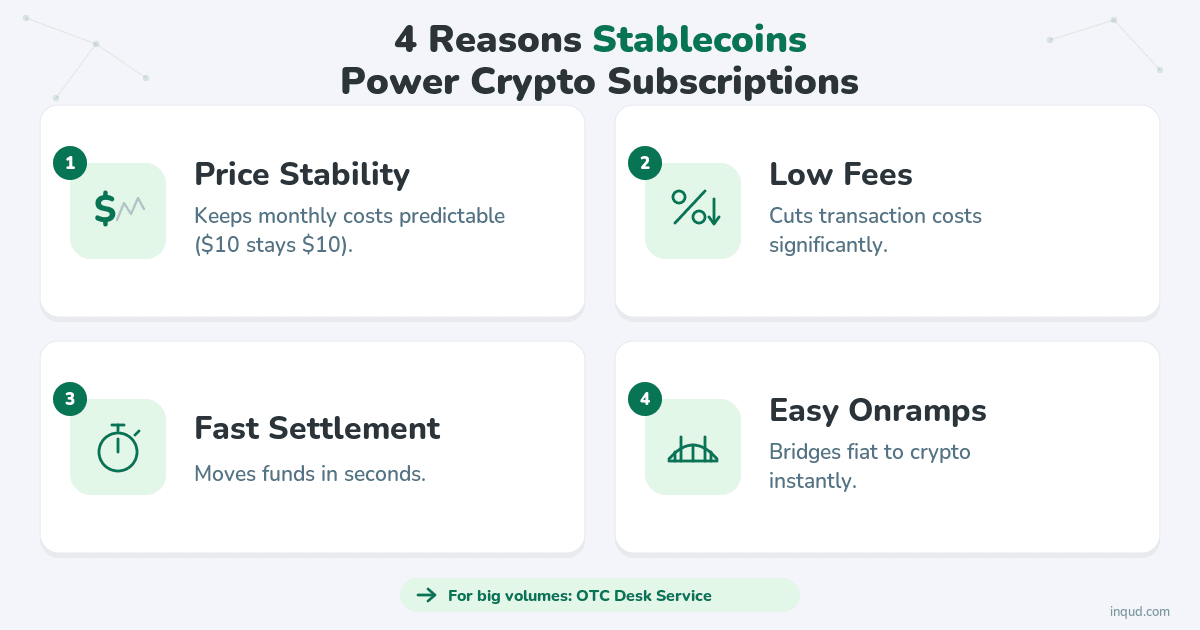
There is a bridge angle too. Many customers still think in dollars, and a good fiat-to-crypto onramp solution lets them top up a wallet in one step. That removes the last bit of friction before they sign up.
For larger deals or bulk conversions, some businesses lean on an OTC desk service to move big amounts without slippage. Small monthly charges rarely need that, but it is handy as volumes grow.
Crypto Subscriptions vs Traditional Subscription Billing
Let's put the two side by side in plain terms. Traditional billing is familiar and widely trusted, but it carries bank fees, chargebacks, and regional limits. Coin billing trades some of that comfort for speed, reach, and lower cost.
Neither one wins on every point. Cards still feel easier for the average shopper. The coin route shines for global, digital, and Web3 focused products where cards fall short.
The smart move for many is to offer both. Give customers the choice, and let each pick their rail. That way you capture card loyalists and coin natives at once.
Crypto vs Traditional Subscription Billing
|
Metric / Dimension |
Crypto Subscription Billing |
Traditional Subscription Billing |
|
Average Fees |
Often < 1% (Highly dependent on network) |
1.5% - 3.5% + interchange + currency markup |
|
Transaction Speed |
Seconds to minutes for global settlement |
Days for settlement batches, cross-border delays |
|
Geographic Reach |
Border-free; instant global market entry |
Restricted by local payment rules, higher declines |
|
Chargeback Risk |
Zero (Blockchain immutability means finality) |
Significant risk of payment fraud or friendly fraud |
|
User Experience |
Requires wallet setup / crypto familiarity |
Seamless & familiar for the vast majority of consumers |
If you want the crypto side handled properly, a reliable crypto payment gateway takes care of the heavy lifting. You focus on the product, and the billing runs underneath.
Industries Most Likely to Adopt Crypto Subscription Services
Some sectors are moving faster than others. They share a few traits: global users, digital delivery, and pain with card billing. Here is where a crypto subscription service is spreading quickest.
Industries Adopting Crypto Billing
|
Industry / Sector |
Primary Driver for Adoption |
Common Payment Model |
|
SaaS Platforms |
Reducing cross-border declines & card fees |
Wallet Authorization / Pull Models |
|
AI Platforms |
Unlocking frictionless instant access globally |
Recurring Invoices / Wallet Caps |
|
Fintech |
Providing native digital payment rails |
Smart Contract / Pull Payments |
|
iGaming |
Bypassing complex card rules and hold delays |
Manual Recurring / Invoices |
|
E-commerce & Marketplaces |
Serving customers in low card-adoption zones |
Recurring Invoices / Stablecoins |
|
Streaming & Media |
Preserving thin margins against processing costs |
Pull Payments / Low-fee stablecoins |
|
Web3 & Blockchain |
Native end-to-end token experience for users |
Smart Contract / Wallet Authorization |
|
Creator Economy |
Bypassing corporate platforms and processors |
Manual Recurring / Stablecoin invoices |
SaaS
Software firms sell worldwide and bill monthly. Card friction across borders costs them signups. A coin option widens their reach and trims fees, so adoption here is strong.
AI Platforms
AI tools exploded in popularity and picked up users everywhere. Many of those users cannot pay easily with cards. Coin billing unlocks that demand fast.
Fintech
Fintech apps already handle money and trust digital rails. Adding coin billing fits their model with little friction. They often lead the way on new billing tech.
iGaming
Gaming and betting platforms deal with high volumes and tricky card rules. Coins sidestep many of those limits. Repeat billing keeps memberships and passes running smoothly.
E-commerce and Marketplaces
Subscription boxes and membership stores bill on repeat. Reaching global buyers without card blocks is a real win. Coins help them serve customers banks would reject.
Streaming and Media
Media platforms run on thin margins and huge user counts. Lower fees and global reach make the coin route attractive. It helps them grow in markets cards ignore.
Web3 and Blockchain Projects
These teams already run on wallets and tokens. Coin billing is the obvious fit for them. Many would not consider cards at all.
Creator and Membership Economy
Independent creators sell access directly to fans. Coins let a fan anywhere back them each month. It cuts out gatekeepers and keeps more money with the creator.
How Inqud Helps Businesses Evaluate Crypto Payment Opportunities
Inqud is a crypto payment provider built for businesses, with more than five years on the market and support available around the clock. We help teams figure out if a crypto subscription service makes sense, then build the setup that fits. No pressure, just a clear plan.
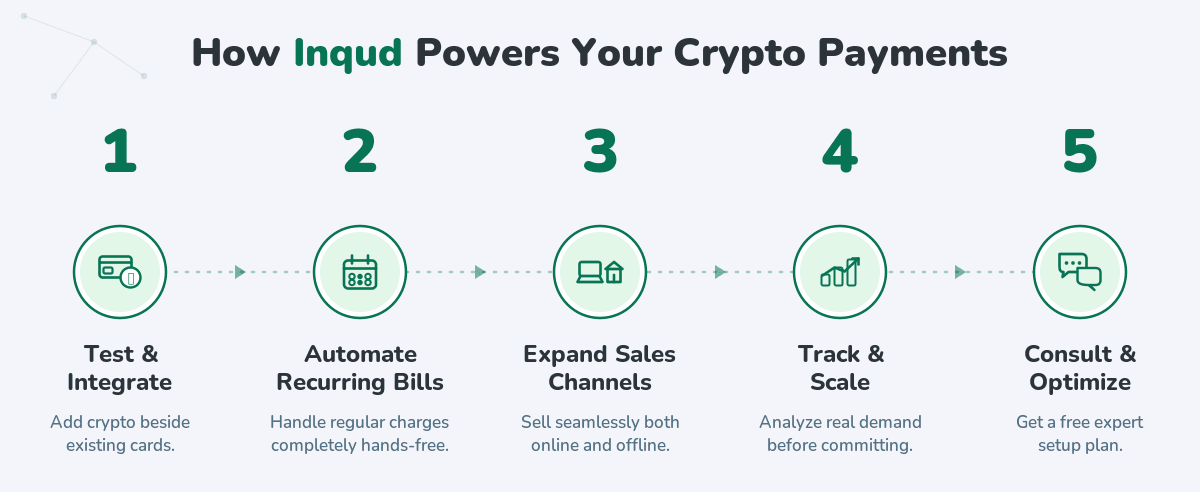
Automate the Charges
Our recurring crypto payments technology handles regular charges in cryptocurrency, so your plans renew without manual work. It supports major coins like USDT, USDC, Bitcoin, and Ethereum across several networks. You get transparent fees and no hidden markups from the start.
Add Coins Next to Your Cards
You do not have to rip out your current checkout to try this. With Inqud you can accept crypto right beside your existing payment methods. Customers keep their favourite option, and you simply add one more.
That lets you test demand before committing to anything big. Watch how many people pick the coin route, then scale from there. Nothing forces a switch until the numbers make sense.
Sell Online and Offline
Some businesses take payments in person, not only on a website. For those cases there is a crypto POS terminal that brings coin payments to a physical counter. It is one more way to meet customers where they already are.
See How It Works for Merchants
Reading about a setup is one thing, seeing it laid out step by step is another. This Inqud's recurring payments solution guide walks merchants through the full flow in plain language. It is a handy read before you decide.
The best way to know if this model fits your business is a short chat. We will look at your customers, your regions, and your billing needs, then suggest a path. There is a free expert consultation on the table, no strings attached.
Ready to see recurring crypto payments in action for your product? Book a free consultation and we'll tailor a solution for you.
Industries
Web3 payments
Products
Сrypto payment gateway
Tags
Payment methods, Educational
Author


Inqud Solutions for Your Business

Crypto Checkout
Start accepting cryptocurrency payments from customers worldwide

Crypto Integration
Embed a cryptocurrency payment widget on your website

Recurring Payments
Set up automatic subscription and recurring billing in crypto

Instant Payment Link
Create and share payment links for crypto transactions

Buy Digital Assets
Enable users to buy crypto with fiat currency seamlessly