


State of Crypto 2026: Market, Stablecoins & Visa
Jun 29, 2026

5 min read
Contents
How Big is the Crypto Market in 2026?
The Rise of Stablecoins
Stablecoin Transaction Volume Trends
Stablecoin Activity Across Blockchain Networks
Are Stablecoins Replacing Visa?
Visa and Crypto: Cooperation Rather Than Competition
How Visa Is Building Crypto Infrastructure
Cryptocurrency Predictions for 2026
Challenges Facing the Industry
What Businesses Should Know About Building with Stablecoins
How Inqud Helps Businesses Navigate the Future of Digital Payments
Share
Somewhere around 2024-2025, stablecoins stopped being a crypto product and became a payments product. Finance teams that previously filed "crypto" under "not our problem" are now asking about USDC settlement timelines and Solana fees. The shift is real, and the numbers back it up.
Here's the breakdown.
How Big is the Crypto Market in 2026?
CoinMarketCap recorded a total market cap above $4 trillion at its late-2025 peak, with the market pulling back to around $2.8 trillion by spring 2026. Bitcoin still leads at 45–50% dominance. Most actual on-chain activity runs through Ethereum and its Layer-2 networks.
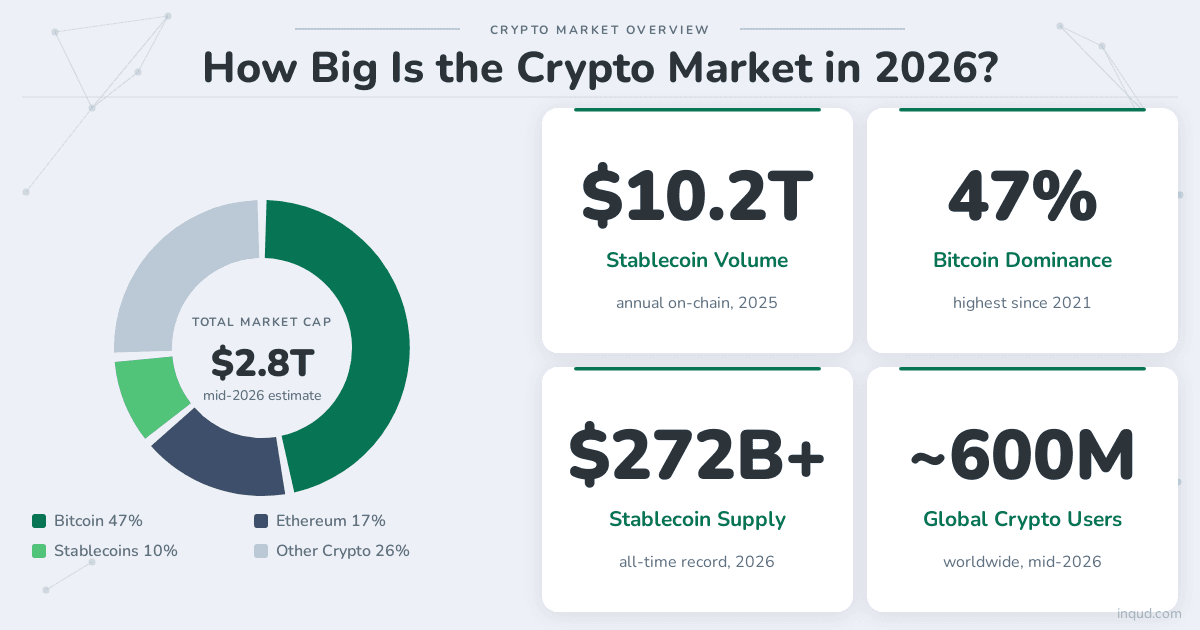
But market cap is a passive metric. It tells you how much value exists, not how much moves. For businesses looking at digital payment infrastructure, stablecoin flows are the more telling number.
Cryptocurrency Market Capitalization
Bitcoin mostly held between $60,000 and $90,000 through 2025, with spot ETF inflows from pension funds and endowments adding a more stable demand base. $100B in AUM in the first year is a number worth sitting with. L2 networks, meanwhile, now account for roughly 95% of all Ethereum transaction throughput.
The mainnet increasingly functions as a settlement layer.
Number of Cryptocurrency Users Worldwide
Chainalysis estimates around 600 million people have used crypto in some form at least once. Those numbers aren't evenly distributed, though. The highest practical adoption sits in countries like Argentina, Turkey, Nigeria, and Vietnam, where stablecoins fill a gap that local banking doesn't.
In these places, stablecoins work as a dollar substitute for people with no easy access to US banking.
Institutional Adoption and the ETF Factor
Bitcoin spot ETFs changed who can hold crypto without changing how crypto works. Pension funds, endowments, and asset managers that couldn't justify direct custody now have a regulated vehicle. That new category of demand has changed the institutional calculus around the entire asset class, stablecoins included. Corporate treasury teams at companies well outside the crypto space have started treating dollar-denominated stablecoins as a serious operational tool, not a speculative side bet.
The Rise of Stablecoins
Of everything that's happened in crypto over the past few years, the stablecoin story is the one with the most direct relevance to business payments.
What Are Stablecoins?
These are dollar-pegged digital tokens – you hold USDT, it's worth $1 today and $1 next week. The value is that combination: dollar stability plus blockchain's speed and programmability. USDT and USDC together account for over 85% of the market. Global circulating stablecoin supply is now above $272 billion, per the Visa Onchain Analytics Dashboard.
Why Stablecoins Became Critical Infrastructure
SWIFT is slow and expensive: an international B2B wire costs $25–$50 and takes 2–5 business days. A USDC transfer on Solana takes under a minute and costs fractions of a cent. For cross-border payroll, supplier settlements, and treasury rebalancing, that gap is hard to ignore.
13% of corporates and financial institutions were already using stablecoins by 2025, per EY-Parthenon's survey, with another 54% of non-users planning to adopt within six to twelve months.
Did you know?
Stablecoin supply crossed $300 billion in 2025. That's larger than the M1 money supply of most countries. Worth keeping in mind when people describe this as a "niche" market.
Major Stablecoin Categories
Not all stablecoins work the same way. The market broadly splits into three models, each with different risk profiles and practical use cases.
Fiat-backed Stablecoins
A company holds actual dollars (or T-bills) in reserve and issues tokens against them. USDT and USDC work this way. The US GENIUS Act of 2025 and Europe's MiCA now require reserve audits and compliance disclosures for regulated issuers, which removed a lot of the "trust me" element that made institutional adoption difficult.
Crypto-backed Stablecoins
Overcollateralized crypto positions maintain the peg. DAI is the main example. More decentralized than fiat-backed, but more exposed during sharp market downturns when collateral values drop fast. Not the default choice for business payment infrastructure.
Algorithmic Stablecoins
Supply-adjustment mechanisms rather than reserves. After Terra/LUNA's collapse in 2022, pure algorithmic models lost most of their credibility. Hybrid approaches like Ethena's USDe (roughly 5% market share by late 2025) combine algorithmic mechanics with yield-bearing collateral, targeting more resilient stability.
Category | Backing Mechanism | Key Examples | Compliance & Rules | Primary Use |
Fiat-backed | 1:1 cash / T-bills | USDT, USDC | Highly regulated (MiCA, US GENIUS Act 2025); audited | Business payments, institutional cash |
Crypto-backed | Overcollateralized crypto | DAI | Decentralized; lower direct oversight | DeFi lending, decentralized trading |
Algorithmic / Hybrid | Supply algorithms / yield collateral | USDe, (Historical: LUNA) | Highly scrutinized; evolving disclosure rules | Yield generation, advanced trading |
Stablecoin Transaction Volume Trends
Depending on which dataset you use, total on-chain stablecoin volume in 2025 came in somewhere between $33 trillion and $46 trillion. Visa's dashboard strips out bot activity and automated DeFi loops, arriving at a more conservative $10.2 trillion adjusted. Both numbers tell the same directional story.
Year-over-year growth ran at 72%. Q4 alone brought in $11 trillion of that. USDC led in volume with $18.3 trillion (55% share), USDT followed with $13.3 trillion (around 40%).
Transaction Volume vs Traditional Payment Networks
Network | Annual Volume (2025) | Settlement Time | Cost per Transaction |
Visa (VisaNet) | $16.7 trillion | 1–3 business days | 2–3% merchant fee |
SWIFT | ~$150 trillion | 2–5 business days | $25–50 per wire |
Stablecoins (adjusted) | ~$10.2 trillion | Seconds to minutes | Under $1 |
Stablecoins (unadjusted) | ~$33–46 trillion | Seconds to minutes | Under $1 |
Sources: Visa annual report; BIS SWIFT data; Visa Onchain Analytics Dashboard
Visa's $16.7 trillion is real consumer-merchant transactions. Keep in mind that a lot of the raw stablecoin figure is trading bots, DeFi loops, and internal reshuffling. The Visa-adjusted $10.2 trillion strips that out and is the more useful comparison. Either way, the growth rate here outpaces anything in traditional payment infrastructure.
Important to remember:
Headlines saying "stablecoins beat Visa" almost always reference the $46 trillion figure. That includes the same dollar cycling through DeFi protocols repeatedly. Use the adjusted $10.2 trillion for any real comparison.
Stablecoin Activity Across Blockchain Networks
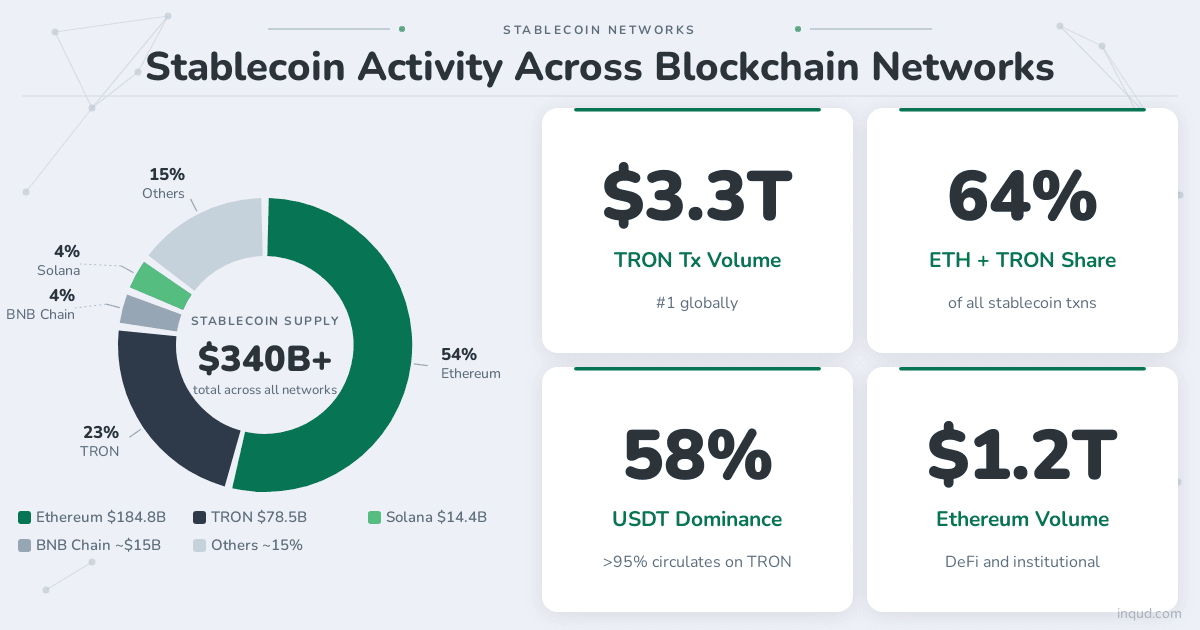
Ethereum and Tron together handle 64% of all stablecoin volume, per the a16z report. Network choice tends to follow cost, compliance requirements, and use case.
Ethereum
The institutional liquidity hub – largest stablecoin issuance, deepest DeFi markets, most trusted by compliance teams. L2s (Arbitrum, Base, Optimism) handle 95% of the actual transaction throughput and the mainnet functions as settlement.
Tron
Carries enormous USDT volume, particularly across Southeast Asia and Africa. Low fees, fast finality, widely supported by exchanges. Less visible in Western coverage, but arguably the most-used stablecoin network globally by transaction count.
Solana
Strong USDC adoption, 400ms finality, sub-cent fees, growing fast for consumer applications and payment products. Western Union's planned USDPT launch on Solana in 2026 will significantly increase its remittance volume.
Other Notable Networks
Base (Coinbase's L2) has grown quickly for consumer-facing applications and is gaining traction with developers building payment products. Avalanche hosts meaningful institutional DeFi activity. Stellar remains a preferred network for remittance corridors thanks to its low fees and established fiat on-ramp integrations. Polygon processes stablecoin volume mostly for gaming and e-commerce flows. The ecosystem is genuinely multichain, which network fits depends on geography, transaction size, and compliance requirements.
$10.2T in adjusted stablecoin volume, Visa moving $16.7T — the two aren't really competing, they solve different problems. Ask us which one fits your settlement flow.
Are Stablecoins Replacing Visa?
Shortly, no. The confusion comes from misunderstanding what each technology actually does.
What Stablecoins Actually Replace
Stablecoins compete with SWIFT, ACH, and wire infrastructure, not with Visa's authorization network. When a company sends USDC to a supplier overseas, they're replacing a SWIFT wire. A $10,000 wire runs roughly $400 in total fees, the same USDC transfer: under $10.
Feature | Visa | Stablecoins |
Direct Competitor | Retail merchant networks & card processors | SWIFT, ACH, and traditional bank wires |
Primary Process | Fast data authorization (settlement happens later) | Immediate, final asset settlement |
Transaction Cost | 2–3% merchant fee | Flat network fee (often under $1) |
Consumer Safety | Fraud protection & chargeback/dispute systems | None; transfers are permanent and immutable |
Main Use Case | Daily consumer retail and e-commerce checkouts | Cross-border B2B payments and remittances |
What Visa Still Does Better
Visa's actual product is authorization, fraud detection, and consumer protection. When you tap a card at checkout, no money moves. What moves is a data message routed between banks in two seconds. Settlement comes later, through traditional rails.
Stablecoin transactions are final. No chargeback, no dispute resolution. For a consumer buying something that might not arrive, that's a real problem. Visa has decades of infrastructure solving exactly that, and nothing on-chain replaces it yet.
Visa and Crypto: Cooperation Rather Than Competition
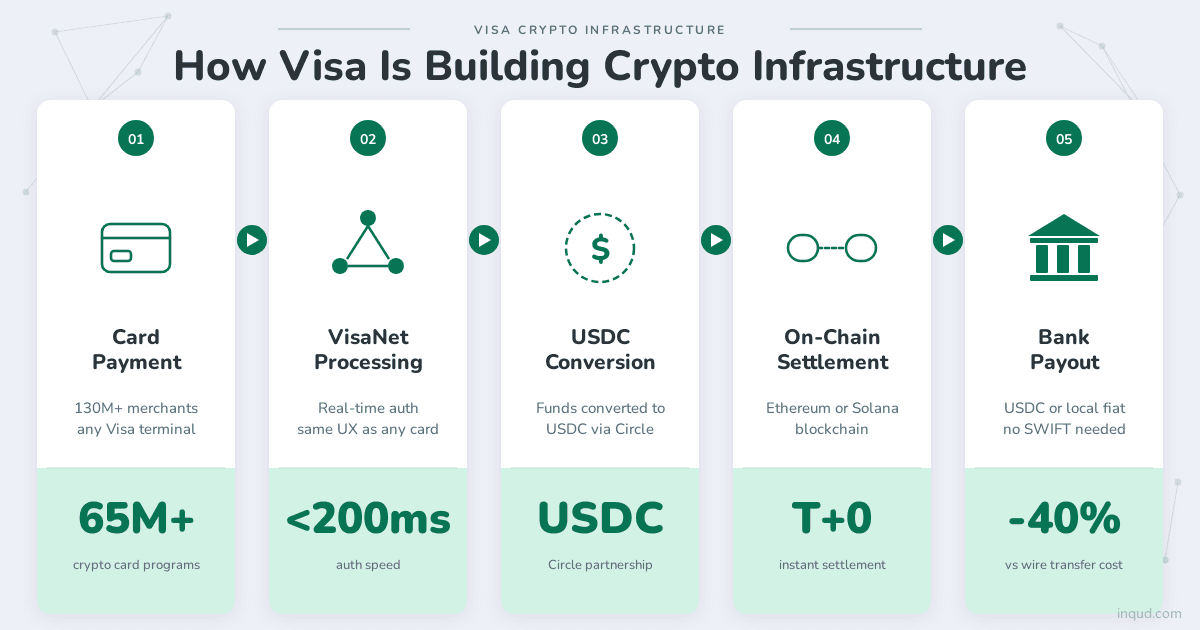
The visa and crypto relationship isn't adversarial. In July 2025, Visa expanded stablecoin settlement to USDC, PYUSD, USDG, and EURC across Ethereum, Solana, Stellar, and Avalanche. Over $225 million has settled through these channels, with issuers fulfilling VisaNet obligations in stablecoins, seven days a week. Mastercard followed in June 2025 with partnerships across Circle, Paxos, Fiserv, and PayPal.
This is the financial system upgrading its settlement rails, not surrendering to disruption.
How Visa Is Building Crypto Infrastructure
Stablecoin Settlement Programs
Issuers can now settle directly with Visa in stablecoins, 24/7. That matters operationally: traditional batch settlement runs on banking hours, stablecoin settlement doesn't. For issuers managing liquidity across time zones and currencies, that's a genuine operational improvement.
Stablecoin-linked Cards
Crypto Visa card programs now give stablecoin holders access to 150+ million merchant locations globally. The conversion from stablecoin to fiat happens at the point of sale. Merchants get local currency. Cardholders hold stablecoins until purchase.
Cross-Border Payments
Visa is actively exploring stablecoins for account-to-account payments into emerging markets. Traditional cross-border flows require either significant infrastructure investment or slow correspondent banking chains. Stablecoin rails offer a lighter alternative, particularly for corridors where the correspondent banking network is thin or expensive.
Partnerships Across the Crypto Ecosystem
Visa built the Visa Onchain Analytics Dashboard with Allium Labs, a free public tool tracking stablecoin supply and volume across ten blockchains. Infrastructure work, not marketing. Visa is helping define how the industry measures stablecoin activity.
Our team advises:
Don't start with consumer checkout when evaluating crypto payments. Start with B2B settlement and cross-border payroll. That's where stablecoins already win clearly on cost and speed, with less regulatory friction.
Cryptocurrency Predictions for 2026
The cryptocurrency predictions for 2026 from major research firms converge on the same themes: continued regulatory maturation, stablecoin expansion into mainstream finance, growing institutional participation.
Western Union's USDPT launch on Solana is a useful signal. A remittance company of that scale choosing blockchain rails purely on economics (not ideology) says something concrete about where cost curves have landed.
The GENIUS Act in the US and MiCA in Europe now provide real frameworks. Both bring AML/KYC standards and reserve requirements. Regulatory clarity historically accelerates institutional adoption, and the late-2025 volume data reflects that.
Stablecoin supply should continue growing from its current $272B+ base, with $500 billion a plausible near-term milestone if corporate adoption follows EY-Parthenon's survey trajectory.
Want to move before your competitors do? Get in touch with Inqud and let's look at what crypto payment infrastructure makes sense for your business in 2026.
How to do it right:
When planning crypto integration in 2026, start with cross-border payroll, B2B invoice settlement, and treasury management. These have the clearest ROI and the most straightforward compliance path. Consumer checkout is a longer road.
Challenges Facing the Industry
Regulatory Uncertainty
MiCA and GENIUS Act cover the EU and US. For companies operating in Southeast Asia, LATAM, or the Middle East, regulatory inconsistency remains a real daily problem. Compliant in one market, restricted in another.
Compliance Requirements
Even in markets with clear regulatory frameworks, meeting compliance requirements is an operational challenge in its own right. KYC and AML processes need to be embedded into product flows from the start. Transaction monitoring, suspicious activity reporting, and record-keeping obligations apply to most stablecoin payment operations the same way they apply to traditional financial services. The cost of building this infrastructure is significant, and getting it wrong carries real penalties.
User Experience Barriers
Seed phrases, gas tokens, and wallet addresses create genuine friction for non-technical users. Mainstream adoption requires products that hide this complexity entirely. Most crypto payment products haven't solved it yet.
Liquidity Fragmentation
Stablecoin liquidity is split across dozens of chains and protocols. Moving between them costs fees and introduces bridge risk. For businesses that need predictable, deep liquidity, this adds operational overhead that doesn't exist in traditional banking.
Security Risks
Smart contract bugs, bridge exploits, and custody failures remain real. Illicit crypto volume reached $158 billion in 2025, an all-time high and a sharp rebound after three consecutive years of decline, per TRM Labs. Audited protocols and regulated custodians are table stakes.
Scalability Challenges
Ethereum mainnet throughput limits and gas fee spikes during high-activity periods remain a real constraint for businesses that need predictable transaction costs. L2 networks address much of this but introduce their own complexity: different security models, different finality guarantees, different liquidity profiles. Anyone building for high-volume use cases should pressure-test network capacity assumptions rather than relying on benchmark figures.
Don't forget that:
Any smart contract in your payment flow needs a current security audit. Check who audited it, when, and whether the code changed since. Your banking partners will ask. Your compliance team should ask first.
Custody, on/offramp access, and blockchain monitoring — non-trivial for a reason. Get the build-vs-buy breakdown for your business before building any of it in-house.
What Businesses Should Know About Building with Stablecoins
When Stablecoins Make Sense
Cross-border B2B payments. Contractor payroll across multiple countries. Treasury management in dollar-denominated stablecoins. These are the use cases where the math works clearly: faster settlement, lower fees, 24/7 availability.
When Traditional Rails Are Better
Consumer retail, any transaction where customers might dispute the purchase, and verticals with heavy regulatory overhead where moving to crypto creates more compliance work than it saves in fees.
Use Case | Recommended | Reasons |
Cross-Border B2B Payments | Stablecoins | Faster settlement, lower fees compared to SWIFT, and 24/7 availability. |
International Payroll | Stablecoins | Seamless, near-instant payout infrastructure for global contractors. |
Corporate Treasury | Stablecoins | Efficient management of dollar-denominated digital assets without cross-border friction. |
Consumer Retail Checkout | Traditional Rails | Visa/Mastercard networks handle instant authorization for retail lines much better. |
High-Dispute Transactions | Traditional Rails | Built-in consumer protections, fraud mitigation, and chargeback/dispute resolution. |
Highly Regulated Verticals | Traditional Rails | Moving to crypto can create more compliance, legal, and audit overhead than it saves in fees. |
Key Infrastructure Requirements
Custody is the first question: where do the stablecoins sit, who controls the keys, and what happens if something goes wrong. On/offramp access is the second: converting fiat to stablecoins and back requires either building relationships with licensed providers or going through an infrastructure layer that handles it. Add blockchain monitoring for transaction surveillance and compliance reporting. None of these components are trivial, and all require ongoing maintenance. Factor that into your build vs. buy calculation early.
Compliance Considerations
AML screening of counterparties, transaction monitoring, KYC verification at onboarding – these aren't optional for any serious operation. Businesses working with institutional counterparties or banking partners will also face enhanced due diligence on their crypto infrastructure. In the US, the GENIUS Act's Bank Secrecy Act provisions mean stablecoin payment operations carry the same reporting obligations as banks.
Choosing the Right Blockchain
Ethereum for large institutional transfers and compliance-sensitive flows. Solana for high-frequency, lower-value payments. Tron for established emerging market infrastructure, particularly heavy USDT volume. None of these is universally "best." Evaluate against your actual transaction profile.
See exactly where Inqud fits in the 2026 stablecoin landscape — settlement rails and compliance this report says businesses need.
Use this hack:
Before picking a blockchain for payment operations, run a real-money pilot across two or three networks simultaneously. Fees, finality, and integration complexity vary far more in practice than any documentation suggests.
Industries
Web3 payments
Products
Сrypto payment gateway
Tags
Educational, Payment methods
Author



Inqud Solutions for Your Business

Crypto Checkout
Start accepting cryptocurrency payments from customers worldwide

Crypto Integration
Embed a cryptocurrency payment widget on your website

Recurring Payments
Set up automatic subscription and recurring billing in crypto

Pay via Link
Create and share payment links for crypto transactions

Crypto Gateway
Enable users to buy crypto with fiat currency seamlessly